Monthly Archives: May 2012

Graham, et al., warn against Defense cuts

The video above contains most of what Lindsey Graham had to say yesterday at the press conference at which he, Joe Wilson, Steve Benjamin, Bobby Harrell and Rich Eckstrom all decried the looming “sequestration” of the defense budget.

I didn’t get the video up and running at the start of Graham’s remarks, so here are some excerpts from what he said before that:

  • “As a Republican, I was very disappointed that my party leadership would put the Defense Department in such a bad spot.”
  • “If politicians can’t come up with a way to reduce spending in a responsible manner, fire us; don’t fire the soldiers. It’s the one thing that seems to be working at the federal level is the military. So we’ve come up with this hare-brained idea that if we can’t do our job, the penalty to be paid is by those who’ve been doing their job very well. I don’t know if you can print this, but I’ll say it: That’s ass-backwards.”
  • “What does it mean to cut a trillion dollars out of the Defense Department budget over the next decade? [the sequestration plus $400 billion in cuts being sought outside that] It means you have the smallest Army since 1940, the smallest Navy since 1915 — 231 ships — the smallest Air Force in history.”

After that, it’s pretty much all on the video. Sorry about the crudity of the clip — I was unable to edit it because I shot it on my iPhone, and don’t have software for editing that on my PC.

Bottom line, the message was that the nation shouldn’t dramatically weaken our defense just because members of Congress couldn’t do their job. Half of the $1.2 trillion in automatic cuts, resulting from the failure of last year’s supercommittee (which was a mere microcosm of the overall failure of Congress), are set to come from the Defense budget — $600 billion. And they would not be targeted — no eliminating $300 hammers and preserving pay for soldiers. “These are blind, across-the-board cuts.”

He kept hitting the point that one part of the government that’s doing its job — the military — shouldn’t get eviscerated because Congress isn’t doing its job at all.

Perhaps fitting given the setting and the presence of Mayor Benjamin, Graham’s tone was decidedly nonpartisan. For instance, he challenged Mitt Romney to put forward a plan for achieving the cuts without hollowing out the military.

I’ve got video of the other speakers as well, and can provide on request. But they said much the same things he said. His presentation was just more complete.

Wesley gets on Joan’s case

In a release today, Dick Harpootlian invited me “to watch the Republican Senate Caucus Director bash Brady.”

That would be Wesley Donehue. If you’ll recall, Wesley got himself in hot water with Nikki Haley back in 2010. Now he’s going after Joan?

He and “Pub Politics” cohort Phil Bailey just keep on getting themselves in trouble. Yes, life can get confusing when you work for them on the one hand, and play the political pundit on the other.

Or do they — get into trouble, I mean? Does Joan Brady have problems within her party, problems that make it OK for a Republican operative to say things like this? She has called attention to herself on the Haley ethics thing, and you can find Republicans at every point along the spectrum of possible opinions about that…

Dick, of course, is trying to embarrass Joan on Beth Bernstein‘s behalf. That’s going to be a general election contest to watch.

Hatfields and McCoys got nothing on Tea Party

Thought I’d share this with y’all since it got reTweeted about eight times after I posted it yesterday:

“Hatfields & McCoys”? If I wanted to watch a bunch of cranky white people who can’t be reasoned with, I’d go to a Tea Party meeting…

I wasn’t just trying to be funny. When I had considered whether I wanted to watch that, that really was the first thought that came to me.

Nikki to Mitt: Think “Indian-American.” Then think, “minority female.” Got that?

Did y’all see this story yesterday?

Republican presidential nominee Mitt Romney may not yet know who will be his vice presidential pick, but S.C. Gov. Nikki Haley has some ideas for him.

“There are amazing candidates for VP and (I) believe whoever Gov. Romney chooses will be part of a dream team. My preference would be Bobby Jindal or Condi Rice,” Haley wrote Wednesday when asked her vice presidential favorites during a Facebook chat with South Carolinians.

I didn’t know Nikki was the subliminal-message type. I thought she was more direct than that.

It’s like she’s swinging a pocket watch in front of him, and saying Miiiiiitt… Miiiiitt… You’re getting sleepy… What do you want in a running mate?… You want an Indian-American… like Bobby Jindal… and you want a female minority… like Condi Rice… oh, nooooo… you can only pick onnnnne… how are you going to get everything you want in one personnnnnn?…

Abracadabra: Panel votes 6-0 to reopen Haley ethics probe

Now get this:

Columbia, SC (WLTX) – The South Carolina House Ethics Committee voted unanimously to reconsider an ethics case against Gov. Nikki Haley.

“Hopefully it’ll be a fair and impartial review of facts and the testimony of witnesses so that we can determine, better determine, and be informed about the allegations against the Governor,” said Kershaw County Rep. Laurie Funderburk, a Democrat.  Hers was the only vote against the initial vote to dismiss the complaint against Haley.

The committee’s decision came after a meeting late Wednesday in which Haley’s lawyer argued that the case shouldn’t be revisited.

Earlier this month, the same committee voted to dismiss all charges against the first-term governor. At issue is her time as a fundraiser for Lexington Medical Center and as a consultant for Wilbur Smith Associates, a consulting firm.

Haley was still a member of the House of Representatives when she held those jobs…

I wish I’d been there to hear the discussion, but I couldn’t get away at that time this evening.

What I would have wanted to hear would have been an explanation of why every Republican on the panel voted to end the investigation so recently — earlier this very month — but has now voted to reopen.

Suddenly, the case has merit, it seems.

Let me say that again another way: Within the same month, every single GOP member of the committee has changed his or her mind from “no” to “yes.” One doesn’t know whether to say “Thanks be for miracles” or “Hey, wait a minute…” Here’s a thought: Do both.

What caused this? Could it be as simple as “there were some feelings out there that more investigation needed to be done,” as chairman Roland Smith put it? In other words, that the people of South Carolina sort of collectively said “B.S.” to the vote to dismiss the charges?

Or was it meddling by the mean ol’ speaker? Nope. I saw Bobby today and asked him why he keeps picking on poor Nikki. “I’m not,” he said. So there you have it.

Are you worried that the gov will be distracted by this from the sterling job she’s doing for us, the trembling masses who elected her? Fear not:

“It’s a shame that South Carolina’s political system is once again failing the people and that politics are trumping the law. The governor will do what she has done time and again throughout this process, before and after the claims were dismissed: be open and honest about her work as a legislator, and stay focused on the things that matter to South Carolinians – getting our economy moving and reforming the backwards, good old boy system of government that so clearly thrives in Columbia,” said Haley’s spokesman Rob Godfrey after the decison.[sic]

I’m sure that makes you feel better. Reading back over that statement, I’m reminded of something we used to say long ago when we were on the old mainframe system in The State‘s newsroom: “I think he’s got that on a SAVE/GET key.” If you don’t understand, that’s OK: It’s technical…

Ladies and gentlemen, Mr. Jeff Wilkinson

So I was at this presser at midday today, at which Lindsey Graham and Joe Wilson and Steve Benjamin and others had gathered to defend the Pentagon’s budget (more on that when I’ve had a chance to write it) and I was aiming my iPhone around doing what I always do at news events these days — looking for interesting, extremely horizontal images that I could use as a new header image. And as you see at the top of this page, I succeeded. At least, it’s extremely horizontal.

At which point Jeff Wilkinson, who still has a job writing for The State, stuck his face in to say, “What are you doing?”

I showed him, and he said, “You have my permission not to use that on your blog.” Or maybe he said, “You have my permission not to publish that.” Whatever. I’m only sure about the first few words.

Which, I want you to attest, is not the same as saying, “You do not have my permission to use that on your blog.”

And I’m a literal kind of guy.

I’m trying to be very careful with this sort of thing. I don’t want to get into the kind of trouble my fellow blogger is in.

Sorry about the focus, Jeff. But I wasn’t aiming at you…

This was a human being, who suffered and died

Once when I was the news editor in Wichita, Dave Barry came to visit. Since he was Knight Ridder’s biggest star, an opportunity was set up for him to meet and bat the breeze with some folks from the newsroom.

It was a light, banter-filled session. At one point, newsroom comedian Dennis Boone challenged Dave by asking, with mock indignation, why he and the rest of us, who worked for the same company, had to sweat away at hard work for long hours while Dave got paid to crack jokes. Barry smiled a satisfied smile and answered with one word: “Talent.”

I had a question I wanted to ask, too, but it felt out of place. It’s one I’ve thought of a lot over the years with regard to humor. It would have gone like this: “Do you ever feel guilty about cracking jokes to a mass audience? Do you ever wonder, when you make a real killer joke about, say, cancer, how many people reading it just lost a loved one to cancer, thereby making your bon mot like a knife to the heart?”

But I decided the question was too dark for the venue — downright weird, really — so I didn’t ask it that day. Nor did I when I ran into Dave again in Atlanta in 1988, where he and I were both covering the Democratic National Convention. We were in the makeshift KR work area in the World Trade Center, and he was telling me about some practical joke that he and others were pulling on Mike Royko over in the next press encampment (I forget what form the gag took). Again, not the right time.

I like a joke as much as the next guy, and probably more than most. I’m generally the guy most likely to go off on a facetious digression in a serious meeting, if only to keep myself interested. I’m guilty of a great deal of the kind of gallows humor that people in newsrooms use to distance themselves from the unpleasantness they report on. (I have my limits, though. I’ve never participated, for instance, in a death pool.) And sometimes I’d forget myself and act that way outside the newsroom. Early in my career, when I’d hardly had time to be jaded (the youngest, least-experienced journalists are often the worst, anxious to show how hardened they are), I was playing tennis one evening with another guy while my wife watched us. There was suddenly a loud, horrible screeching sound followed by a tremendous crash on the nearby busy street that was just out of sight. I said with a grin, “Let’s play that point over; that noise distracted me.” My wife was horrified, and when she pointed out that someone may have just been killed, I felt the appropriate regret, or at least I like to think so. But I knew that we said things that cold all the time at work, about all sorts of human tragedies. We might even dignify it by relating it to professional detachment.

Over time, that sort of humor became less and less the special province of journalists, cops and others who dealt routinely with the uglier sides of life. Starting about the time that “Saturday Night Live” started its long run, society as a whole started accepting an ironic approach to terrible things. A landmark might have been Dan Akroyd’s hilarious sketch in which Julia Child is bleeding to death from a wound inflicted while preparing a meal. Over the years we devolved from that down to laughing at “South Park” and “Family Guy.” We got hipper and hipper and more and more ironic.

Now, with the Web, the lines between professional and audience are largely erased, and everyone competes to be the biggest wiseacre on the Twitter feed. But I was struck today by a gag among professionals that I felt crossed the line — to the extent that there still is a line:

Celeste HeadleeCeleste Headlee

Was he on a plane? RT @TheFix: Man who handles poisonous snakes dies from….wait for it…a poisonous snake bite. http://ow.ly/bf0HQ

To interpret for those not familiar with the Twitter syntax, @TheFix (the feed of the blog written by Chris Cillizza of The Washington Post) said “Man who handles poisonous snakes dies from….wait for it…a poisonous snake bite.” He also provided the link to this story, “Serpent-handling pastor profiled earlier in Washington Post dies from rattlesnake bite.” Then, Celeste Headlee, the co-host of The Takeaway, which I regularly enjoy on public radio), added “Was he on a plane?”

Keeping the ball rolling, Steve Skinner — him I don’t know — added “….and was Samuel Jackson on said plane?” (Such overexplication is, of course, a joke-killer, but hey, nobody’s perfect.)

At this point I decided to play wet blanket — the Harry Hairshirt, the Captain Buzzkill, the Church Lady — and replied:

This was a human being who suffered an untimely and painful death, folks.

No one answered, and that was merciful of them. I had committed such a gaffe, slathering on the self-righteousness like that.

But come on, people.

By the way, if you read the story at the link, it’s appropriately and sensitively done. After all, it’s written by someone who actually got to know the victim in the course of profiling him. That’s an interesting thing about journalistic facetiousness — the reporter out in the field who gets to know sources as human beings is almost never as cynical as the desk types who never leave the newsroom. To the reporter, this wasn’t just some redneck yahoo who took his Bible too literally — which these days is a stock character tout le monde is encouraged to laugh at. He’s a human being who believed in something, rightly or wrongly, and died for it.

Died horribly, in case you don’t know anything about snakebite (and if you don’t, the story sets you straight).

Yeah, I know I was acting like a prig, and that’s no way to get followers on Twitter. But there it is.

A conservative celebrates “growing government” — in the judicial branch

Our regular contributor Bryan Caskey celebrates the Senate’s passage of legislation expanding the state judiciary:

Six More Family Court Judges On the Way

Normally, I view additional government spending with a healthy dose of skepticism. However, even as someone who extols the virtues of fiscal restraint, I can absolutely say that we need more judges here in South Carolina.

Finally, the State Legislature has realized that South Carolina needs more judges to help manage the rising caseload here in the Palmetto State. Today, the SC Senate passed a bill approving the creation of six new family court judges and three new circuit court judges; nine in total.

This has been long overdue. South Carolina has the fewest number of judges per population and more than twice the national average of case filings per judge. Each year, Justice Toal tells the legislature these facts in her State of the Judiciary Report.
As a practicing lawyer here in South Carolina, I can tell you that wait times for hearings are longer than they need to be. I do a fair amount of family court work, and I do it throughout the state. Some counties run a tight ship, and others are an absolute nightmare.
In a certain county, in family court, just to get a hearing scheduled, not heard, can take up to six months. That’s insane. I know the wheels of justice are slow, but six months to get a hearing scheduled means the wheels of justice have fallen off. If you want to get the dockets moving, you have to have more people available to get the cases disposed of. Alternative dispute resolution (mediation) has taken some pressure off the court, but you cannot force people to agree. Sometimes, especially in family court, you have to have an adjudication…

I give him joy of those new judges. They were needed. It’s good to see at least one of the neglected areas of state governmental responsibility get at least some of the resources it needs.

And that would make it less “political” HOW?

I was a bit surprised by this move by Joan Brady:

A Midlands lawmaker says the investigation into Gov. Nikki Haley has gotten too political and is encouraging it be investigated by the state Attorney General’s Office instead of a legislative committee.

“The State Attorney General’s Office has the experienced investigators and staff necessary to address this matter in a fair and timely manner,” wrote Rep. Joan Brady, R-Richland, a member of the House Ethics Committee that is looking into charges that Haley illegally lobbied while a member of the House.

In a letter to the committee’s chairman, Brady continued the committee is “not positioned to hire the criminal investigators and lawyers necessary to fully investigate this complaint.”…

On the one hand, the attorney general should be someone who could credibly do this. That is the one great advantage, theoretically, to having the A.G. elected separately from the governor.

On the other hand, what’s our experience been? The A.G.’s office was much criticized for supposedly dragging its feet on the Ken Ard investigation. I’m not saying Alan Wilson DID delay dealing with that sticky wicket; I’m saying he was accused of it. And I think it fair to say that criticism was… political. In the end, the thing was handled properly, but along the way there were plenty of recriminations. Political recriminations.

Does an investigation by lawmakers of one of their own have a political dimension? You bet. But so does an investigation by an elected official from outside the General Assembly.

And as it happens, the way the law is set up, it’s the Legislature’s job to investigate this. Rep. Brady not wanting to do so comes across as little more than wanting to ditch a hot potato.

Maybe it is more than that. If so, Rep. Brady should present clear evidence that the process has been compromised. That is to say, more compromised than that party-line vote to dismiss the charges the first time around.

The innuendo here — raised by Nikki Haley (who would never seek to influence an investigation of herself — would she?) — is that Bobby Harrell has improperly influenced the investigation by urging the panel to DO something this time.

I suppose you could see that two ways — as Harrell out to get Nikki, or as the speaker wanting a trustworthy ethics panel that won’t punt at the first whiff of public scrutiny.

If Rep. Brady has evidence that Harrell has crossed a line, let’s hear it when the panel meets on Wednesday. If not, if it’s just that the members are in an uncomfortable position here — well, Alan Wilson would be, too, if you dumped it on him.

Democratic heavyweights line up behind Brittain

After Ted Vick imploded about as completely as a candidate can last week, top Democrats are publicly lining up behind Preston Brittain in the primary for the new 7th Congressional District:

Brittain

On Tuesday, May 29 at 11:15 AM, Congressman Jim Clyburn, former Congressman John Spratt, former Governor Jim Hodges, and Senators Vincent Sheheen and John Land will hold a conference call for the press to announce their endorsement of Preston Brittain. Brittain, a local Horry County attorney, is currently a Democratic candidate in the newly drawn 7th Congressional District of South Carolina.

Prior to reapportionment, Clyburn and Spratt each represented portions of the newly drawn 7th Congressional District including Florence and Darlington Counties….

That sort of leaves Gloria Bromell Tinubu, the preferred candidate of Donna Dewitt‘s AFL-CIO, out in the cold in the June 12 primary.

Gallup: Veterans are cause of the gender gap

Here’s an interesting fact I didn’t know before.

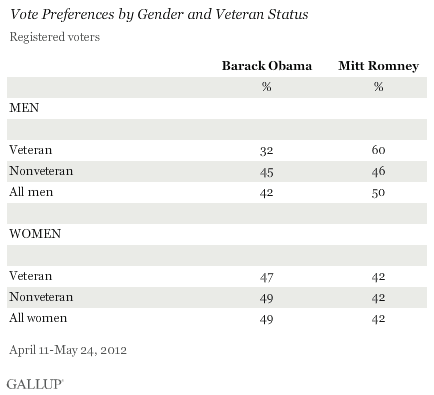
Turns out that the “gender gap” that has Mitt Romney doing better among men and Barack Obama doing better among women (the usual pattern for a generation, at least) is less a gender thing, and more a matter of whether men have served in the military or not. According to Gallup:

PRINCETON, NJ — U.S. veterans, about 13% of the adult population and consisting mostly of older men, support Mitt Romney over Barack Obama for president by 58% to 34%, while nonveterans give Obama a four-percentage-point edge.

These data, from an analysis of Gallup Daily tracking interviews conducted April 11-May 24, show that 24% of all adult men are veterans, compared with 2% of adult women.

Obama and Romney are tied overall at 46% apiece among all registered voters in this sample. Men give Romney an eight-point edge, while women opt for Obama over Romney by seven points. It turns out that the male skew for Romney is driven almost entirely by veterans. Romney leads by one point among nonveteran men, contrasted with the 28-point edge Romney receives among male veterans.

The small percentage of female veterans in the U.S., in contrast to their male counterparts, do not differ significantly in their presidential vote choice from the vast majority of women who are not veterans…

Here’s a graph:

Interesting. I wonder what the long-term implications of this will be. Most of the men who have served in the military are older than I am. Twenty years from now, will much of the gender gap have disappeared, in favor of Democrats? I don’t know. I’d need to understand better why this veteran gap exists to be able to answer that.

Bad news, good news about newspapers

I learned yesterday that one of America’s great cities will no longer have a daily newspaper in the unkindest way, courtesy of my favorite celebrity Twitter follower, Adam Baldwin:

Adam Baldwin Adam Baldwin
@adamsbaldwin

Buggy-Whipped?! | RT @carr2n “Times-Picayune facing deep layoffs, may cut back from daily publication.” – http://nyti.ms/Jsib87

He jests at scars that never felt a wound. How would ol’ Jayne Cobb feel if the financial underpinnings of movies and TV suddenly collapsed? (Hey, don’t say it could never happen. Have you heard about Autohop? Remember, newspapers didn’t start dying because people didn’t want news; it was the ads drying up.)

That newspapers are having to cut back isn’t new (especially not to me), although nothing quite like this has happened before in a major city, so it’s a milestone (and the same company is doing the same with its papers in several other cities, including Birmingham). But my sadness is for the city as well. I lived in New Orleans almost as long as anywhere else growing up — I went to school there for two years (7th and 8th grades) instead of the usual one — and news like this makes it feel like the city itself is dying, with a vital spark fading:

The latest to go to three days a week: The storied New Orleans Times-Picayune, one of America’s oldest papers, which announced Thursday that it plans to limit its print schedule — beginning this fall — to Wednesday, Friday and Sunday editions. It will maintain 24/7 online reporting via its site, Nola.com.

This is a tactical trend for New York-based Advance Publications, which owns the Times-Picayune, as it pushes toward a limited print-digital model. Advance said Thursday that in addition to the Times-Picayune, it will also cut back the print frequency of its three papers in Birmingham, Mobile and Huntsville, Ala., to three days….

First Katrina, now this.

But enough bad news. We have some startlingly good news from closer to home: Warren Buffett is investing in newspapers. Including in South Carolina.

You may have seen that news last week. I was sufficiently surprised that I didn’t know what to make of it, and haven’t commented yet. But I have a new news peg: Buffett has written a letter to his editors and publishers, communicating his thinking in making this move. It’s a bracingly confident message:

Until recently, Berkshire has owned only one daily newspaper, The Buffalo News, purchased in 1977. In a month or so, we will own 26 dailies.

I’ve loved newspapers all of my life — and always will. My dad, when attending the University of Nebraska, was editor of The Daily Nebraskan. (I have copies of the papers he edited in 1924.) He met my mother when she applied for a job as a reporter at the paper. Her father owned a small paper in West Point, Nebraska and my mother worked at various jobs at the paper in her teens, even mastering the operation of a linotype machine. From as early as I can remember, my two sisters and I devoured the contents of the World-Herald that my father brought home every night.

In Washington, DC, I delivered about 500,000 papers over a four-year period for the Post, Times-Herald and Evening Star. While in college at Lincoln, I worked fifteen hours a week in country circulation for the Lincoln Journal (earning all of 75? an hour). Today, I read five newspapers daily. Call me an addict.

Berkshire buys for keeps. Our only exception to permanent ownership is when a business faces unending losses, a remote prospect for virtually all of our dailies. So let me express a few thoughts about what lies ahead as we join forces.

Though the economics of the business have drastically changed since our purchase of The Buffalo News, I believe newspapers that intensively cover their communities will have a good future. It’s your job to make your paper indispensable to anyone who cares about what is going on in your city or town.

That will mean both maintaining your news hole — a newspaper that reduces its coverage of the news important to its community is certain to reduce its readership as well and thoroughly covering all aspects of area life, particularly local sports. No one has ever stopped reading when half-way through a story that was about them or their neighbors…

So… if we are to take Mr. Buffett at his word, this isn’t some bid to rack up losses for tax reasons, or any other convoluted strategy. He actually believes this is a good investment. And he’s not known for being wrong about such things.

Back when I was first laid off, the executive editor position at the Florence paper was open. But I didn’t apply for the job — a combination of wanting to stay where my grandchildren are, and a reluctance to jump back into a dying industry, having done more than my share of laying-off and cutting back in the last few years.

But had the opening occurred under these circumstances — with new ownership, and that owner being Warren Buffett, and he bullish on newspapers — I might have looked at it differently.

The upside is that you NEVER lose an argument

video platformvideo managementvideo solutionsvideo player

Or if you do, you have a whole other set of problems…

Anderson Cooper brings our attention (blast him) to the following:

Daytime Exclusive: Woman Marries Herself in Ceremony

Nadine, 36, joins Anderson to explain why she married herself after getting a divorce. Nadine had a ceremony to celebrate the event and invited 40 guests. She even received wedding gifts.

Her unusual event made headlines, but Nadine says she wasn’t in it for the publicity. She says she decided to go through with the self-marriage because “it was about really committing to changing my life. I feel very empowered, very happy, very joyous. I want to share that with people, and also the people that were in attendance, it’s a form of accountability.”

Nadine experienced a painful divorce and says it was rough after learning her two kids wanted to live with their father. “Six years ago I would’ve handled a problem by going out and drinking. I smoked, I was 50 pounds overweight… this is just celebrating how far I’ve come in my life.”

Since the split, Nadine enjoys spending time with herself, going out on date nights, buying treats and gifts for herself, and says she’s no longer waiting for “someone to complete her.”

What are we going to call this? “Same-self marriage?” Will it catch on?

I hope not. The whole thing worries me. It’s just so easy for self-love to turn to self-abuse…

This could definitely be a setback for Ted Vick

State Rep. Ted Vick seems to have suffered a significant setback in his bid to represent the new 7th Congressional District:

Columbia, SC (WLTX) — State Representative Ted Vick of Chesterfield County was being held Thursday after he was arrested during a traffic stop.

Early Thursday morning Columbia Police stopped the Democratic candidate for U.S. House District 7 for speeding, resulting in an arrest for D.U.I. and possession of a firearm with an expired permit.

CPD Spokesperson Jennifer Timmons tells News 19 that after officers stopped Vick for speeding, and upon approaching the vehicle and speaking with Vick, smelled alcohol.

They asked him to take a breathalyzer test, but he refused. He was put into custody under suspicion of D.U.I., and he then told officers he had a gun in his car.

The officers found the gun, but Vick informed them his concealed-carry permit had expired…

Of course, how this affects his campaign is one of his lesser problems at the moment.

Whites not the majority? Nothing new in that…

Did y’all see the “news” the other day — ironically, the day before my grandson was born — that white babies are no longer the majority? I first heard it on NPR’s Talk of the Nation. Quoth Neal Conan:

We’ve known for years this day would come, but here it is. The Census Bureau announced today that nonwhite births now make up a majority in the United States. Data gathered in 2011 show that nonwhite, Hispanic, African-American, Asian, Native American, mixed race and others combined for 50.4 percent. That’s the first time that white births were not a majority in U.S. history, and that raises some questions about policy – from education to social services programs – and about how we see ourselves as a nation….

Perhaps this is a good time to inject a bit of historical perspective…

I’m still off-and-on gradually making my way through Charles C. Mann’s 1493, while reading several other books at varying rates, and every time I read a stretch in it, I learn something startling. For instance, I refer you to the fact that for most of the history of Europeans in the Americas — up to the mid-nineteenth century — there were far more people of African descent in the Western Hemisphere than there were white. Way more. An excerpt (I hope the publishers will excuse the length of this quote. I share it within the context of urging you to run out and buy this book; there are many other things in it that will surprise you, and enlarge your understanding of our world.):

This was surprising to me for a couple of reasons. For instance, I had long known that before and after the Civil War, South Carolina had a larger black population than white. Which means that before 1860, most of the state’s population was enslaved.

I used to think of that as anomalous. I thought of it as helping explain the fact that South Carolina slaveholders were more fanatically devoted to their Peculiar Institution that the white elites anywhere else. Hence that firing on Fort Sumter thing.

But as it turns out, if you look at ALL post-Columbian immigration across the hemisphere, not just English, you see that far, far more were brought here as slaves from African than came here, either free or indentured, from all Europe. By 1860, this balance had changed in many places (thereby making SC somewhat anomalous), but for most of the time from 1492 until then, a larger black population had been the norm. (Of course, for that same period, there remained more Indians than whites or blacks, in spite of the way native populations had been decimated by European and African diseases.)

I also found it surprising because I spent part of my childhood in Latin America, and it did not prepare me for this statistic — even though I studied history in Spanish in school (Mann’s references to Columbus as Cristóbal Colón seem very natural to me). In Ecuador, where I lived for two-and-a-half years, it was very unusual to see anyone who looked at all African. I knew that Brazil had imported vast numbers of slaves during the colonial period, and that you could see the results on the streets of Rio. I would have said the same of the islands of the Caribbean.

But for there to be that many more blacks than whites across all the Americas? I had no idea. We all are aware that black labor largely built this country, but I guess I thought that was because those workers were owned by a white majority. I was wrong. At least from a hemispherewide perspective.

In any case… whites not being the majority? Nothing new about that on this side of the world.

General guide for mazes, crowds: Always turn left

Did you know this? I didn’t, until Andrew Sullivan told me:

Corn mazes are designed to trick participants, and studies have shown that most humans will naturally, when confronted with a fork in the road, turn right; the hour I spent last night testing this on satellite images of corn and hedge mazes absolutely proves that clever maze-makers love to play on your instincts. (Side note: I’ve heard that that turning-left tip is also a good strategy for avoiding long lines at amusement parks.)

Here’s a passage from the second link he refers to above:

Ok, MrMoonPie, here’s the one, time-tested, don’t-ever-forget-it rule regarding success at Disney World: every time you are presented with a choice, GO TO THE LEFT. I’m serious. Any time a line splits, or you have a choice of entrances, or you’re deciding which part of the park to explore next, GO TO THE LEFT. Many have scoffed, but many more have proven that this trick – simple as it is – actually works.

(I remember reading somewhere that this is due partially to Americans driving on the right side of the road and partially to a preponderance of people being right-handed. I have no idea why this works, but I have been to Disney World literally dozens of times, and I swear to you it does.)

It almost makes me want to go to Disney World again, to try it out.

Here’s some more info on the phenomenon.

By the way, I don’t think there’s a political message here. Certainly not coming from Sullivan.

Kids, lost in a latter-day Heart of Darkness

Have you followed the case out of Rutgers that led earlier this week to the sentencing of a former student accused of spying on his roommate, who later committed suicide? I hadn’t followed it closely, but I did follow this suggestion on Twitter:

The New Yorker (@NewYorker)
5/21/12 1:15 PM
Revisit Ian Paker’s in-depth piece on the Clementi case in the wake of Dharun Ravi’s sentencing: nyr.kr/y3umI3#ravi #clementi

It took awhile. I read it in short bits now and then over the last couple of days. Because it really, truly is “in-depth.” And fascinating. And depressing. (And these few reflections took me some time, too. I wrote most of this post late yesterday, and am only finishing it up now.)

It’s a little hard to briefly explain what I got out of the piece. But I quote the following just to make the point that what was found was probably not exactly what anyone would have expected the author to find:

Clementi’s death became an international news story, fusing parental anxieties about the hidden worlds of teen-age computing, teen-age sex, and teen-age unkindness. ABC News and others reported that a sex tape had been posted on the Internet. CNN claimed that Clementi’s room had “become a prison” to him in the days before his death. Next Media Animation, the Taiwanese company that turns tabloid stories into cartoons, depicted Ravi and Wei reeling from the sight of Clementi having sex under a blanket. Ellen DeGeneres declared that Clementi had been “outed as being gay on the Internet and he killed himself. Something must be done.”…

It became widely understood that a closeted student at Rutgers had committed suicide after video of him having sex with a man was secretly shot and posted online. In fact, there was no posting, no observed sex, and no closet. But last spring, shortly before Molly Wei made a deal with prosecutors, Ravi was indicted on charges of invasion of privacy (sex crimes), bias intimidation (hate crimes), witness tampering, and evidence tampering. Bias intimidation is a sentence-booster that attaches itself to an underlying crime — usually, a violent one. Here the allegation, linked to snooping, is either that Ravi intended to harass Clementi because he was gay or that Clementi felt he’d been harassed for being gay. Ravi is not charged in connection with Clementi’s death, but he faces a possible sentence of ten years in jail. As he sat in the courtroom, his chin propped awkwardly on his fist, his predicament could be seen either as a state’s admirably muscular response to the abusive treatment of a vulnerable young man or as an attempt to criminalize teen-age odiousness by using statutes aimed at people more easily recognizable as hate-mongers and perverts….

What follows is a long, appallingly detailed account of several young people’s trek through a latter-day Heart of Darkness.

I say “appallingly detailed” because it makes clear the fact that we now live in a time in which the private thoughts of people who are not makers of history or even (until the tragedy of Tyler Clementi’s death) newsmakers can be strip-mined and laid out in a detail that rivals anything that has been compiled about the thoughts and communications and actions of kings and presidents and generals in the past.

Even when they’re kids. Even when they are lost, confused kids staggering through a world that no longer offers standards or guideposts, social or otherwise, or at least none that they consider to be relevant. Offhand, careless, only semi-articulate bull sessions between adolescents are recorded, rather than being mercifully forgotten, and set in virtual stone like the carefully considered edicts of monarchs and parliaments.

To the extent that the story has a chronological beginning, it starts when high school graduate Dharun Ravi, who I guess we could say is a not atypical teenager (excuse the double negative, but it seemed more accurate than the more direct “typical”), learns the partial name of his roommate-to-be, and decides to research him on the web, and discuss what he finds with friends online. We are exposed to the most trivial, casually cruel, contradictory, insecure, stream-of-consciousness examination over every thought and half-thought and emotion that he experiences as he tries to decide what he will make of this stranger. This goes on for hours and hours in the initial session — much of which is spent discussing the wrong person. About the only thing that is determined in this search is that the roommate is gay.

Ravi’s attitude about that particular piece of knowledge reflects the contradictions of his generation, a generation that contemptuously dismisses any reservations that some older people may have about, say, same-sex marriage, but does not hesitate to use “that’s so gay” as a pejorative. The typical kid of this generation is both more open and accepting toward homosexuality, and yet more willing to say dismissive things about it, than a kid in the 1950s (or at least as willing — certainly more open and candid about it). It is never clearly established what Ravi’s attitude is, at least not in the simplistic terms of “tolerant” or “supportive,” or “homophobic.” He’s all of the above.

The boy who killed himself left a similar record of his thoughts and actions, although not quite as exhaustive, as he wasn’t as technology-adept. But he leaves enough that it is positively stunning that there is no clear, cause-and-effect explanation of why he killed himself. Even with all this data, the sequence of events is circumstantial.

Does that make Ravi innocent? No way. No one is innocent in this appalling narrative, in any sense other than, perhaps, cluelessness. Real innocence has long ago been burned out of any of these kids.

I went to college during the alleged sexual revolution, but I find overwhelming the utter lack of a sense of boundaries that afflicts the existence of these kids. It’s one thing to act on one’s sexual urges, or even to have curiosity about those of others. It’s another to discuss such acts and urges in such exhaustive detail, in writing, for publication, for everyone you know and everyone you don’t know, to read in real time and forever after. There are seemingly no boundaries for these kids, either regarding what to do, or what to say about it or whom to say it to or how to say it. They are lost, drifting in a universe without any sort of social norms.

Because social norms have not caught up with the technology. The village had its rules about what should be said and when and to whom. This world does not. And the human animal is a long, long way from having evolved quickly enough to cope with it.

And these kids are lost in it — every one of them, not just the two main protagonists in this tragedy.

I mean, set aside the homosexuality angle — especially since everyone in the story is so ambivalent about it. Imagine that we’re talking about a situation in which Clementi brought a girl to his room. The shocking thing then becomes that no one treats this encounter between apparent strangers as anything deserving of any kind of discretion or privacy or respect, much less censure. It is an open topic, as everyone in the dorm, and everyone within reach of the various actors’ Twitter and Facebook feeds, is a participant in a convulsive, confused, on-and-off, half-hearted form of voyeurism.

What happens, briefly, in the saga’s critical episode, is that Clementi was going to have a guest in his room, and asked his roommate to make himself scarce. Ravi obliged, but left his computer set to automatically receive a videoconferencing request, and with the camera pointed toward Clementi’s bed. Then he went to the room of a girl he knew from high school, and activated the link. They watched for a few seconds, saw the two guys kissing (fully clothed), and then had a reaction on the level of “Ewwwww” and shut off the link.

The girl later said, ““At first, we were both, like, ‘Oh, my gosh, we can’t tell anybody about this, we’re just going to pretend this never happened.’ ”

For Ravi, that resolution last three or four minutes, before he Tweeted, “Roommate asked for the room till midnight. I went into molly’s room and turned on my webcam. I saw him making out with a dude. Yay.”

Later, there was an abortive plan to spy on Clementi on another occasion, with a larger audience, but that didn’t happen — apparently because Clementi realized what was happening (how could he not? he had read the Tweet) and disconnected Ravi’s power strip.

Clementi wondered online to a friend what to do about what his roommate had done, although at no time did he seem freaked out about it. He wrote things like, “When I first read the tweet I defs felt violated but then when I remembered what actually happened . . .
idk… doesn’t seem soooo bad lol…”

He wonders whether to complain, or request another roommate. He never quite makes up his mind.

What does not happen, what never seems to happen, is any sort of real communication between the two roommates. The wasted opportunities for it are tragic. For instance, we read an online exchange, before any of these incidents, that Clementi has with a friend about how to initiate a conversation with new roommate Ravi… with Ravi sitting right there.

Again, the thing that strikes me is how crippled these kids seem to be when it comes to normal human interaction, and how utterly unfettered their online communications are — communications that do damage that they are not equipped to repair. (I say unfettered… but there is evasion, and obfuscation, and false bravado… for instance, “lol” is used repeatedly in a context that suggests it’s more of a nervous giggle of insecurity than a belly laugh.)

The dysfunction is profound. And there are no capabilities in these kids’ nervous systems (evolution can’t keep up) or in our social mores and etiquette for setting things right.

When I first started communicating with people electronically, in the early 80s, I was an adult, with all sorts of social skills to fall back on. I quickly learned the ways that electronic communications were different, and the pitfalls that they contained. Not that I don’t frequently misstep to this day, on this blog and elsewhere.

But these kids, they’re just in a dark void, clueless as to how to cope constructively with other humans, at a time when it is easier than ever (theoretically) to communicate.

And it’s a deep, dark tragedy.

Organized labor hits back — again and again…

Still have a lack of details regarding this video clip (which won’t let me embed it, so you have to follow the link). I don’t consider the text explanations one gets from YouTube as the most helpful or authoritative, but so far that’s all I have to go on here:

Gov. Nikki Haley has been vicious to organized labor, saying in her State of the State address that “unions are not needed, wanted or welcome in South Carolina.” After years of being treated like a union thug, Donna Dewitt gets sweet revenge at a retirement reception in her honor.

I just want to go on the record as saying, right here and now, that I do not believe that Nikki Haley should be bludgeoned with a baseball bat. Even symbolically.

Did anyone at this event go, “Umm… wait a minute…” and think it was excessive? Was anyone creeped out? One hopes so. But one doesn’t know…

The key quote: “Wait ’till her face comes around, and WHACK her… Give her another whack! Hit her again!

Yep. We’ve sunk pretty low, folks.

This was brought to my attention by Bryan Caskey, who got it from CNN’s Peter Hamby:

South Carolina labor official beats a Nikki Haley pinata with a baseball bat —http://bit.ly/KQ70py

Are women fed up with Democratic pandering?

Tom Edsall makes some interesting observations in this piece in The New York Times from over the weekend. If you haven’t read it, you should.

His topic is the impact of Barack Obama’s rather overt bids for the renewed affections for key Democratic constituencies and interest groups defined by demographic identity. Unsurprisingly, Edsall finds that the voting public at large is suspicious of such moves. For instance, while the public is evenly split on the subject of gay “marriage,” there is widespread cynicism toward the president’s embrace of the notion:

Some evidence that Obama must walk a fine line as he seeks majority backing can be found in the May 15 CBS News/New York Times poll, which showed that 67 percent of respondents said Obama came out for same-sex marriage “mostly for political reasons,” while just 24 percent said he made the decision “mostly because he thinks it is right.”

But the really surprising thing he finds is the way, after all the gyrations Democrats have gone through in recent months, including the “war on women” and other absurd rhetoric, the president has lost ground among women:

In an equally troublesome finding for Obama, the Times poll recorded a dramatic drop in the level of support for Obama among women, with Romney actually pulling ahead, 46-44. Obama’s support among female voters has fallen from 49 to 44 percent over the past two months, while Romney’s rose three points.

Stephanie Cutter, deputy manager of the Obama campaign, has challenged the accuracy of the Times poll, arguing that the methodology – calling people who have been previously surveyed,  known as a “panel back” — resulted in “a biased sample.”

But even if the poll findings can be reasonably disputed, they still suggest that Obama’s aggressive bid to strengthen his support among women may be backfiring. Separate polling by Marquette Law School in Wisconsin shows Obama holding a strong, but declining advantage among women voters. In February, Obama had a 21 percentage point lead among women, 56-35; by mid-May, his margin among women had fallen to 9 points, 49-40….

Could it be that you just can’t go past a certain point in pandering to women without insulting their collective intelligence? It would appear so…