Daily Archives: June 4, 2012

Inglis on why the tribe turned against him

Kathryn brings my attention to this interview piece with Bob Inglis on Salon.

Bob Inglis is a guy for whom I’ve always had a lot of respect — ever since he got elected to Congress in the early 90s as a fiscal (and cultural) conservative, and then voted against highway money for his own district. This was back when nobody did this. “Conservatives” like Strom Thurmond had always talked a good game, but brought home the bacon. Inglis was a trailblazer.

To listen to Bob Inglis talk is to respect him, just as he respects others — something that sets him apart.

Inglis has always been deeply conservative, and deeply committed to his principles. But the know-nothings of his party unceremoniously dumped him in the last election, basically — as near as I can tell — for not being as angry as they were.

Anyway, this is an interesting passage:

Inglis remembers campaigning door-to-door and encountering hostility for the first time.

“I’m wondering, ‘Why is this happening?’” he said. “And what I came around to is that what happens is the tribe selects you to go to Washington. You believe with the tribe, you agree with them, and you go to Washington as their representative.

“Then you get there and you mingle with these other tribes, and you come to understand their point of view – not agree with it, but understand it. So when that view is presented, you don’t have the same sort of shocked reaction that some of the tribe members at home have to hearing that view.”

He recalled getting to know John Lewis, the civil rights icon and Democratic congressman from Georgia.

“He is an incredible American,” Inglis said. “I just disagree with him on this budget thing. But back at the tribe, at the tribal meeting, it’s like, ‘He’s some kind of Communist, that John Lewis. He’s not an American.’ No! He’s an incredible American. He’s one of our heroes.

“But the tribe doesn’t see that. The tribe sees you as sort of getting too cozy with John. And then they start to doubt you, because of this betrayal response. We are hard-wired to respond very violently – as I understand it, the brain really responds to betrayal. It’s one of the strongest human emotions.”…

Inglis, a conservative Republican to his core, speaks here to a very UnParty sensibility. You have your principles and you stand up for them. But that doesn’t mean you delegitimize those with whom you disagree. If you do that, the deliberative process upon which our system of government is built collapses.

Bob understands that. Too few who still hold office do.
I don’t go for these same-sex work partnerships

Having decided it was time, after 10 years, for me to leave The Jackson (TN) Sun, I started putting out feelers in the spring of 1985.

Just before I flew out to Wichita to interview for a job I would eventually take, I got a call from an editor at The Charlotte News, who wanted me to come there before making up my mind. By the end of the conversation, we had made travel arrangements for right after the Kansas trip. (But then days later, the editor called me back to cancel. The hiring freeze word had just gone out; the afternoon paper would close later that year.)

It was a fairly lengthy call. When I got off the phone, my wife asked who I’d been talking to.

“An editor in Charlotte who wants me to go there instead of Wichita.”

“Was it a woman?” she asked.

“Yeah… how could you tell?”

“You were enjoying yourself,” she said.

She knows me very well. Most of my career, my closest working relationships — certainly most of the really enjoyable ones — have been with women. (One of my best friends at the Jackson paper once referred to herself as one of “Brad’s women.” Some might have misunderstood that, but all within hearing knew what she meant.) I don’t know why. Nothing against guys. I’ve had a great working partnership with plenty of guys, such as Robert Ariail, as I described back here. But who’s to say? — maybe if we’d also had a cartoonist who was a woman, I might have an even closer partnership with her. Or not. I never set out to work more closely with women. It just keeps happening.

Earlier today I mentioned the Power Failure project. While I worked with people from across the newsroom off and on during that year, there was a core group of three women, from start to finish, without whom I couldn’t have gotten it done. One of them was assigned to the project mainly to keep me on track, to make sure that all my theories and plans and ideas were actually translated into articles and graphics and photos, on time. She was essential to the project becoming something that you could hold in your hand.

And anyone who had occasion to observe the portion of my career spent at The State knows how important was the partnership I had with Cindi Scoppe, from when I first supervised her as a 23-year-old reporter in the late ’80s through those last 12 years on the editorial board.

Anyway, I share all this to explain why I thought this piece in The Wall Street Journal today was such a crock:

Picking Someone for a Project? Chances Are, He’ll Look Like You

Here’s at least one instance of parity among the sexes: Men and women are equally biased when it comes to choosing work partners, a new study suggests.

When selecting colleagues to collaborate with on a daily basis, males and females are both significantly more likely to choose someone of their own gender, according to an analysis by Innovisor, a Copenhagen-based management consulting firm…

“We prefer to collaborate with people who look just like us,” says Jeppe Hansgaard, a managing partner at Innovisor. “That’s a management issue, because you want your employees to collaborate with the right people, not just people who look like them.”…

Maybe the piece set me off particularly because I’d just read (part of) this distressing report telling me that the Obama campaign plans to stress Identity Politics more in this election. But every time I read anything about  how people choose to associate with “people like them,” it ticks me off. I like to think people are broader than that.

Hoping Obama won’t really run this way

Maybe y’all have time to read this piece by John Heilemann in New York Magazine. I don’t, not today. If you do, please get back and tell me that things don’t really look as dark as they do at the beginning:

The contours of that contest are now plain to see—indeed, they have been for some time. Back in November, Ruy Teixeira and John Halpin, two fellows at the Center for American Progress, identified the prevailing dynamics: The presidential race would boil down to “demographics versus economics.” That the latter favor Mitt Romney is incontestable. From high unemployment and stagnant incomes to tepid GDP growth and a still-pervasive sense of anxiety bordering on pessimism in the body politic, every salient variable undermines the prospects of the incumbent. The subject line of an e-mail from the Romney press shop that hit my in-box last week summed up the challenger’s framing of the election concisely and precisely: “What’s This Campaign Going to Be About? The Obama Economy.”

The president begs to differ. In 2008, the junior senator from Illinois won in a landslide by fashioning a potent “coalition of the ascendant,” as Teixeira and Halpin call it, in which the components were minorities (especially Latinos), socially liberal college-educated whites (especially women), and young voters. This time around, Obama will seek to do the same thing again, only more so. The growth of those segments of the electorate and the president’s strength with them have his team brimming with confidence that ­demographics will trump economics in November—and in the process create a template for Democratic dominance at the presidential level for years to come…

Y’all know how I feel about Identity Politics. I want leaders who want to lead all of us, not this or that arbitrarily selected subset. Obama, to me, is the guy who inspired a victorious crowd in Columbia to chant, on the night of the 2008 South Carolina primary, “Race doesn’t matter!” Amen, said I. The atmosphere that night — when voters rejected the continued partisan strife that the Clinton campaign seemed to offer — was one in which we put our divisions behind us, and work toward building a better country together, as one people.

And if there’s anything more distressing in my book than Identity Politics, it’s Kulturkampf. Those couple of paragraphs are enough to push me toward political despair on that count. The next two grafs are worse:

But if the Obama 2012 strategy in this regard is all about the amplification of 2008, in terms of message it will represent a striking deviation. Though the Obamans certainly hit John McCain hard four years ago—running more negative ads than any campaign in history—what they intend to do to Romney is more savage. They will pummel him for being a vulture-vampire capitalist at Bain Capital. They will pound him for being a miserable failure as the governor of Massachusetts. They will mash him for being a water-carrier for Paul Ryan’s Social Darwinist fiscal program. They will maul him for being a combination of Jerry Falwell, Joe Arpaio, and John Galt on a range of issues that strike deep chords with the Obama coalition. “We’re gonna say, ‘Let’s be clear what he would do as president,’ ” Plouffe explains. “Potentially abortion will be criminalized. Women will be denied contraceptive services. He’s far right on immigration. He supports efforts to amend the Constitution to ban gay marriage.”

The Obama effort at disqualifying Romney will go beyond painting him as excessively conservative, however. It will aim to cast him as an avatar of revanchism. “He’s the fifties, he is retro, he is backward, and we are forward—that’s the basic construct,” says a top Obama strategist. “If you’re a woman, you’re Hispanic, you’re young, or you’ve gotten left out, you look at Romney and say, ‘This [f*@#ing] guy is gonna take us back to the way it always was, and guess what? I’ve never been part of that.’ ”

Yeah, that’s all we need. A campaign that sees itself as an army of indignant minorities, feminists, gays and young people up against a coalition of self-interested white males, Ayn Randers, birthers and nativists, with both sides convinced that it is at war with the other. And each subset being motivated not by what’s good for the country, but by what it sees as advantageous to itself as a group.

So much for the United States.

All that’s left to me at this point is to hope the campaign plays out differently from the way this writer envisions it.

If Mitt loses election, he also loses $5 million a year

The AP reports on an additional reason for Mitt Romney to run really, really hard to win this thing:

WASHINGTON (AP) — To see where the presidential candidates stand on taxing the rich, just look at how they’d tax themselves. Under his own proposal, Mitt Romney would pay half what he would under President Barack Obama’s tax plan. For a man of Romney’s means, that could save almost $5 million a year.

For Obama, not as loaded as Romney but still well-off, losing re-election could provide a tax windfall. He’d save as much as $90,000 a year if Romney’s plan were enacted rather than his own tax-the-rich vision.

Two nonprofit research groups, the liberal-leaning Citizens for Tax Justice and conservative-leaning Tax Foundation, did the calculations, based on the most recent completed tax returns released by the candidates. Compared with what they owed in April, both men would be dinged in 2013 under Obama’s proposal, along with other wealthy taxpayers. They could expect savings under Romney, depending on which tax breaks the former Massachusetts governor decides to oppose….

That’s assuming, of course, that paying a lot more in taxes matters to Mitt. It apparently doesn’t to his opponent, but of course, he has less to lose.

If I had Mitt’s fortune, I don’t think it would matter to me. But then, that’s probably because I’m not the kind of guy who was ever motivated go out and amass all those bucks. Chicken or egg thing.

Adam uncovers a blast from the past

Adam Beam of The State Tweeted this over the weekend:

Adam Beam
Adam Beam
@adambeam

@BradWarthen Look what I foundpic.twitter.com/7V5M1vlr

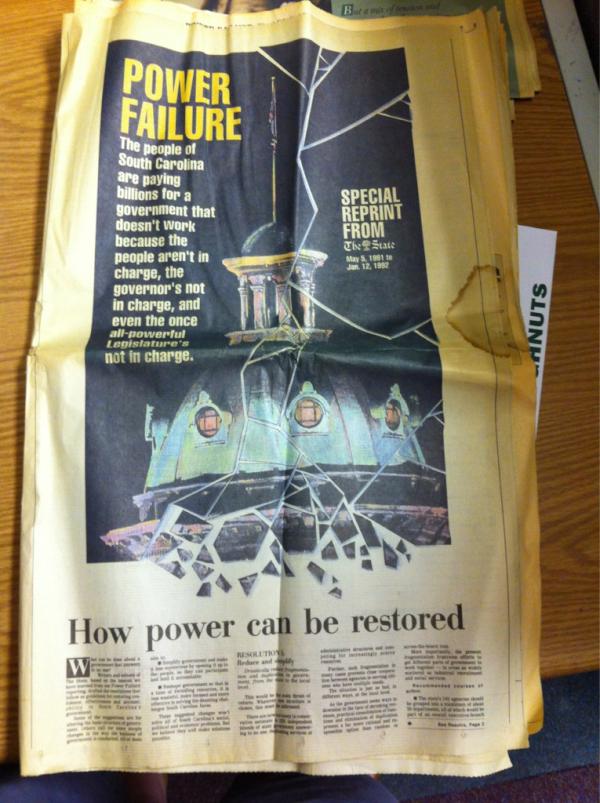
Adam must have been spending Saturday at the office going through old drawers in the newsroom. There are a number of these scattered about here and there.

This is the special reprint we did early in 1992 of the Power Failure series that I had spent most of the previous year directing.

Power Failure was something I dreamed up in 1990. As governmental affairs editor that summer, I had been going nuts keeping up with an unbelievable string of scandals in and around state government, the most memorable of which was the Lost Trust investigation, which led to indictments against a tenth of the Legislature.

In the midst of it all, then-executive editor Gil Thelen stopped by my desk one day to wonder, What could we do to give our readers a positive way to respond? What could be done to make state government better, rather than just wallowing in the bad news day after day?

The answer I came up with was a project highlighting all of the deep, structural flaws in South Carolina’s system of government — flaws that set South Carolina apart from every other state. Flaws that made our system particularly resistant to change.

These flaws are difficult to summarize briefly, but all of the problems — the weak executive, weak local governments, centralization of authority, fragmentation of that central authority, almost complete lack of accountability (in terms of anyone being able to hire and fire key officials), and on and on — were vestiges of a constitutional system originally designed to put all authority in the hands of the landed, slaveholding antebellum gentry, and to fragment that power across that whole class of people, so that no one person could make important decisions. For instance, not only did departments that in other states reported to the governor (an official elected by all of the state’s people) report to a separately elected official, or to a board or commission appointed by the Legislature, but even decades after the passage of Home Rule, lawmakers still retained a surprising degree of control over local government services.

As I said, it’s difficult to summarize briefly, although we tried with the tagline, “The Government that Answers to No One.” To explain it, I conceived of a 17-installment series, each installment filling several full pages of newsprint (back in the day when pages were much bigger than they are now), totaling well over 100 articles. Gil and Paula Ellis, then the managing editor, essentially laid the resources of the newsroom at my disposal for most of 1991. Reporters came and went from the project, depending on which subject area we were dealing with at the time.

Were there results? Yes, but nowhere near what we were seeking. A partial restructuring of state government in 1993 put about a third of the executive branch under the governor. That third of a loaf, though, was great success when you consider that huge areas that were just as important — Home Rule, education governance, reducing the number of statewide elected officials — were pretty much ignored.

As for me — I was ruined as a governmental affairs editor, since the project was an unprecedented sort of news/editorial hybrid — for instance, I had written opinion columns advocating all of these changes throughout the series. I spent a couple of years supervising this or that non-political team (although I retained control of the Washington Bureau) until I made the move to editorial at the start of 1994 — where I spent the next 15 years continuing to advocate these reforms. Most of the items I listed in my last column for The State, “South Carolina’s unfinished business,” was to a great extent a recap of Power Failure.

Recently, we saw one tiny piece of the reform picture fall into place, with the legislation putting the governor and lieutenant governor on the same ticket advancing. Hoorah for small victories.

It’s been frustrating, but hey, this system had been in place in one form or another for 300 years — and the one great characteristic that it possessed all that time was a profound resistance to change. That is still the hallmark of government in South Carolina.