Daily Archives: August 10, 2012

Terrorism? Hate crime? It was worse. It was “multiple counts of first-degree murder”

This morning on the radio, I heard the question raised as to whether the killings at the Sikh temple in Wisconsin should be considered an act of “domestic terrorism.”

Sure, I said to myself. And that would have been that, except that I then proceeded to think about it, and changed my mind.

“Terrorism” has to have a political aim — a goal to be achieved by sowing terror within a population. (Such as, for instance, trying to cow Americans to the point that we withdraw troops from Saudi Arabia, which was Osama bin Laden’s motive.) Without that, it’s something else.

The Oklahoma City bombing pretty much (although not perfectly) fits the definition because the conspirators — and the existence of multiple conspirators lends credence to the political aspect — were trying to send a message in response to Waco and Ruby Ridge. I’m not entirely clear what policy goal they hoped to achieve, but the use of mass murder to send a political message seems pretty clear.

We’ve heard about how the Sikh temple killer was a white supremacist, which nudges us toward politics, but that only suggests that if he was going to kill somebody, it seems likely he’d strike at nonwhites. Which he did. But that still suggests irrational personal animus more than saying he had some policy goal in mind.

There are those who would call it a “hate crime.” Well, they can do so without me. I could see it as a crime motivated by hate (one supposes some strong emotion was involved, although perhaps not), but I don’t hold with having a special category of crime based in the attitudes of the perpetrator, beyond such basics as whether the crime was intentional. We punish actions in this country, not opinions.

Attorney General Eric Holder seems to have wanted to cover all bases today, calling it “an act of terrorism, an act of hatred, a hate crime.”

Of course, his goal is to offer succor to mourners on behalf of the community, which means saying anything and everything that might express the country’s horror. If he were acting as a prosecutor in the case, we would have every right to demand that he be more precise.

And that’s the thing here that makes the search for motives, for terminology that will place a name upon these horrific crimes and thereby place them in a box of understanding — there will be no trial, no public proces of discernment and administration of justice. The killer robbed the mourners of that by killing himself.

On “Tell Me More” this afternoon as I was coming back from lunch, I heard a discussion that contained some foolishness (something to the effect that if it had been a dark-skinned man shooting up a bunch of white people, that would be terrorism), but also some wisdom — the point was made that people reach for an explanation like “terrorism” (or, I would add, “hate crime”) rather than random act of evil because that suggests there’s something we can do about it going forward. A political movement with a violent agenda is something you can take action against, and prevent further such acts. But an individual act of madness, or personal evil — how do you ward that off?

What we know is that there were six acts of senseless, premeditated murder. Which is more, far more, than bad enough. And in terms of how empowered we feel to deal with it, more horrible than anything else.
Where do kids listen to their pop music today? (All I know is, it better not be on my lawn…)

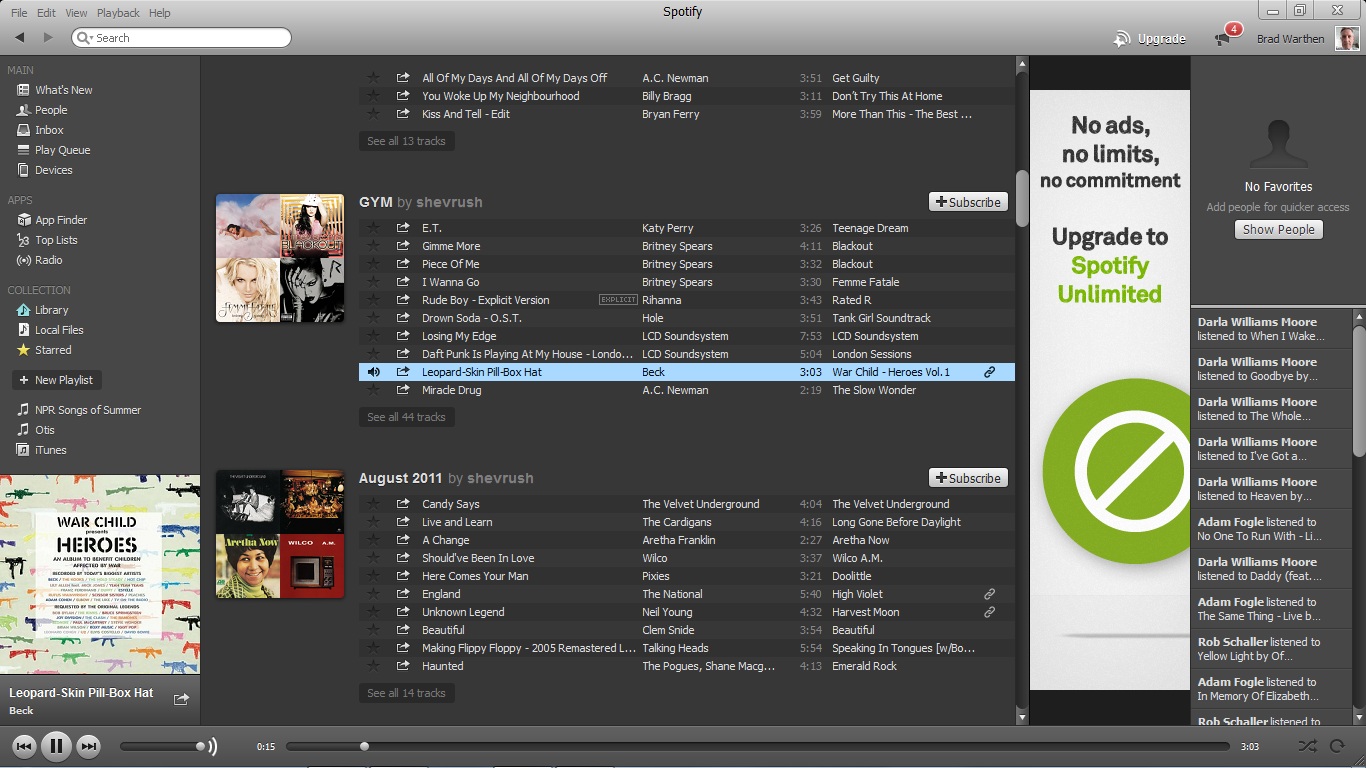
Spotify informs me that Darla Moore has subscribed to “my” playlist, “NPR Songs of Summer.” Of course, it’s not “my” playlist. It’s NPR’s.

For a moment I thought I’d discovered what Darla had been up to since Nikki bumped her from the USC board of trustees — listening to Adele, LMFAO, Taio Cruz, Gnarls Barkley, Simon and Garfunkel and the Stones. But then I realized it was another Darla Moore altogether — but one, it should be said, with pretty good taste, who also listens to Emeli Sandé, Kate Bush, R.E.M., Loudon Wainwright III, Beck, the Velvet Underground and the Psychedelic Furs, among many others, according to her public profile.

Which is aside from my point. The point is, I have a confession to share.

After having played them over a bunch more times, I realize I was wrong about some of those songs on the NPR list. Some of the recent songs I rated really low on my zero-to-five-stars scale are a lot better than I thought they were when I first rated them.

For instance… I wake up in the morning with LMFAO’s “Party Rock Anthem,” which has really grown on me, in my head.

And more dramatically, I originally rated Adele’s “Rolling in the Deep” at two stars, which was ridiculous. I now consider it to be worth at least four, if not five. It’s amazing. I didn’t come to this decision because of seeing two of my older (male, amazingly enough) cousins dancing to it with abandon at a wedding a couple of weeks back — doing something that looked very like an Indian rain or war dance, which the song’s driving rhythm tends to abet.

No, I’ve come to that conclusion from listening to it over and over. And eventually going, wow. You know how I posed the question of what, exactly, makes Leonard Cohen’s “Hallelujah” so mysteriously stirring? What, I asked, is the music doing to the ear, the brain, the soul in that part that “goes like this, the fourth, the fifth/ The minor fall and the major lift…?”

Well, something comparably awesome happens, building irresistibly, and then exploding, every time, when Adele sings this part:

The scars of your love remind me of us
They keep me thinking that we almost had it all
The scars of your love, they leave me breathless
I can’t help feeling

We could have had it ALLLLLLL…

It’s just amazing.

But it took time for me to fully realize it.

And it occurs to me that that is a large part of the difference, in terms of my appreciation, between recent songs and something like, for instance, “Honky Tonk Women,” with which I was saturated during the summer of 1969. (When I hear it, it brings one particular memory specifically to mind… driving down Highway 17 between Myrtle Beach and Surfside, passing by right where Tad’s used to be, telling my Uncle Woody — who’s just a little older than I am, and therefore sort of like an older brother — that that was just the best driving song ever. This was possibly influenced by the fact that I had just started driving.)

It’s not that I’m an old fogy — although I’m sure some of you will have your own opinions as to that. The thing is, I react to music much the same as I did in my youth. I certainly feel the same inside when I hear it.

But back in the day, we heard the songs so often, and they had a much better chance of growing on us. On TV, on the radio, walking down the street, coming from a juke box. Music was so common, and shared, and unavoidable. Grownups were able to mock The Beatles’ “yeah, yeah, yeah” because they heard it, everywhere.

There was one Top 40, and everybody was exposed to it. Now… music is more diverse, and specialized, and broken down. And I have the sense that you have to go out and seek it more than you do today. Even if it’s only clicking on a link from a friend via social media, you sort of have to seek it out.

Yeah, maybe it’s just because I’m not invited to those kinds of parties, but music just doesn’t seem as public and as ubiquitous as it once did. Is that a misperception? I don’t know.

I do know that music took a shift toward the private and esoteric and fragmented in the 70s, as we all became “album-oriented.” But then it came back together, became more democratic, in the 80s with MTV, to where most of us have a shared soundtrack for that era.

Now, just as people can choose highly specialized TV channels to watch — rather than having to be satisfied with three networks — they are more empowered to choose a specific musical direction, and have it be private, through their ear buds. Yes, it’s shared, but more person-to-person, rather than communally.

Or so it seems. As I say, I don’t go to parties where current pop music is being played, assuming such parties still exist. But then, I was a pretty antisocial kid, and didn’t go to all that many parties.

So what’s different? How do y’all see, or rather hear, the music scene today?

The music used to be so public, and unavoidable.