Are the Cuban people moving to end dictatorship?

Map of Cuba, circa 1680.

Map of Cuba, circa 1680.

EDITOR’S NOTE: Here’s something Bryan tried to post, but it mysteriously disappeared on him. So I’m hereby posting it for him, in appreciation for his recent efforts to keep this blog alive when I’m too tied up with stuff to do so (which I still am). I, too, have been thinking about the Caribbean, and not just because my youngest daughter lives down there and, after a too-short visit, is returning there tomorrow. I’ve been wanting to write something about Haiti. Maybe I’ll find time at some point…

Over the weekend, protests moved into the streets of various cities in Cuba.

It looks like the protests started over the chronic issue of food shortages and other essential products and services. The pandemic has only made conditions on the island country worse. The protesters also demanded vaccines to combat the pandemic, but began shifting in tone with chants of “Freedom!” and “Down with Communism!”

The New York Times has this:

Shouting “Freedom” and other anti-government slogans, hundreds of Cubans took to the streets in cities around the country on Sunday to protest food and medicine shortages, in a remarkable eruption of discontent not seen in nearly 30 years. https://t.co/BbqQPLrNiE

— The New York Times (@nytimes) July 11, 2021

Freedom and other anti-government slogans?” sort of seems an odd thought, but… whatever. If your government is ever on the other side of things from people legitimately asking for “Freedom,” you’re doing something wrong.

In any event, I certainly hope the people of Cuba are allowed to be free to choose their own form of government at some point. If this protest turns violent the current lack of medicine and food is going to exacerbate the poor conditions that already exist.

It’s not boring. It’s baseball. And it’s perfect…

still baseball

Bryan started off his excellent “summer beach movie songs” post with a dismissive aside about “debating a replacement song for the national anthem.” I thought:

If America is decadent and unlikely to recover, which of these two phenomena would be more likely either the cause, or perhaps I should say the most stark effect?

  1. We are now a country in which people can mention “debating a replacement song for the national anthem,” and not be entirely joking.
  2. We are now a country, and have for some time been a country, in which football is more popular than baseball.

Both thoughts are depressing, evidence of a great nation losing its way. Those two are enough to cause concern, without even mentioning the disaster of Trumpism. And the distressing nature of Phenomenon 2 was driven home by a couple of tweets Saturday morning…

First, this one at 9:47 a.m.:

Arghh. Here I am still looking desperately, and usually unsuccessfully, for some affordable ways of seeing some live MLB on my TV without having cable, and this guy has to remind me — gleefully, I infer — that very soon I won’t be able to turn on the blasted contraption without seeing football everywhere.

And just a few moments later, this one from my friend and former campaign comrade Ashleigh Lancaster.

Let’s concentrate on Ashleigh’s since, although it has sad elements, it is at least about baseball.

Since for some reason I was unable to embed Ashleigh’s (maybe because it was her retweet of somebody else’s), I’ll at least share my response to it:

I’m a fan of Ring Lardner, especially of his work on “You Know Me, Al,” but let’s face it: The lively ball didn’t kill baseball. Nevertheless, I respect his points about it — and it certainly helped lead to the unhealthy obsession with home runs on the part of many less-discriminating fans — and respect the debate itself as one of the things I enjoy about the game. It’s right up there with debates we can have about other abominations that have tried to destroy the game within my lifetime, such as the playoff system (we all know that in an orderly universe, the team with the most wins during the season wins the pennant, right?) and the designated hitter.

No, baseball has never been boring, and excellent pitching isn’t making it more boring. It’s not intended to be an unending stream of hits (most of them home runs, if the aforementioned less-thoughtful “fans” have their way). If it were, I wouldn’t be trying to watch it.

It’s a contest, a contest that batters are meant to lose most of the time — which makes it that much more exciting when they don’t. Of course, the best part of the excitement is watching the fantastic defensive feats of the players on the field reacting to the ball being put into play. (Something that you miss out on entirely when the ball is hit out of the park, by the way. Everybody just stands there. Now that’s boring…)

The pitchers are constantly trying to keep the guys from hitting, and the batters are all constantly trying to overcome the pitchers’ and catchers’ craftsmanship. And from time to time, everything explodes into action involving everyone else. But not too often. Just enough.

And it’s not boring. It’s perfect…

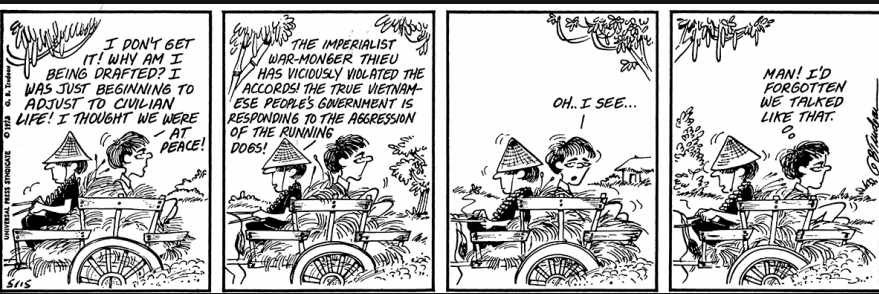
You_know_me_al_comic_strip

Top Five Summer Beach Songs

20210706_120214 20210707_203354

Paul said that debating a replacement song for the national anthem might be a good topic, and we might get to that later. For now, I’ll go with something a little lighter. Here are two photos from my family’s beach week at Isle of Palms. We’ve been enjoying the beach, bike riding, great food, and summer ease. Above is a picture of my daughter enjoying perhaps the best chocolate milk ever, and below that is the view of the IOP beach.

We’ve also been giving our kids a tutorial in some of our favorite music. In keeping with summer here are my top five (High Fidelity Style, of course) summer beach songs:

  1. Under the Boardwalk (The Drifters)
  2. Surfin’ USA (The Beach Boys)
  3. Paradise City (Guns N’ Roses)
  4. Night Moves (Bob Seger)
  5. One Love (Bob Marley)

What are some other songs you associate with summertime and the beach?

What do you think of watching fireworks?

fireworks

I said I wouldn’t have time to post today (again), but I thought I’d just put up a quick post before the subject is too old.

I spoke briefly with my brother on Sunday, and he told me that he was at Lake Hartwell with his family to watch fireworks (he lives in Greenville, and that is apparently somewhere Greenville people go). My reaction was something to the effect of “Better you than me,” and he said it wasn’t his idea; he had just gone along with the inevitable, as dads often do. This led to a brief discussion in which we found we were both, at our now-advanced ages, quite unenchanted by such spectacles.

As I said to him, such displays have little attraction to me as a spectator activity. I enjoyed blowing stuff up as a kid. I can even recall enjoying writing my name in the air with sparklers, as tame as those are.

Remember this picture of our late friend Burl taking pride in one of his early models? It caused me to respond thusly back when I first saw it:

I’m wondering — is that behind your house in Foster Village? I ask because the background looks a lot like the view from my backyard when we lived in that subdivision. We had this unbelievable view of both Pearl Harbor and the Waianae range in the background. (The lots were terraced so that our backyard lawn was higher than the roof of the house behind us, making for an amazing panorama of southwestern Oahu.)

In fact, I’m flashing on a memory here. Unlike Burl, I wasn’t a master builder of models. I didn’t paint the pilot or other small details. I’d put on the decals, of course, but beyond that my finishing touches didn’t extend beyond maybe heating the point of a pin and using it to melt machine-gun holes in the wings and fuselage.

I definitely didn’t bother with details on the little model of a V1 buzz bomb that I test-flew in that backyard in Foster Village. I built it around a firecracker, wedged into the fuselage tightly by wrapping toilet paper around it, and threaded the fuse out through a hole before final gluing. (The V1, a fairly featureless rocket, was way too boring to look at, and there were no more than five or six pieces in the kit — the only thing that made it worth building was to blow it up.)

Then I took it out there, lit the fuse, and threw it. It worked — green plastic blasted everywhere. But it was over so quick, it didn’t seem worth the time it took to build the model, even as simple as it was. So that’s the last time I did that…

Anyway, that sort of thing was cool — for a kid. But the idea of watching someone else’s fireworks go off — especially if I had to fight traffic or get into a crowd to watch it… well, that’s only slightly more enticing than watching someone else play golf. Playing golf is fine. Watching someone else do it is rather mind-numbing.

I did, a few years back, enjoy watching the fireworks over the center of London on New Year’s Eve. But that’s because I was miles away, standing atop Primrose Hill in a park, amid a fairly chill (and not overly large) group of Londoners who had walked there for the same purpose. The fun then was less in the distant fireworks, and more in the novelty of the situation — walking through London in the middle of the night, seeing the other folks arriving from various directions pushing prams and such, and watching the Brits launch those quiet UFOs I wrote about. I had never seen those before. It was all quite pleasant.

But the rest of the time, I find fireworks fairly tiresome — the neighbors setting them off as soon as the sun goes down at certain times of the year (which always makes me glad I no longer have a dog and am forced by such thoughtlessness to try to calm the poor creature down), strangers doing them on the beach when I’m trying to have a nice evening walk there, and so forth. And the idea of driving out of town to watch other people set them off is pretty unthinkable. Although, of course, we do things for kids and grandkids.

So I’m just wondering: Do you like these things? Why? Or why not, for that matter. Your reasons may differ from mine…

The terrible image I took of fireworks over London on my Blackberry, because that's what I was carrying back on the evening of Dec. 31, 2010...

The terrible image I took of fireworks over London on my Blackberry, because that’s what I was carrying back on the evening of Dec. 31, 2010…

DeMarco: What Gwen Berry does for America

The Op-Ed Page

This is a view of the giant American flag in the parking lot of Shuler’s BBQ.

This is a view of the giant American flag in the parking lot of Shuler’s BBQ.

By Paul V. DeMarco
Guest Columnist

Many people are rightly offended by hammer-thrower Gwen Berry’s disrespect of the American flag after her third-place finish in the U.S. Olympic Trials on June 26. The response from certain sectors was swift and predictable. Ted Cruz castigated Berry on Twitter, asking “Why does the Left hate America?” You’re shocked, I know.

But in addition to flame-throwing politicians, many fair-minded Americans expressed legitimate displeasure. In addition to scorning the flag, Berry was criticized for self-aggrandizement and for failure to understand her role as a member of the U.S. Olympic team and as an ambassador to the world.

I think all those criticisms are fair. It is reasonable to hold the flag as sacred and to be protective of what it represents to you and your fellow citizens. Many people see disrespect and desecration of the flag as unforgiveable sins. This is the same flag, they argue, that led soldiers into battle and represents the freedom for which so many have died.

I have a less rigid view of the flag, and one that has changed over the last decade or so. For me, the flag represents America, both its great strengths and its deep flaws. When I look at the flag I see both sides. One side represents our ideals, our desire to be Reagan’s “shining city on a hill.” On the other side are the many American mistakes and cruelties.

This two-sided view came naturally with the Confederate flag. From the moment I was old enough to be able to comprehend the realities of the Civil War, seeing that flag unsettled me. The bumper sticker defense of proponents was “Heritage not Hate.” But for me it was always “Heritage and Hate.” I understood what Confederate flag advocates were seeing on the front side of the flag – the bravery of Southerners who refused to capitulate to what they viewed as a tyrannical federal government. But I, along with many others, saw on the back side of the flag the horrors of slavery.

In contrast to my understanding of the Confederate flag, my current faceted view of the American flag was not immediate. For me and my family, America has been the land of opportunity promised by Lady Liberty, who greeted my paternal grandfather when he immigrated from Sicily. The flag, for most of my life, has been a symbol of unalloyed pride and devotion. Massive American flags that some businesses fly never fail to inspire (the closest one to me is in front of Shuler’s BBQ near Latta (worth the trip!)).

But over the past decade, I’ve become gradually aware that my wholesome view of Old Glory was not universally held. My first epiphany around my unexamined patriotism came with the Pledge of Allegiance. After repeating it for years, I finally thought about the last line from the perspective of someone whose family had not had the opportunities that my parents and grandparents did. If my ancestors had been born with exactly the same intellect and skills, but been Southern blacks, my view of America would be less sanguine, and “liberty and justice for all” might induce anger for America’s unfulfilled promises rather than pride. When I had that small but significant revelation, I had to do some soul-searching about my lazy self-satisfaction. Did it change my love for my country? Not one bit. But it has changed my understanding of what America has meant to people who don’t look like me.

Speaking of people who don’t look like me, let’s return to Gwen Berry. Berry is a powerful woman who is taller, stronger, and braver than I. She is an exhibitionist who wears lipstick like war paint. I admire her athletic ability as I do that of DeAnna Price and Brooke Andersen (who finished first and second in the competition, respectively). I think Berry made an impulsive and self-destructive decision to turn her back on the flag. It was the wrong time and place. What bothers me most is that it was likely ineffective. Indeed, it may have hurt her cause more than it helped. But part of me is glad she did it. Here are my reasons:

First, her actions say to me that she believes in America’s capacity for change and improvement. You don’t take a stand like she did for a lost cause. But the pace of change in America is slow, and she is impatient. “America is the greatest country in the world,” she said. “We are capable of fixing these issues. I am tired of talking about them. I won’t do it anymore.” What do you do when you are tired of talking? You act.

Second, she made a sacrifice to promote her beliefs about America. She is not unique in this regard. America’s men and women in uniform do this daily. But few of us act on our beliefs in ways that put our reputation and careers at risk. Berry states her motivation was “to represent my communities and my people, and those that have died at the hands of police brutality, those that have died to this systemic racism.”

Third, the greatness of America lies not in our reverence for the flag, but our reverence for the freedom it represents. Some people are incensed by protesters who burn the American flag. And my first thought when I see images of the flag on fire is “Don’t do that. It’s disrespectful and not likely to help your cause.” But my second thought is, “I’m glad I live in country where that kind repulsive expression is allowed.” And to know if America is truly still that country, we must regularly be put to the test.

So I thank Berry for testing us, and for America once again passing the test. No one is calling for her to be jailed, although some have suggested, with some merit, that she be banned from the Olympic team. My hope for Berry is that she will represent America well in Tokyo. If she makes the medal stand, I would advise her not to use it as a protest venue. The name recognition she has gained through her gesture at home will allow her to promote anti-racism in more effective ways.

Attorney General Garland Orders “Pause” to Federal Executions

We all know that progressives are pushing Joe Biden to end the death penalty. So it’s not a huge surprise that earlier this week Attorney General Merrick Garland issued a memo to the DOJ that puts all executions on “pause” while the issue is studied.

However, if you read the memo, it’s really a mixed bag. (Isn’t that just like a lawyer?) Garland says the DOJ will not be carrying out any death sentences, but it doesn’t say that the DOJ will stop seeking the death penalty in cases where the DOJ deems it appropriate to do so.

Accordingly, if you’re hoping the feds were going to just eliminate the death penalty, you’re going to come away disappointed. It’s sort of muddled. In the memo, Garland also talks about using a single drug for lethal injections rather than the three drug method, and how that is going to be reviewed. If the DOJ is worried about whether the one drug method is effective, it doesn’t sound like it’s going to do away with the death penalty entirely, does it? Why study it if you’re going to get rid of the whole process?

Cutting against that, Garland talks about “arbitrariness of capital punishment” and its “disparate impact on people of color,” which sort of makes it sound like he’s against the whole idea of capital punishment.

But then going the other way (again) Garland is saying the memo has “no effect” on the DOJ pushing for the death penalty on Dzhokhar Tsarnaev, the convicted Boston Marathon bomber.

So, do we all have that clear? The Attorney General isn’t sure if the current drug used for lethal injections is a good idea, and he’s going to have it reviewed. However, he also thinks the death penalty is applied in an arbitrary manner and might be kind of racist. Nevertheless, Garland is pushing for the death penalty for Tsarnaev. But even if Tsarnaev is sentenced to death, the execution might not actually happen since we’re on a “pause”.

July 1 – Open Thread

Office 7-1-21

Brad is on shore leave, which is why some comments were held up in moderation. As the Lt. Pullings of the blog, I’ve made sure we’re back on schedule and approved some comments. I’ll be monitoring the comments so nothing should be held too long unless it’s something I have to edit or trash. I’m sure everyone will be on their best behavior while the captain is on shore leave. Above is a photo I took of my office all decorated for the Fourth of July holiday.

Here’s a few items to comment on:

Mississippi State ends a 126 championship drought. The Mississippi State Bulldog baseball team won the College World Series last night and delivered the first ever national championship to MSU in any sport. It was a great performance from the baseball team, soundly defeating the defending national champion Vanderbilt Commodores. A feel good story if there ever was one. Huzzah for the boys from Starkville!

Bill Cosby gets his walking papers. In a less feel good story, Bill Cosby was released from prison after the Pennsylvania Supreme Court held that the prior prosecutor’s grant of immunity to Cosby precluded any prosecution. So he’s out. Has to be a real punch in the gut to the victim and her family.

Why people aren’t looking for jobs. As an anecdote, I was driving through Hendersonville, NC last week and saw a sign in front of a Taco Bell offering a $1,000 signing bonus to any new employee. To TACO BELL. Amazing.

The Olympics starts in three weeks. It will be interesting to see how Japan handles the big, international event in the context of all the COVID-19 protocols.

Today in History, in 1863: The Battle of Gettysburg started. Hey, it’s an Open Thread, not a news thread.

Just a quick something to talk about, if you’re interested…

The rest of my week is pretty packed, but since I posted this on Twitter earlier, I’ll post it here, in case anyone is interested in discussing. It occurs to me this is a quick-and-dirty way to set up a discussion about something in the news today. If it works, I’ll do this more often. If not, you’ll have to wait until I actually have time to comment on something:

DeMarco: Bishops move to sever the tie that binds

The Op-Ed Page

eucharist-1591663_1280

By Paul V. DeMarco
Guest Columnist

You would think that American Christians, including the United States Conference of Catholic Bishops, would be rejoicing that there was a faithful occupant of the White House.

Although white evangelicals overwhelmingly supported Biden’s predecessor and cheered many of his policies, Trump rarely attended church and seemed unfamiliar with the Bible (once referring, during a campaign speech at Liberty University, to the book Second Corinthians as “Two Corinthians” a mistake that any child with a year of Sunday school would avoid).

Most Christians believe that corporate worship is essential to a complete and thriving relationship with their Creator. Biden’s desire to join weekly with other Catholics and remember who they are and to whom they owe their most important allegiance should be reassuring to those of every faith and no faith. However, some of the bishops are disquieted by the highly publicized gap between Biden’s abortion stance and Catholic teaching (he personally opposes abortion but supports abortion rights policy). At an assembly of the bishops last week, there was enough concern that three-quarters of them approved drafting a document examining the “meaning of the Eucharist in the life of the church.” Some of the bishops clearly have Biden in mind with their vote, including Archbishop Samuel Aquila of Denver, who has said unequivocally that Biden “should not receive Holy Communion” for his abortion stance.

Catholics are obligated to attend Mass weekly and expected to take Communion. Although I married into the Methodist church, I was raised as a Catholic and understand the centrality of Communion to Catholics, who believe that the elements actually become the body and blood of Christ in the sacrament.

Refusing Communion to any Christian who comes to a house of worship is an affront. The bishops’ desire to deny Biden the Eucharist put me in mind of an experience I had over two decades ago while I was visiting with a Catholic family member. During the visit, our families went to Mass together. Although I am no longer Catholic and technically should not partake, I always accept Communion when it is offered. Methodists have an open table. The invitation is to “all who love him, who earnestly repent of their sin, and seek to live in peace with one another.” So, no matter who is offering Communion, I feel invited.

When I rose from the pew, my children, who were still in elementary school, naturally followed. I knew this might be a problem since this was a large church in which one stood before the Eucharistic minister, received the wafer in cupped hands, and the took a sip of wine from a common chalice. In our home church, we kneel at the altar rail and take juice in tiny individual cups. I didn’t have time to give them any instructions except, “Watch me.” I chose one of the side aisles thinking that a modestly dressed nun might be less imposing to them than a tall, portly priest arrayed king-like in his vestments. They were both nervous and the nun deduced by their hesitation that they had not received the strict instruction Catholic children get when they prepare for their first Communion. Thankfully, she did not withhold the elements from them, but she gave me a look of displeasure I will never forget.

I understand the bind that faith leaders are in. If there is no dogma, then they worry “What do we stand for?” and “How do we distinguish ourselves from the secular world?” And I also understand the moral urgency that the bishops feel toward abortion. Lives hang in the balance. I think their denunciation of abortion is defensible, as is Biden’s position.

Unfortunately, and Brad can disagree with me here, the Catholic Church is expert at inducing guilt. The majority of bishops feel so strongly about Biden’s positions on abortion and same-sex marriage that they feel a public shaming is in order. I saw both the positives and the negatives of the church’s robust adherence to dogma in my parents, whose educations through high school were entirely in Catholic schools. They both are highly motivated, disciplined, honest and smart. The nuns who taught them expected, even demanded, that they excel. But there was a downside. Eventually the weight of those rigid expectations and a perceived dearth of compassion drove them, as adults, to the Episcopal church (the Catholic teachings barring women from the priesthood or from using birth control also played a major role).

I can see nothing to be gained by the bishops denying Biden Communion. It will satisfy no one but a group of authoritarian Catholics. Biden is the kind of faithful man that any church should want. There are very few Catholics (or adherents of any faith, for that matter) who accept every one of their church’s precepts. For example, more than half of Catholics surveyed by the Pew Research Center in 2019 agree with Joe and support abortion in all or most cases.

And what disastrous evangelism. At a time when U.S. Catholic affiliation is dropping (along with most other denominations) the bishops’ desire to rebuke Biden will only serve to repel potential converts and may push some teetering Catholics out of the flock.

The Catholic faith needs some good news. It will take decades for the reverberations of the sex abuse scandal to dampen. Still, as Brad reminds us, Catholicism is the oldest and largest (by far) of the Christian denominations. It offers its followers a connection through time and space that is rivalled only by Islam. Even though I’m no longer Catholic, I experienced that connection one morning in February 2020 in Africa. I travelled there for a two-week mission in a hospital in Mbeya, Tanzania, with the USC School of Medicine. The leader of the trip was a Catholic physician who took me to an early morning Mass at Saint Anthony of Padua Cathedral. It was one of the most moving worship services I have ever experienced. A group of nuns chanted and sang accompanied by shakers and drums giving the service a unique energy and rhythm. Even though I understood almost nothing except “Yesu Kristo” and “Mungu” (“Jesus Christ” and “God” in Swahili) I felt the connection that Brad has described.

The bishops would do better focusing on our commonalties as human beings and what binds us rather than trying to humiliate the President.

Dr. DeMarco is a physician who lives in Marion, and a long-time reader of this blog.

The churc h in Mbeya, Tanzania, where Paul attended Mass in 2020.

The churc h in Mbeya, Tanzania, where Paul attended Mass in 2020.

Your Virtual Front Page for Thursday, June 17, 2021

NATO HQ

Haven’t had one of these in awhile. But there’s been a lot going on. Here’s some of it:

  1. Affordable Care Act survives third Supreme Court challenge — Remember how so many people were worrying about this before the election, during the hearings for Amy Coney Barrett (while I was cringing over the fact we were having those hearings right then, because I was worried they would hurt Joe’s chances)? Well, they needn’t have worried. It was 7-2. I guess I needn’t have worried so much about the other thing, either.
  2. Biden, Putin hold ‘positive’ summit but divisions remain — This is getting a little old, but makes the page anyway because there wasn’t a page yesterday. Probably the best take I’ve seen on this so far is from E.J. Dionne, who wrote, “Biden to Putin: Stability, sure. But democracy matters.” That said, I should mention something else E.J. refers to: The Putin meeting was a sideshow, unavoidable in light of the last four years of madness. But the important thing that happened this week was the fervent embrace of Biden’s America by Europe. Yes, America is back.
  3. House votes to repeal 2002 authorization for military force — In other news, maybe there’ll be a vote coming up to repeal the Alien and Sedition Acts. Bet you didn’t know we still had those, did you? I’m not sure what the force authorization vote is about, other than people who weren’t there to make a difficult decision trying to distance themselves from Bush’s moves on Iraq, which are now unpopular on both the left and the “America First” right (which I suppose is why it was bipartisan enough that Nancy Mace voted for it). For the record, I would have been against the A&S Acts at the time, but I still probably would have voted for Adams in 1800.
  4. Former SC telecom exec Lightsey to succeed Hitt — This is the closest thing I could find to actual news on the local front. It makes it because Bobby, whom I first knew 30-something years ago in a radically different context, has now had this job for a decade.
  5. Supreme Court unanimously rules for Catholic group in Philadelphia dispute — They’ve been busy today, haven’t they?
  6. Biden is set to sign a law making Juneteenth a federal holiday — This is kind of old, too, but I guess Joe signing it today will make it fresher. And a lot of people are really happy about it, and good for them. Of course, I continue to think it an odd day to celebrate. Were it up to me, we’d be talking about Dec. 6, the day on which the 13th Amendment was ratified in 1865. That’s when slavery ended, not on a day when, in one out-of-the-way place, people first heard about the Emancipation Proclamation from two years earlier, which of course did not end slavery. But I’m kind of a pedant, right?
She's a pretty nice girl, isn't she?

She’s a pretty nice girl, isn’t she?


DeMarco: When Did You Learn About the Tulsa Race Massacre?

The Op-Ed Page

Tulsa, Oklahoma burns during the race massacre of 1921.

Tulsa, Oklahoma burns during the race massacre of 1921.

EDITOR’S NOTE: This was supposed to run a couple of weeks ago, at the time of the anniversary of what happened in Tulsa, but it didn’t, and it’s entirely my fault. As y’all know, I’ve had a lot going on lately, day and night, and so certain routine activities — such as blogging, and checking my personal email — have fallen by the wayside. Well, yesterday, I managed to put up a post, and I’m getting close to catching up on email (maybe an hour or two of intense monotony left to do, whenever I can find an hour or two). Anyway, I still think we can have a useful conversation on this subject, so with my sincere apologies to Paul, I pass on his column, “When Did You Learn About the Tulsa Race Massacre?”

By Paul V. DeMarco
Guest Columnist

I am astonished and embarrassed that I learned about it so late in life. It’s particularly galling because the black freedom struggle is something I’m interested in and have read about. The March on Washington occurred the year of my birth, and I have always felt a connection to the Civil Rights Movement. The PBS documentary series Eyes on the Prize brought the movement to life for me and propelled me to read the first volume of Taylor Branch’s trilogy Parting the Waters: America in the King Years. My interest in the subject has recently been rekindled and I have resumed my reading about it, focusing on South Carolina’s role in the movement. I just finished Claudia Smith Brinson’s Stories of Struggle: The Clash over Civil Rights in South Carolina which tells of some of the unsung heroes and moments in our state.

I have no memory of hearing about the massacre until earlier this year while I was listening to the podcast Teaching Hard History, a project of the Southern Poverty Law Center. I learned that the massacre was a brutal decimation of the wealthiest black community in America by an organized white mob. Estimates vary but dozens to hundreds were killed and more than a thousand black homes and hundreds of black businesses were destroyed. After two days of annihilation, approximately a 35-block area had been burned to the ground. No one was ever prosecuted. The 100th anniversary of the massacre coincides with Memorial Day.

The reclamation of this suppressed history is part of the George Floyd effect. Many whites, myself included, had been lulled into believing that America was becoming a post-racial society. But over the past decade there has been a growing sense of incompletion, of too much left undone. This unease began to disturb the national conscience in 2013 with the death of Trayvon Martin, was inflamed by the election of Donald Trump, and reached a tipping point with Floyd’s death. Each name that made national headlines (Garner, Brown, Rice, Scott, Castille, Taylor, etc.) was a message: We are nowhere near finished with racial reconciliation in the U.S.

I’m glad that this part of history is finally being told. The title of the podcast Teaching Hard History is apt. We know the easy, comfortable parts. If you’re a Christian, you will recognize a parallel with our religious education. The story of Tulsa has been treated by whites in a way similar to the way Christians have treated the hard sayings of Jesus. All of us have our favorite comforting verses. But some of what Jesus spoke to his followers was searing. One of the most demanding of Jesus’ prescriptions is found in the gospel of Mark. When a rich young ruler asks Jesus what he must do to have eternal life, Jesus replies, “One thing you lack: Go and sell all you possess and give it to the poor.” Only courageous preachers use this as a sermon text.

Mixed with my gratitude that these neglected stories are finally being told is a disappointment that I have been deliberately miseducated. In contrast to my ignorance of Tulsa, I have retained the name of Denmark Vesey, a free black man who planned a slave revolt in Charleston in 1822. The plot was discovered and he and about thirty of his followers were executed. I remember being taught several times about this. How could I know the name of a man who killed no one but simply scared the bejesus out of white Southerners and not know about Tulsa?

Reasonable people can disagree about what history is essential to teach our children. However, I would submit that not teaching me about the Tulsa massacre was a deliberate omission by a white society that didn’t want to spoil the narrative of its benignity and wholesomeness. In that same vein, in the late seventies when I took South Carolina history in middle school, I was taught the Lost Cause narrative, the crux of which is that the Civil War (usually referred to as “The War Between the States” and sometimes as “The War of Northern Aggression” in my classroom) was about states’ rights, not slavery. Even at that tender age, I remember being confused. Wasn’t the right that all the fighting was about the right to own slaves? I remember arguing this point after class with a friend whose family had lived for generations in the Charleston area. We did not reach consensus.

Some whites are not interested in any reappraisal of our history. Exposing our middle and high school students to this and other episodes of ruthless racially-motivated violence takes some of the shine off the narrative that we have always been the good guys. Conservative politicians and news outlets recognize whites’ fear of this long-overdue reexamination and their desire to change the subject. This desire is the motivation behind the focus on critical race theory (CRT). I suspect that most people who oppose CRT have a very shallow understanding of it. Since they can’t say they are against studying the truth of our racial past, they beat up on the straw man of CRT, which they portray as a shadowy Marxist plot to convince our children to hate America.

Some states, including Oklahoma, have banned CRT and others are trying (Note to legislators: the best way to stoke interest in a subject among young people is to ban it). But most of those who recognize the omissions in the history we teach have no interest in CRT. All we want is for the full, unvarnished story to be told. Hearing the truth of Tulsa and other history like it will be a painful. But it will also set us free.

Dr. DeMarco is a physician who lives in Marion, and a long-time reader of this blog.

The burned-out Greenwood District after the Tulsa Race Massacre.

The burned-out Greenwood District after the Tulsa Race Massacre.

Kent Babb, Coach Fink and the Karr Cougars

We were the Karr Cougars!

We were the Karr Cougars!

Any of y’all remember Kent Babb, who used to cover sports at The State? He was very good at it. Y’all know I don’t really follow sports, but I used to read his stuff whenever I noticed the byline, because it was that good.

Anyway, he’s at The Washington Post now, and you may be interested in reading a piece he wrote recently about youth football culture up the road in Rock Hill. The news peg was the horrific Phillip Adams story, but Kent went deep into the culture Adams grew up in, one in which football is everything, and when it’s over, young guys tend to get lost.

That’s the part of the post that might interest some of y’all. The rest just interests me, most likely.

Apparently, Kent made a similar, even deeper dive into prep football in a whole other place, and has written a book about it, as I discovered recently on Facebook:

Throughout the 2019 season, I embedded with the Edna Karr High School football team in the West Bank of New Orleans. It’s a story about a championship program and how its head coach, Brice Brown, is a football savant who just sees the moving parts of a complex game in his mind.
But more than that, it’s about how Brown teaches life and survival skills to a group of at-risk kids in a city besieged by gun violence. This is a city where, in 2016, an 18- or 19-year-old Black male was 56 times more likely to die by gunshot than the national average. It’s a place that has big dreams but not much hope. The main player character, a soft-spoken linebacker named Joe, desperately wants to get to college. But “college” is something he can barely imagine; he has only seen references to it in movies. Joe’s mother is in prison, and Joe used to be her lookout, begging her to come inside at 3 a.m. If not for football, it’s very possible Joe wouldn’t have reached his 18th birthday….

Well, that dug up some memories for me. I commented:

Wow, Kent! I attended Edna Karr when it was a junior high, 1965-67. I didn’t even know it was a high school. Did anyone in the book happen to mention the legendary Olaf Fink? He was my PE coach in 8th grade, and he was also a state senator…

I guess it was the fact that this was about sports that made me think of Coach Fink, rather than other educators who made an impression on me back then. Kent replied:

Man, I didn’t know that. I don’t remember Olaf Fink’s name coming up, but Karr and the West Bank have undergone many dramatic changes since Katrina. It’s not a magnet school anymore; it’s a citywide charter that became a huge melting pot in 2006 because it was among the only schools in New Orleans that sustained minor or zero damage.

I saw that this morning, and wrote back:

“Since Katrina” doesn’t mean that much to me, since I went there from 1965-67. 🙂 According to Wikipedia, it was still a junior high until 1990. And when you look it up now, it’s apparently in a completely different location, near the river. Confusing. Wikipedia shows it in the old location. Better yet, Coach Fink is the one individual person mentioned in connection with the school. Famous in his day, but I’m not surprised people don’t remember him now. I learned from my brief research that he died in 1973.

Wow, Coach Fink. My old buddy. I was the scrawniest kid in his P.E. class. I didn’t get my growth until a year or two later (and was still super-skinny after getting my height). Coach Fink took notice of this one day when we were doing gymnastics and learning to tumble. He had this safety device that consisted of an adjustable leather belt with ropes attached to both sides. When we tried to do walkovers or whatever, we’d wear the belt while two other guys held the ropes to hold us up and keep us from breaking our necks.

Problem was, the tightest, skinniest holes on the belt left it still too loose to hold me. I reported this, and Coach scoffed, saying that was impossible. So I showed him it was possible, and he was impressed. From then on, I had a new name. Coach Fink called me “Sego,” which I suppose means nothing to younger people, but everyone got it back then. Sometimes he said “Metrecal,” but eventually settled on “Sego,” and that stuck.

From then on, I was sort of Coach Fink’s pet. He decided to make me a leader in the class. He deputized me to be in charge of various things. At the start of class, when we had just gotten dressed out and before he and the other coaches went back into the coaches’ office to smoke and watch game films and whatever else coaches did, he’d say, “Sego, run ’em through calisthenics!” And I’d tell the guys to line up — and they would, perhaps amused at the little guy being in charge but totally accepting that Coach had delegated his authority to me — and I’d stand in front of them and lead them through jumping jacks and such before we went out and played ball or whatever. Like the other boys, I just accepted this as my role; I don’t remember questioning it. After all, Coach had named me “Sego,” and that’s who I was.

Looking back, I suppose that experience helped boost my self-confidence. So you can blame him! But seriously, my ego was already pretty big in the academic classes, and now I had this added thing. Which was nice, for a kid who got picked last for games on account of being the little guy and having unremarkable (at best) athletic skills for overcoming that. (No one ever said admiringly of me, “Yeah, Sego’s little, but he’s an amazing playmaker at point guard!”)

Coach Fink. The first time any of us heard the name, we’d laugh, because this was at the height of the Rat Fink craze. (Let’s hear it for Ed “Big Daddy” Roth!) That his first name was “Olaf” only added to the effect. But that was when we’d heard of him but not yet met him. He was an imposing figure, and his natural authority loomed over that of the other coaches. Also, we heard that he was a “state senator.” I didn’t know what that meant at the time, but it sounded important, which seemed fitting.

Anyway, Kent and I wrote back and forth a bit more about Karr Junior High (unfortunately, I was unable to help him on the origin of the name), but that part of the conversation kicked my memory into gear, and I thought I’d share.

Sorry I haven’t posted lately. Things have been crazy. I’ll try to get back to it soon…

Open Thread for LATE Wednesday, June 2, 2021

We got the deck job done on Saturday!

We got the deck job done on Saturday! Don’t mind the scraps of wood lying about.

Y’all, I started doing this yesterday, but stuff came up and I didn’t finish. Anyway, I’ll change the date in the headline and try again:

  1. Our top story tonight… — Imagine Garrett Morris shouting that. (I really appreciate his News for the Hard of Hearing, now that I’m, you know, that way.) Remember the project I was working on, on my deck, when I cut up my hand? Well, the hand is pretty close to 100 percent now, and we got it done over the weekend! Staining will be completed once it’s weathered a bit.
  2. Wide-Ranging Israel Coalition Reaches Deal to Form Government — Buh-bye, Bibi! Well, it’s about time, don’t ya think?
  3. Sri Lanka Faces An Environmental Disaster As A Ship Full Of Chemicals Starts Sinking — This is terrible, and I’m concerned, but as usual, I’m always befuddled. As usual, I have to go to Google Earth to remind myself where Sri Lanka is. I always go, “Sounds like East Asia, but isn’t it closer to Africa?” Which is kind of right. It’s that chunk that broke off of India. Now that I’ve got that sorted, I can be properly concerned for the folks who live there. And the environment, too, of course. (Yeah, I know: What kind of idiot can’t remember where Sri Lanka is? Yeah. I feel that way about those who don’t know where Ecuador is.)
  4. Mike Krzyzewski made college basketball history by never making excuses — For those who think we don’t have enough sports here. Just a nice piece about a guy who did a good job…
  5. China Three-Child Policy Aims to Rejuvenate Aging Population — I imagine this will be kind of a blow to Bud — even China is seeing the likely economic problems that result from a low birth rate. This was the lede story in The Wall Street Journal yesterday morning.

News I can do without

Oh, be quiet, Kitty. Jeff Bezos owns you now...

Oh, be quiet, Kitty. Jeff Bezos owns you now…

Earlier today I said that at some point, I’m going to write a post about how tired I’ve been getting lately of reading and hearing the news of the day, and I might just stop at some point, because I’m sick of hearing the same unpleasant stuff over and over.

This is not that post. I don’t have time now to write that post. But as a tiny example of what I’m talking about…

Right after I wrote that, I went for a walk around the neighborhood. And I started out by listening to the last half-hour news summary on NPR. The stories were:

  1. Mass shooting with multiple fatalities in San Jose. I definitely don’t ever want to hear about one of THOSE again. Especially since I know we’re not going to do anything about it. (And no, that’s not a pitch for gun control, because as you know, I’m pretty pessimistic that we could ever pass any gun control that would actually deal with the problem. But I’d sure like to be offered some hope.)
  2. Secstate Blinken in Jordan. OK, I do want a summary about that. But I didn’t need the long digression about how Hamas doesn’t want aid from anybody because they don’t need it because Iran keeps giving them all the money they need as long as they keep firing missiles at Israel and getting them to strike back.
  3. Amazon buys MGM. Mildly interesting, but you notice how all our major economic news lately is about people buying and selling entertainment content? Does this bode well? I enjoy my movies, but maybe we should start shifting back to making useful things…
  4. Where COVID came from. I forget what the upshot was, but I think it was probably like the other gazillion stories I’ve read and heard, which said, “We don’t know.” In fact, I’d be perfectly happy for you to not mention the subject again until you DO know. At least, thank God, we didn’t have to listen to a discussion of the President of the United States saying “Jina” caused the “Kung Flu.”
  5. There was some sort of plot to pay bloggers in France to pass on lies sowing doubt about vaccines. Something was mentioned about Russian involvement. Not that I want the Russians to go back to putting nukes in Cuba and shooting people trying to cross the Berlin Wall, but at least back then they weren’t perpetually insulting everyone’s intelligence.
  6. The Dow was up. OK, nice. But talk about monotonous. One day it goes up. Another day it goes down. It seldom does anything interesting, and if it did, it probably wouldn’t be good.

After that summary, I switched to a Kara Swisher podcast that promised to be interesting, but it wasn’t.

So I switched to Pandora. I do that a lot lately.

So what is this? Ennui? I’m just getting kind of… jaded from this stuff. Was it always this tiresome and repetitive, or is it me?…


Where are all these stupid cicadas, anyway?

This story on my Washington Post app this morning was the last straw that caused me to write this.

This story on my Washington Post app this morning was the last straw that caused me to write this.

Have you heard enough about the stupid Brood X cicadas? I have.

I mean, one story saying, “Hey, it’s the year when this one big bunch of cicadas will be out and buzzing” would have done me. A take-note-of kind of thing. Although it would not have hurt my feelings not to have even that one story, because when the cicadas come, I can hear them.

And that’s the thing. I keep seeing, and hearing (via NPR One) all this coverage. But I haven’t heard, much less seen, any big noisy bugs. I’m hearing a lot more from bullfrogs this year than I have in recent years. I hear them in the evenings near the two lakes in my neighborhood. It’s nice that we’re hearing from them, because I’d been kind of worried about them.

But I haven’t noticed any cicadas. Or if I have, they’ve blended into the background, so they’re not at a volume that would demand attention.

But let me try to read any of the national newspapers or magazines to which I subscribe, on any day, and I see as much coverage of these bugs as I do the insurrection in Washington on Jan. 6. Here are headlines from just one of those publications — The Washington Post — in the past week.

A cicada’s life

People love Brood X so much they’re taking cicada-cations

Want to try cicadas? Give the Brood X insects this spicy popcorn treatment

Freaked by cicada swarms? You could just stick a fork in ’em

A fungus could turn some cicadas into sex-crazed ‘salt shakers of death’

Wet hot cicada summer: An endless buffet for hungry animals and entomologists

My life in cicadas

Wet hot cicada summer: A timeline of Brood X

As we enter cicada peak bloom, here’s where they’ve already emerged

Zombie-like cicadas strive to mate despite losing the necessary parts

An open letter to the emerging cicadas in my backyard

All hail Queen C: Female cicadas are choosy and in charge

Partly cloudy with a chance of cicada pee

Who’s all in favor of eating cicadas? The scientists who study them.

Billions of cicadas blanket the Washington region. The Smithsonian is looking for a perfect few

Periodical cicadas are an evolutionary marvel. Enjoy the show.

So as you see, I’m not making this up. We are subjected to an actual plague of cicada stories. Throw this many cicada stories at Pharaoh, and he’d have let Moses’ people go in a skinny minute.

You’ll note that a bunch of them are about humans eating cicadas. Something that, again, if you must tell me, once would suffice. For awhile, the great fad was tongue-in-cheek features that pretended cicadas were intelligent beings who needed to be brought up on all the news they’d missed over the last 17 years. Which, again, was a mildly cute concept maybe once. Here’s one of those, from that same paper. Here’s another from elsewhere. And another. Oh, and yet another. I’ll stop now…

So again, I’m wondering, Where are these blasted bugs?

The answer, apparently, is not here. I found this in a newspaper in Ohio, which apparently is Cicada Central. Or at least it’s next door to Cicada Central, which is Indiana.

The story said that mainly, this is where you’d find them:

  • The southeast corner of Pennsylvania, almost all of Maryland, parts of Delaware and New Jersey, and a few areas in New York.
  • Ohio, almost the entire state of Indiana, a few areas in eastern Illinois, and northwest and eastern parts of Kentucky.
  • Western North Carolina, east Tennessee and a scattering around west Tennessee and the northern part of Georgia.

So not here. Our own cicadas won’t emerge until 2024. So now you may ignore this blog post, and all those other stories…

cicada map


Open Thread for Tuesday, May 25, 2021

Haven’t had one of these in a while. So here ya go:

  1. He worked with McMaster to elect Caslen. Now he’s leading USC’s new presidential search — I’m not so sure that’s good thing. I dunno. Is it a good thing? Or is it more like time to change the way we govern public higher ed in South Carolina?
  2. How America Is Marking the Anniversary of George Floyd’s Death — A couple of days ago, I was wondering why I was seeing so many opinion pieces talking about George Floyd (such as the one that follows). Then I figured out why. I’ve never had a lot to say about anniversaries of recent news events, but maybe you do. Thoughts?
  3. If Only There Were a Viral Video of Our Jim Crow Education System — I thought this was the best of the George Floyd pieces I saw. It’s by Nicholas Kristof, and I think it’s dead-on, because it brings up an actual policy problem that we can do far more about — if only we will — than we can anything specific to Mr. Floyd’s horrific death. As Kristof writes, the circumstances of that death enable people “to feel indignant and righteous while blaming others. But in some areas, such as an unjust education system, we are part of the problem.” Yup.
  4. McMaster signs law protecting free South Carolina beach parking, amid home rule concerns — Hey, I can really dig that! But I have to say, Henry, I share those concerns. Nothing like throwing the voters something that doesn’t cost you anything, without considering the locals in the places where the cars descend.
  5. Giant Marilyn Monroe Statue Divides Palm Springs — This one’s pretty interesting, but I need to find a link without a paywall so y’all can read it. I’ll get back to you on that. Gotta run right now.
The statue recreates this moment.

The statue recreates this moment.


Hey, I aced the Slate News Quiz! For once…

461

In keeping with my policy of posting the results on the rare occasions when I do well on the Slate News Quiz, and ignoring the whole business when I don’t, I share with you today’s result.

Of course, a lot was at stake today. They had taunted me with the challenge, “Think You’re Smarter Than a Slate Staff Writer?”

A “staff writer?” Are you kidding me? Obviously, the honor of editors everywhere was at stake!

I still went into it with some trepidation, given my record with these quizzes, but I kinda lucked out: Seems like there was only one sports-related question (which I suppose are gimmes for most people), and I guessed right on that one.

See how you do

What it’s like for a South Carolinian in Israel now

Editor’s note: To our family, Marina is much more than just “a South Carolinian.” She’s one of my youngest daughter’s oldest and best friends. Her family still lives in our neighborhood, just a few houses away. Several years ago, she met an Israeli while she and my daughter and another girl were traveling around Europe together. She later moved to Israel and married him, and they have a little boy named Yahm. This is something she posted on Facebook a couple of days ago. I asked her if I could post it here, and I’m grateful that she agreed. I haven’t edited it at all.

By Marina Druseikis Guttman

Tuesday night the rocket sirens went off as I was putting Yahm to sleep. We entered the stairwell with the other neighbours. We heard explosions, one after the other and uncomfortably close. Someone suggested we move to the basement and we did, where we stayed for at least 30 minutes as the sirens and explosions continued. I didn’t try to count the number of booms, and even though I smiled with the neighbours at Yahm’s cuteness, I had images of worst-case scenarios running through my head. I didn’t sleep well but still managed to go to the lab the next day to get some data for an experiment that I’ve been really looking forward to.alerts

I moved to Tel Aviv in 2013, so I’d already experienced sirens, running to a safe room, rockets and the iron dome from the 2014 conflict. But this time felt different. On Tuesday some 130 rockets went over central Israel in an hour timespan. The iron dome is an amazing technological achievement, but it’s not perfect and with the increase in simultaneous rockets, it’s not possible to intercept all of them. There were direct hits to an apartment in Givatayim and a parked (empty) bus in Holon.

We had almost 2 days of quiet in Tel Aviv.

Then Saturday afternoon there was a siren at exactly the time Matan and Yahm were supposed to be biking home from down the street. Thankfully they hadn’t left yet. I sat in the stairwell with the neighbours and heard the explosions. Again I didn’t try to count the booms, but there were three blasts in particular that really got to me, one right after the other with each one seeming to get louder, closer, and again the worst-case scenarios ran through my head. During this barrage there was another direct hit in Ramat Gan, about 5 km from us, with one man dead as he was disabled and didn’t make it to a protected space in time. We had another barrage that night, shortly after midnight, as Hamas made good on their promise to “bring hell to Tel Aviv at midnight”, or something like that, as retaliation for the IDF taking down the tower housing international news organisations (the IDF say it was targeted because it was also a Hamas headquarter. I’ll just say the optics are terrible either way).

I don’t write this for sympathy or to detract from the Palestinian’s suffering or Israel’s wrongdoing. I choose to live here knowing what comes with it. But civilians – Israeli, Palestinian, Jewish, Arab, and those of us who fit none of those categories – are suffering and nobody wins.
I guess I feel the need to give my firsthand account because the media usually portrays the situation as David vs Goliath (though David wins so really that’s a poor analogy for the point they’re trying to make), and I’ve heard reporters say “it’s Palestinians throwing rocks versus a modern military.” But it’s not rocks. If there was no iron dome, Tel Aviv would be in rubble right now after just Tuesday night, not to mention the four other attacks since then. People who obviously don’t live here claim these are homemade pipe bombs and therefore not a threat (??), but that’s not the reality. I’m writing from the relative safety of Tel Aviv, but people living less than an hour south of here have had non-stop rockets for a week and are living in bomb shelters.rockets

For lack of a better word, I’m impressed by Hamas’ military advancements since 2014. It’s not like Israel played patty cakes then – no, the IDF destroyed many buildings housing weapons, and got a lot of international backlash for it. But in 6 years time Hamas has built and stockpiled thousands of rockets, and apparently missiles as well as drones that can carry explosives.
The events leading up to this were totally avoidable and the government’s actions, led by Bibi, are horrendous and inexcusable. And of course I don’t think Hamas’ retaliation on Israeli civilians can be justified, although I admit I’m biased because they are literally targeting my city. But that’s what it is. And now every little noise sounds like the start of the siren or a bomb exploding in the distance. It’s nerve wracking.

Perhaps the scariest part of all of this is the civil unrest. Jews and Arabs are attacking each other in mixed cities that have lived together peacefully for years (Arabs make up 20% of Israel’s population – these are Israeli citizens, not Palestinians from Gaza or the West Bank). It’s both heartbreaking and disgusting.

It’s important to separate the people from their governing bodies. I learned this many years ago as an American who was horrified by our actions in the Middle East and South and Central America, to name a few. But it’s still hard to read comments online that say anyone defending Israel or even showing sympathy for Israel is a promoter of ethnic cleansing, apartheid, genocide, etc. Hamas is purposefully bombarding civilians with rockets but no one claims the Palestinians are trying to commit ethnic cleansing or genocide – and they shouldn’t make that claim. Because Hamas doesn’t represent all Palestinians, just like Bibi doesn’t represent all Israelis.

Nothing is black and white. Everything is nuanced. I hope and pray for peace and an end to this cyclical violence.

Here’s Yahm and I trying to enjoy the sunshine after a difficult night and some snapshots of what it’s like to live in central Israel right now.

Marina and Yahm

DeMarco: Will Brad’s Unparty Dream Finally Be Realized?

The Op-Ed Page

The last third party to have success in American politics (it was a while back).

The last third party to have success in American politics (it was a while back).

By Paul V. DeMarco
Guest Columnist

Back in November 2005, Brad argued for the creation of a non-partisan political party which he called the Unparty. In 2008, he suggested a similar party called the Grownup Party.

Whatever you called it, his party would be pragmatic rather than ideological. His first tenet: “Unwavering opposition to fundamental, nonnegotiable tenets.” It would accept liberal, conservative and other ideas, choosing the polices that were best for the country. It would seek compromise rather than holding out to score political points. Ask Brad put it “Every Unpartisan would have his or her own set of positions on issues, having worked them out independently.”

He was clear that he didn’t expect the Unparty to adopt his views. Many would hold opposite positions. He expected some very lively platform debates at party conventions. But what would bind Unpartisans together would be more about people and process than positions. We would be a rational, moderate, thoughtful group. Screaming, ad hominem attacks, all-caps texting, and adherence to falsities and conspiracy theories would be discouraged.

I signed on as a charter member of the Unparty because its existence as a viable force in America politics seemed so needed and salutary. Brad was so committed to this notion that he thought seriously of offering himself for a State House seat in 2016 as the Unparty candidate. Had I been in his district, I would have enthusiastically supported him.

Meanwhile, for those of us who see Donald Trump’s rise to power as an unparalleled disaster in modern American politics, there would be blessed irony in his most important legacy being the creation of a viable third party.

Liz Cheney’s ouster from the Republican House leadership could be the catalyst for something like Brad’s Unparty. A key component of Unparty membership is to evaluate a candidate’s gravitas and competence when voting. I rarely vote based on policy positions because it is unusual for a candidate to fully translate his or her promises into policy when elected. Cheney’s willingness to call out Trump’s lies and blast his Republican sycophants demonstrate to me that she has mettle.

Soon after Cheney’s ouster from her position of House Conference Chair, a group of more than 150 Republicans issued a “Call for American Renewal.” In their preamble, they state, “We…declare our intent to catalyze an American renewal, and to either reimagine a party dedicated to our founding ideals or else hasten the creation of such an alternative.”

Their website then lists thirteen principles that guide their call. They are so basic as to be almost meaningless (“Democracy,” “Truth,” and “Rule of Law” among them). By the time I had read half the list I was expecting “Baseball,” “Hot Dogs,” or “Apple Pie” to come up in the second half.

But the appeal is the same as Brad’s call for an Unparty 16 years ago.

There’s a group of Americans, which I think is growing, who are tired of the inanity and immaturity of our politics. We are tired of Fox vs. CNN and Trump vs. “The Squad” dominating our news feeds. We understand that Twitter and memes are no way to conduct political dialogue. We are hungry for serious, intelligent leaders. We disdain that scathing personal attacks that have replaced civil discourse.

Although I am fully behind Brad’s call for an Unparty, the realist in me is skeptical. Third parties have a tough go in U.S. politics. The last long-lived new party in America was the Republican Party, which was formed to oppose the expansion of slavery into the western states in the 1850s.

Could I throw in with a Grownup Party led by the those who signed the “Call for American Renewalstatement? The signers are mostly unrecognizable to me. They are listed alphabetically by first name so, jarringly, Anthony Scaramucci is near the top of the list. Not a great start. But it does include some Republican heavyweights like Tom Ridge, Christine Todd Whitman, Max Boot, and Michael Steele. South Carolinians Bob Inglis and Mark Sanford have signed. These would be strange bedfellows. But I would be open to voting for a Grownup Party member the majority of whose policies I could support. I’m even open to voting for Grownups the majority of whose policies I oppose if I think they are better leaders and will steer America more steadily once elected.

In my limited political circle, there does seem to be some interest in a third way. I had a conversation recently with a Republican friend. He said, “I’ll never vote for Trump or McMaster. And I’ll never vote for Graham or Scott again.” Strong words from a country-club Republican. Later that same day, I spoke with a physician colleague who leans left but told me he would welcome a third party.

My guess is that we will see stronger factions in our two current parties rather than a third party. The Biden moderates vs. the AOC progressives on one side and the Cheney Republicans vs. the Trump Republicans on the other. The moderate wings of each party will compete for my vote. For example, Tom Rice has staked a claim to the moderate wing of his party after his vote to impeach Trump. That increases the likelihood I will support him (although I am concerned he will not survive a challenge from the right in the primary). What about you? Are you ready for a third party? Do you think it could happen?

Dr. DeMarco is a physician who lives in Marion, and a long-time reader of this blog.

cheney

No hate-crimes law? That’s actually a good thing…

The state Chamber of Commerce and other backers of hate-crimes legislation at a recent presser.

The state Chamber of Commerce and other backers of hate-crimes legislation at a recent presser.

I just saw this story in the Post and Courier about the legislative session ending without a South Carolina hate-crimes law being passed.

Well, that’s a good thing — although I’m sure my relief will be short-lived. It’s only a matter of time before pressure from peers and well-intended others — we’re one of only two states without such a law — will have the effect I oppose.

Yes, I know that the motives of those who want such a law are generally kindly, and the motives of many (if not most) people opposing it are abhorrent.

Nevertheless, I’ve opposed the idea as far back as I can recall — here’s a post on the subject from 2007 — and I believe my reasoning is as sound as ever.

This is America, a country where we don’t criminalize thought. We punish actions, not attitudes. There’s a very important reason why all those seemingly different concepts — freedoms of religion, speech, press and assembly — are squeezed together into the very First Amendment to our Constitution. They all assert one thing: They say the government can’t interfere with our freedom of conscience. We get to believe what we want and say what we want and write what we want and hang out with whom we want. And we have a legitimate gripe against the government if it sticks its nose in.

I know that many people feel strongly that such a law is needed. But their arguments don’t add up to anything that outweighs the values expressed in the First Amendment.

I’ve written about this a number of times in the past. I summed up my position fairly succinctly in this comment back in 2009 (which I later elevated to a separate post):

Such things should not exist in America. That’s one of the few points on which I agree with libertarians. Punish the act, not the thought or attitude behind it.

Oh, and I assure you that when I agree with libertarians on anything, I strongly doubt my conclusion, and go back and reexamine it very carefully. But this position has stood up to such scrutiny.

Perhaps you can offer something that will shake my certainty, although at this late date it seems doubtful. I’m pretty sure I’ve heard all the arguments, and while I’ve often admired the sentiment involved, I end up shaking my head at the logic.

But have at it…