Category Archives: Higher education

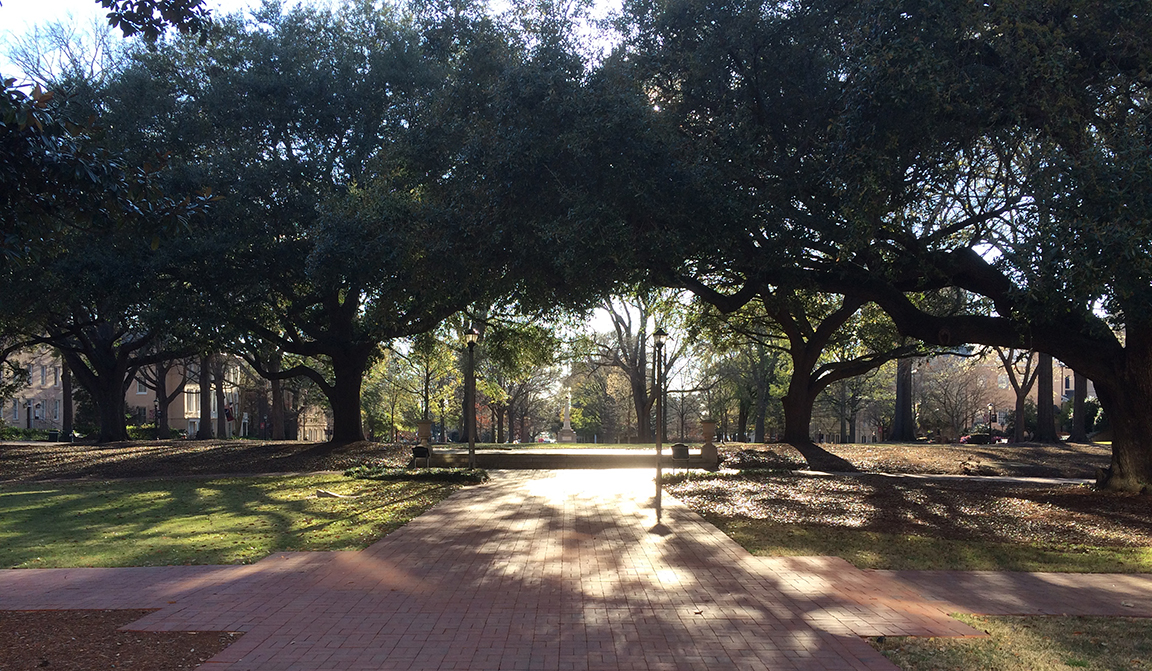
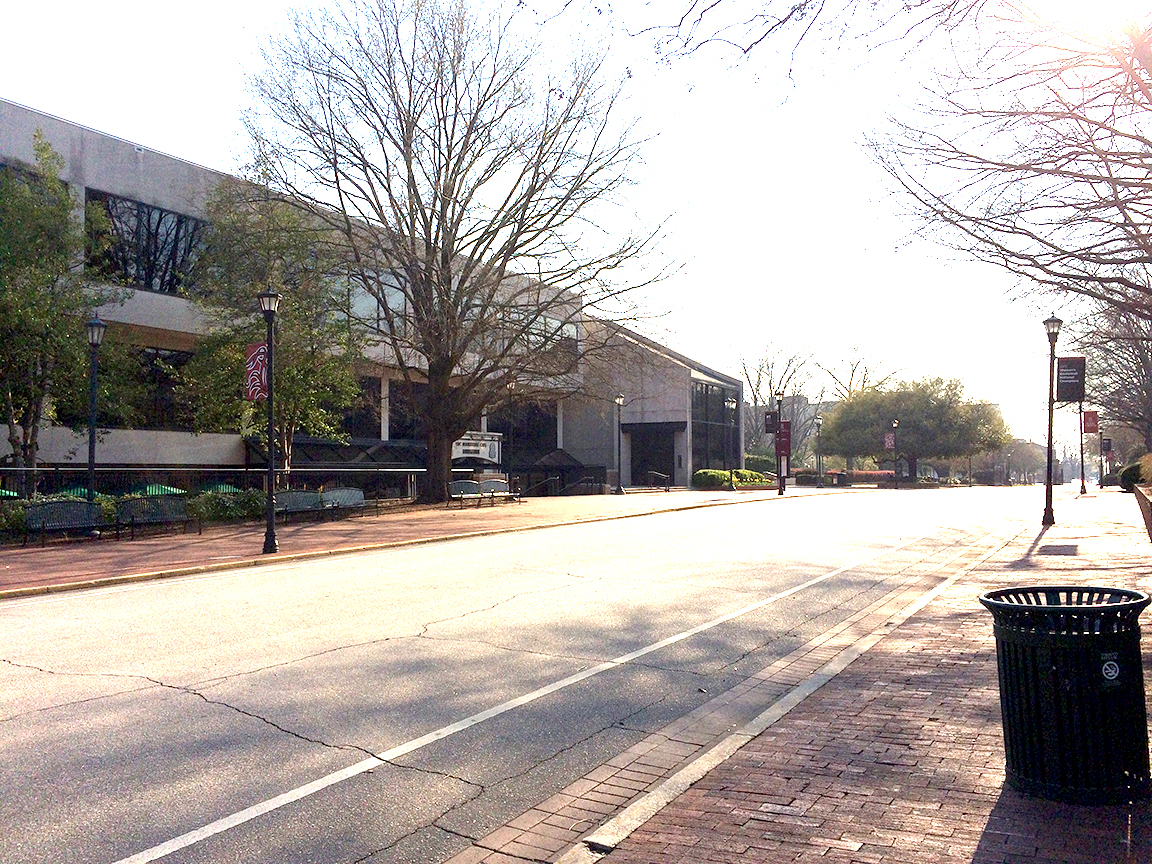
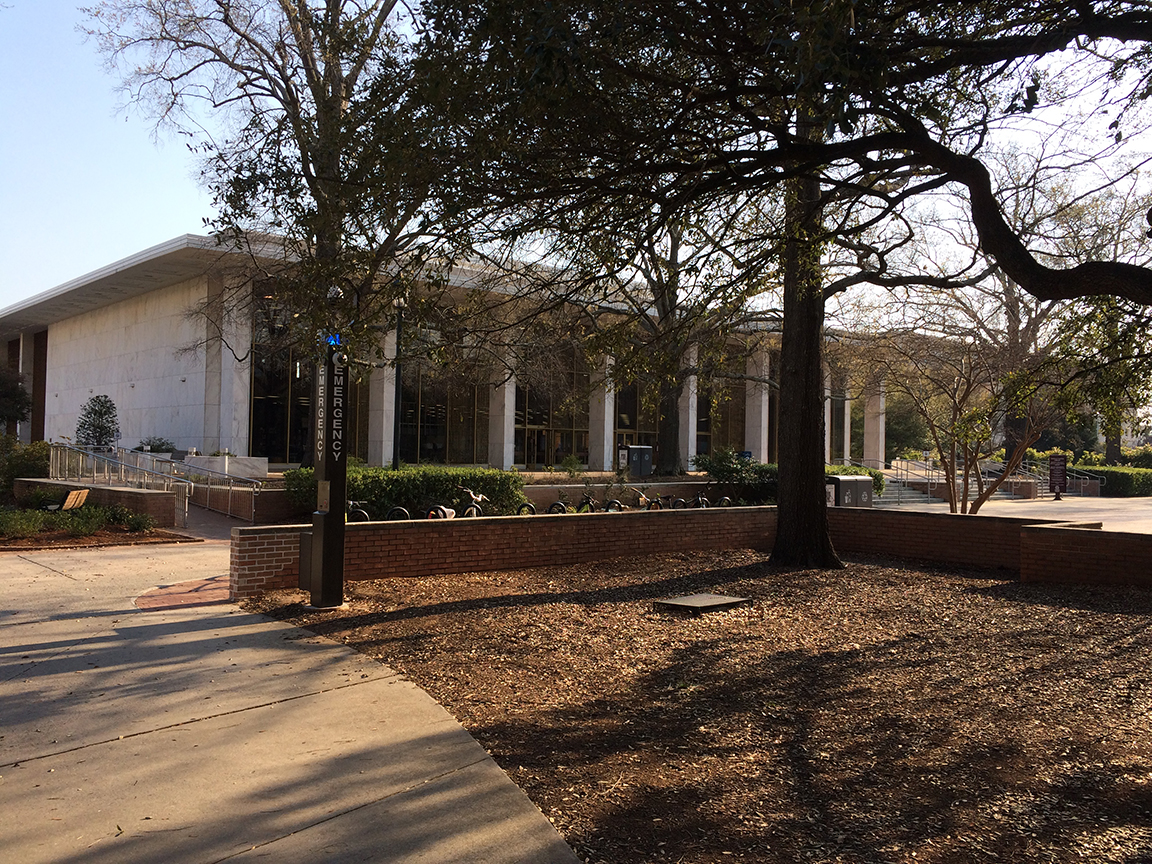
Some views of the Moore School that is to be

This is a story from the “drive-by” beat that I always wanted The State to create, but it never did. The idea would have been to satisfy people’s curiosity about things they drive by every day and wonder about. Today, we answer the question of, “What’s that thing coming out of that hole in the ground next to the Carolina Coliseum?”

That was the subject of Hildy Teegen’s talk today to the Columbia Rotary Club. (Disclosure, to the extent that it means anything: I invited Hildy to speak to the club, and introduced her.)

Speaking to Rotary. That's Club President J.T. Gandolfo in the foreground.

It’s the new Moore School of Business, of which Dr. Teegen is the dean. It’s intended, among other things, as the gateway to the Innovista, and should go a long way toward helping people understand that Innovista is NOT those two buildings everybody keeps obsessing over, but will constitute a transformation for that whole underdeveloped urban expanse from this location down to the river.

Innovista is conceived around the “live, work, play” concept, and the new Moore school has been designed to complement that. The key word Hildy keeps using to describe it is “permeable.” That goes from the literal sense of the rooftop garden, to the fact that it will be open to the whole community 24/7. In fact, she pointed out, it is architecturally impossible to close off the building.

One of the goals is for the building to achieve “net-zero” status, meaning its energy and carbon impact on the surrounding community will be nonexistent.

The building, which is to be completed in December 2013, will house the nation’s No. 1 international business master’s program and all of the school’s other business education programs — such as the night school that has just entered the top 25 in the U.S — except, of course the multiple distance-learning opportunities the school offers across SC and in Charlotte.

You can see the entire PowerPoint presentation here. And here are some pictures:

Great to see my old friend Michael Mercer!

An old friend sent me the above video. When I got home last night, I asked my wife to watch it without telling her why. She looked at it only a second before saying “Michael!”

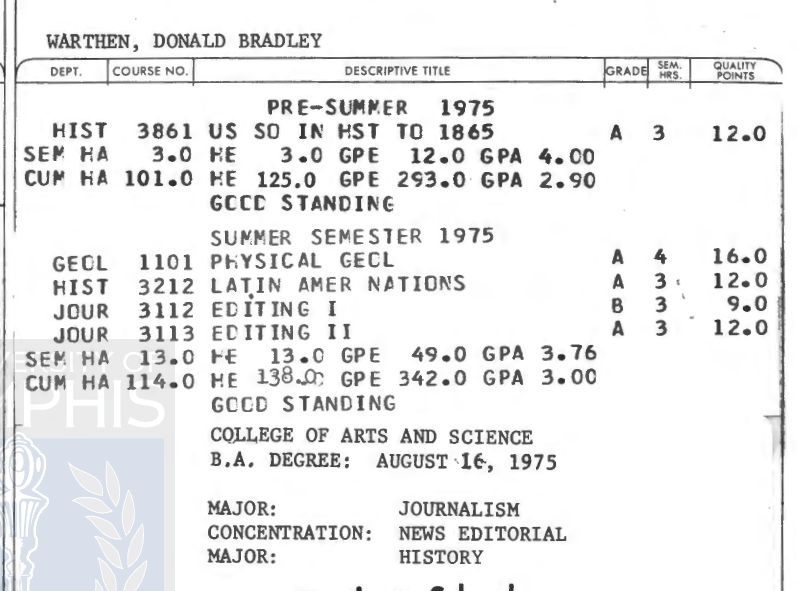
Yep. The guy playing the “English teacher” at the beginning is Michael Mercer. Michael and I started out as copy editors together at The Jackson (TN) Sun in 1975, soon after I graduated from Memphis State. Michael got out of the business long before I did, taking a teaching gig at Auburn. Now he’s at another college in San Antonio, as he explained when I asked about the video:

The young lady featured in the film is one of my student-advisees at the University of the Incarnate Word in San Antonio. She’s a communication arts major concentrating in journalism — although broadcast like most of them do today. She asked me at the last minute to be in the video that she and the filmmaker — her boyfriend from another school in San Antonio — were doing for a video contest promoting San Antonio park recreation.

They didn’t win the contest but I thought they, too, did an excellent job. I was only familiar with the classroom scene where they asked me to  mouth a few words as an “English teacher.” Those other students in the video in the classroom are UIW students but not any of mine. We spent about an hour shooting various takes, angles, short bites. I was told it would only take about five minutes. Then a week later, my student asked me to wear the same shirt and pants for a scene they wanted to shoot minus the class in that same classroom showing me walking out the door after that “chill” comment.

No, most of my South Carolina readers won’t know Michael, but some of our former colleagues will see this, which is why I share it here. The fact that I can do so so easily — the fact that a student could even produce something like this — is testament to how the world has changed since Michael and I started out.

In those days, the copy desk was still a big horseshoe (or “elephant’s commode,” as one of my Tennessee colleagues referred to it), with the slot man (or woman) sitting in the center, distributing copy to those on the rim who would edit it and write headlines as assigned by the slot. The copy and headlines would then be passed back to the slot for checking before being sent to the composing room. Except that the editing wasn’t done on paper at this point. The text had been scanned and output onto a paper punchtape, which was clipped to the hard copy with a clothespin (without clothespins, we couldn’t have gotten the paper out). After an editor received the copy with attached tape from the slot, he or she would take it over to a Harris 1100 editing machine, and feed the punch tape into it. The copy would appear on a CRT screen, and the editor would use a keyboard to edit it. When done, the edited text would be output to another punch tape of a different color, which the editor would roll up the tape (using a little electrical device that was sort of like one of those handheld, flashlight-sized fans) and clip it back to the copy. That bundle is what the editor would pass back to the slot, along with a headline written in pencil on a hand-torn strip of paper.

A couple of months after I joined The Sun, I was pulling shifts in the slot, and I found I liked it so much that by the time I moved on from the desk, I was doing it most days. The job entailed what would have been three to five jobs at a paper the size of The State in those days. The slot not only supervised the editing process, but laid out the entire A section, monitored the wires and selected all wire copy, and oversaw the production process in the composing room. If a page was late, it was the slot’s fault. And in those days, things were so loose and informal at The Sun that an assertive slot (which, I confess, I was) could pretty much decide how all of the news in the paper was played, including local copy.

The day started at 5:30 a.m., and the whole first edition (which was more pages than you find today in The State) had to be out at 11. Then we’d grab a quick lunch before having the city edition out by 1:30.

Doing that job at the age of 22 gave me a lot of confidence that stood me in good stead in the years to come. And it gave me a taste for calling the shots. Which is why after that gig, I only spent a couple of years as a reporter before becoming a supervising editor. You can learn a lot by starting out in a small pond.

Michael followed a similar path, without being quite as power-mad as I was (you can probably tell in his brief appearance that Michael is a nicer guy than I am — which I’m betting is why he was cast in this film; I’m sure he’s the sort of teacher who might be students’ favorite). He was one of my assistant editors over the news reporters at The Sun in later years.

And now there he is, playing the “English teacher.”

Interesting speaker this week..

Carl Evans over at USC brings this to my attention:

Friends,

Sheryl WuDunn, the first Asian-Amerian reporter to win a Pulitzer Prize, will be speaking in Gambrell Hall this Wednesday, April 11, at 6:00 p.m.  If you care about social justice and especially about issues facing women around the globe you will be interested in WuDunn’s talk.

WuDunn is the author of Half the Sky: Turning Oppression into Opportunity for Women Worldwide, co-written with her husband Nicholas Kristoff, a New York Times op-ed writer.

There is also a related colloquium at Columbia College this evening, April 9, from 6-7 p.m.  Please read the attachment for additional details about both the lecture and the colloquium.

Regards,

Carl

Personally, I’m not familiar with her work, but I’m a great admirer of her husband’s, and I sense that she’s been a strong influence on him.

Because of his work, I would not expect this lecture to be a string of feminist cliches. I expect that her critique is reality-based, like Kristof’s, based on what she’s actually seen in the world.

That’s one of the things I really appreciate about Kristof. He’s the kind of liberal who routinely flies in the face of the left’s (and anyone else’s) orthodoxy, based on his first-hand knowledge of real conditions. For instance, he’s the guy who persuaded me of how indefensible the Democratic position was on the Colombia Free Trade agreement several years back.

As for the plight of women, there’s little room for argument over the outrages he exposes in the parts of the world where “war on women” wouldn’t actually be true and not absurd hyperbole. I wouldn’t be surprised if his wife has a similarly compelling message. Perhaps even more so.

Talking blogs, reaching no particular conclusions

The seminar from the panelists' point of view.

Late yesterday, I was one of three bloggers — the others being Will Folks and Logan Smith — who spoke to a seminar journalism class taught by Charles Bierbauer at USC.

It went fine, although I can’t tell you with any certainty that the students learned anything useful. They didn’t learn, for instance, how blogging will lead to a business model that will pay for real journalism in the future, because none of us know the answer to that. It’s sort of the Northwest Passage of our day — people keep looking for it, generally in the wrong places.

The unanswerable question is, and has been for some time: How, going forward, are media that report news and share commentary going to pay the bills — most particularly, the salaries and expenses of those who do the reporting, writing, editing and presentation of the content? Mind you, I’m talking about doing so on the state and local levels. One can still make money reporting national and international news and commenting on it, which is why we are inundated to the point of suffocation with news and opinions about Barack Obama and Mitt Romney. But it’s almost impossible for the average voter to be fully informed about state and local government or issues, and increasingly, too few even try. Which does not bode well for the health of our federalist system.

Will blogs be part of the solution to creating an informed electorate on levels below the national? I don’t know. As I joked to one of the students who asked something related to that, obviously The State didn’t think so, because I was the only active blogger at the paper, and they canned me. (Lest the students get the impression that I’m portraying my former employers as Luddites, I quickly added the truth, which is that I was canned for making too much money.)

Among the three of us, Will has made the most progress on the making-it-a-business front. He repeated what Nancy Mace told me months ago, which is that his blog brings in “several thousand” a month. I, so far, am more in the several thousand a year category. Logan is just starting out.

That points to the wide difference between the three of us. Back when I was a newspaperman, you could assemble a panel consisting of me and editors from other papers, and we would have a lot in common. A general-circulation newspaper was a definite thing, and working at one implied certain things that were predictable. Assemble a panel of bloggers, and you’ve got a group of people who are doing entirely different things, and for different reasons. It’s as though you had put together a panel consisting of one newspaper city editor, a photo editor from a magazine, and a newsletter writer.

For instance, among the three of us:

  • Logan started the Palmetto Public Record because he thought the “progressive” outlook was sort of thin on the ground in the SC blogosphere, and he probably has a point, with Tim Kelly and Laurin Manning currently out of the game. He’s trying to build it up from nothing, and learning as he goes.
  • Will started his blog by accident. He wanted to leave a comment on another blog that was criticizing him (he now says that the criticism was justified), and he clicked on the wrong things, and got a page inviting him to start his own blog. Which he did, and used it to push his Sanfordesque political views. But he tried to do more than that, becoming a news source, and breaking stories whenever he could (which, if you ask me, is why he has more traffic than I do — I reject the idea that it’s because of the cheesecake pictures). He devotes himself totally to the editorial content — which you have to do to post as often as he does. His wife handles the money, and Nancy Mace handles the technical side.
  • The roots of my blogging are in the 1980s, when I was governmental affairs editor of The State. I had about 10 reporters working for me in those days, and I was always frustrated by something: Reporters would come into the newsroom and share some interesting incident or exchange with sources that didn’t really rise to the point of being news, and wouldn’t fit logically into the news stories they were writing that day (even then, the finite nature of available space was highly restrictive), but which added color and life and context to my perception of what was happening out there in state government. I wanted readers to have that same benefit, so I started a column made up of such tidbits, which ran on Sunday and was called “Earsay.” (Something roughly like that still exists in the paper, I think.) Later, when I was editorial page editor, I was likewise frustrated by the fact that I had SO many things I wanted to say about the day’s news that I had no room for on the editorial pages. So I started the blog for all that other stuff — things I felt motivated to say beyond what got into print, things that interested me and might interest someone else, but probably not the vast majority of newspaper readers. That’s still what my blog is. I don’t even pretend or try to “report the news.” Having once commanded platoons of reporters, I know how impossible it would be to presume to do that well alone, even if I didn’t have a day job. So it remains a medium consisting of stuff I want to comment on, period. And I still never manage to get to all of that.

A couple of other quick points…

One of the students wanted to know when blogs would command the respect that mainstream media still do. He said he covers prep sports for The State, and when he arrives at an event and tells people that, he gets respect and cooperation that he wouldn’t get otherwise. I told him he had a long wait on that; the blogosphere is still the Wild West and will take some time to settle down and be respectable.

A corollary to that… Logan complained that he can’t get credentials to get onto the Senate or House floor over at the State House. When someone noticed me shaking my head I elaborated… I told Logan it doesn’t matter. Nothing much happens in the chambers anyway. Debate is dead in this country; the days of Daniel Webster and Henry Clay are long gone. To know what really happened on a key vote, you’ll have to talk to people outside afterward anyway. And all the members have cell phones if you want to ask them to come out for a chat.

I’ll close with this postscript that I enjoyed, posted by Logan Smith on Twitter:

Highlight of tonight’s Q&A: @BradWarthen talking about being a reporter in 1980, @FITSNews turns to me and asks “were you born then?” (No)

The funny part is that 1980 was when I stopped being a reporter. I was an editor from then on…

Bold new step for IT-ology, Innovista

This just came in a few minutes ago:

It’s a sign of progress. Friday, the Tower at 1301 Gervais — a landmark in the Columbia skyline — becomes IT-oLogy @ Innovista.

The installation of the IT-oLogy @ Innovista signage exemplifies the already successful partnership between IT-oLogy and Innovista to foster the development, growth and relocation of information technology (IT) companies, small and large.

“This marks the fruition of one of our original visions: a district with the strategic clustering of IT companies in one locality,” said Don Herriott, Director of Innovista Partnerships. “More companies are seeing the advantages of co-location, and IT-oLogy @ Innovista now houses 9 IT companies, and counting.”

SignIT-oLogy’s mission is to promote, teach and grow the IT talent pipeline and profession. With Innovista’s mission of creating, attracting and growing knowledge-based companies in the Midlands of South Carolina, the two constitute a perfect partnership for recruiting to the new IT-oLogy @ Innovista building.  Clustering IT companies in a single location, such as the Tower at 1301 Gervais St., can open the door for new opportunities for partnership and business development, stimulate new ideas and industry innovation and help in the recruitment of new companies to the region.

“Our goal is to bring the IT community together in a collaborative environment to develop the IT pipeline through programs at all levels,” said Lonnie Emard, executive director of IT-oLogy. “The partnership with Innovista is a perfect example of this collaborative effort because we are bringing together people and companies that are dedicated to both of our missions.”

The establishment of an IT district is not about a sign at the top of the Tower at 1301 Gervais St. While that is a visible representation of the partnership, the real story is what happens both inside and outside of the building. The uniqueness of IT-oLogy is that it is not a single company or entity; instead, it is a non-profit collaboration of companies, academic institutions and organizations uniting to address the nationwide shortage of skilled IT professionals. To address this challenge, IT-oLogy offers K-12 programs where students explore numerous IT career options, internships for undergraduate students and continuing education opportunities that keep professionals constantly learning and up-to-date. When all this happens, the result is a vibrant economic picture, which is the goal of Innovista.

The confluence of opportunities in IT-oLogy @ Innovista will provide a home in the community for local talent as well. “At the University of South Carolina, our responsibility to students and alumni extends beyond education. It includes a commitment to helping them find jobs, good jobs, when they graduate,” said Dr. Harris Pastides, president of the University of South Carolina. “The pairing of IT-oLogy and Innovista is perfect because of their complementary missions, each focused on growing our innovation economy in this region and across South Carolina.”

“From the outset, the vision of IT-oLogy has been to have business and academic partners collaborate to advance IT talent,” Emard said. “The lack of IT talent is a national epidemic that is solved in a local manner. The establishment of IT-oLogy @ Innovista is a visible representation of bringing companies together to collaborate and partner, fostering new ideas and technologies.”

Recently, IT-oLogy announced the establishment of the branch IT-oLogy @ University Center of Greenville, located in Greenville, S.C. This is yet another way IT-oLogy is working locally to address a national issue. In the future, IT-oLogy will continue to open branches across the nation as a way to advance IT talent in a grassroots manner.

Innovista is a strategic economic development effort that is connecting USC and university-spawned innovations with entrepreneurs, businesses and stakeholders. Its purpose is to help attract and create technology-intensive, knowledge-based companies, which result in higher-paying jobs and raise the standard of living in South Carolina.

For more information about Innovista, visit www.innovista.sc.edu

This is interesting on a number of levels.

Several months ago, I heard a rumor that Innovista’s headquarters were going to move from the USC campus to this building, in part to emphasize the point (emphasized by Don Herriott) that Innovista is about the whole community, not just those blocks in the area described by Assembly and the river, Gervais and the baseball stadium (and certainly far, far more than those couple of buildings people keep going on about).

Then I heard that wasn’t right. Maybe this idea is what started the rumor I’d heard.

Anyway, this is interesting, and I’m not sure what all the ramifications are yet…

The infrastructure of a healthy society

Well, I’m back. I had some sort of crud yesterday that made me leave the office about this time yesterday– upset stomach, weakness, achiness. It lasted until late last night. When I got up this morning, I was better, but puny. So I went back to bed, and made it to the office just after noon. Much better now.

Anyway, instead of reading newspapers over breakfast at the Capital City Club the way I usually do, I read a few more pages in my current book, 1493: Uncovering the New World Columbus Created, by Charles C. Mann. Remember how I was all in a sweat to read it several months ago after reading an excerpt in The Wall Street Journal? Well, having read the prequel, 1491, I’m finally well into this one.

And I’m reading about how settlement by Europeans in many parts of the New World established “extraction societies.” At least, I think that was the term. (It’s one I’ve seen elsewhere, related to “extraction economy” and, less closely, to “plunder economy.” The book is at home, and Google Books won’t let me see the parts of the book where the term was used. But the point was this: Settlements were established that existed only to extract some commodity from a country — say, sugar in French Guiana. Only a few Europeans dwelt there, driving African slaves in appalling conditions. Profits went to France, and the institutions and infrastructure were never developed, or given a chance to develop.

Neither a strong, growing economy with opportunities for all individuals, nor its attendant phenomenon democracy, can thrive in such a place. (Which is related to something Tom Friedman often writes about, having to do with why the Israelis were lucky that their piece of the Mideast is the only one without oil.)

Here are some excerpts I was able to find on Google Books, to give the general thrust of what I’m talking about:

There are degrees of extraction societies, it would seem. South Carolina developed as such a society, but in modified form. There were more slaves than free whites, and only a small number even of the whites could prosper in the economy. But those few established institutions and infrastructure that allowed something better than the Guianas to develop. Still, while we started ahead of the worst extraction societies, and have made great strides since, our state continues to lag by having started so far back in comparison to other states.

It is also inhibited by a lingering attitude among whites of all economic classes, who do not want any of what wealth exists to be used on the kind of infrastructure that would enable people on the bottom rungs to better themselves. This comes up in the debate over properly funding public transit in the economic community of Columbia.

Because public transit doesn’t pay for itself directly, any more than roads do, there is a political reluctance to invest in it, which holds back people on the lower rungs who would like to better themselves — by getting to work as an orderly at a hospital, or to classes at Midlands Tech.

It’s a difficult thing to overcome. Other parts of the country, well out of the malarial zones (you have to read Mann to understand my reference here), have no trouble ponying up for such things. But here, there’s an insistent weight constantly pulling us down into the muck of our past…

Ayn Rand disciple teaching Citadel cadets

This video, brought to my attention by Nancy Mace Jackson on Twitter, is interesting on a couple of levels. First, it’s apparently a course on conservative theory taught by Mallory Factor, who’s been in the news again recently.

Second, the guest speaker appearing before the class is Yaron Brook, director of the Ayn Rand Institute. Interesting guy. He’s introduced as having served in Israeli Intelligence. He has an accent I can’t quite place — he sounds vaguely like former USC President John Palms.

The ideas he’s talking about could hardly be more timely than now, when various strains of libertarianism, from Ron Paul to the Tea Party, are striving to seize control of the Republican Party.

What I was doing all weekend

Gerrita Postlewait, Fred Washington, John Simpkins and Terry Peterson discuss "Education, Poverty and Equity on the Ground in South Carolina" with moderator Mark Quinn.

Y’all probably think I haven’t blogged in days. I have; it was just microblogging. One of these days I’m going to get social media totally integrated into this blog so y’all can immediately see my posts on Twitter, because when I’m away from my laptop, that’s where I’m sharing observations.

From Friday through Sunday, I was at the Riley Institute’s Diversity Leaders Initiative graduate weekend in Hilton Head. When I arrived, Cindy Youssef of the Riley Institute asked me to Tweet as much as possible, and to use the hashtag #onesc.

It’s dangerous to tell one of the Twitterati to Tweet as much as possible. There were others putting the word out there, but I was probably the most manic, as you can see by looking at the hashtag results. There was a respite of a couple of hours when I took my iPhone up to my room to recharge it, but other than that I didn’t slow down much.

Here you see most of my Tweets from the weekend. I left out some asides that had nothing to do with what was going on, but also left a couple of those in, for flavor.

For a complete roster of who was there, you can look here.

Most of the Tweets were when people said something I agreed with, although not all (as I’ve explained before, I favor single-payer NOT because people have a “right” to health care, but because it’s a more rational system for society overall than what we have now; but I thought it very interesting that Ed Seller thinks it’s a fundamental right).

When someone else’s Tweet is quoted, I use that person’s handle in front of it, and then insert my own as it goes back to my voice. I hope that makes this easier to follow.

Anyway, enough explanation. Here you go:

Brad Warthen ‏ @BradWarthen

Listening to Marlena Smalls singing to Riley Institute Diversity Leadership graduates in Hilton Head… He’s Got the Whole World…#OneSC

I was listening to Ken May talk about folk art traditions in SC when the coffee started to kick in… #OneSC

Just had an enjoyable political chat with Alston DeVenny, husband of Susan & law partners with the uncle of @fitsnews in Lancaster.#OneSC

Will Folks aka Sic ‏ @fitsnews

@BradWarthen ha! my uncle Robert is a good dude …

Brad Warthen ‏ @BradWarthen

Don Gordon talking about the need to transform the two South Carolinas into One… #OneSC pic.twitter.com/PQNaC7Qc

Harvey Peeler ‏ @harveypeeler

What is it about Starbucks that makes people want to tell you they are there and does the Drive-thru count ?

Brad Warthen ‏ @BradWarthen

@harveypeeler @Starbucks is awesome, they have time to kill, they’re caffeinated, and no, it doesn’t count.

In reply to Harvey Peeler

Harvey Peeler ‏ @harveypeeler

I think I can remove my “Tweeter training wheels ” when @BradWarthen pays attention to what I Tweet.

Brad Warthen ‏ @BradWarthen

“Medicine is a social science, and politics is nothing else but medicine on a large scale.” Rudolph Virchow, quoted by Ray Greenberg.#OneSC

MUSC’s Greenberg: Problem of people not getting needed meds because of cost is getting WORSE… #OneSC

MUSC’s Ray Greenberg: People with higher levels of educational attainment spend more on alcohol… #OneSC

Greenberg: Stats indicate I-95 corridor is SC’s stroke belt… #OneSC

Greenberg: In many rural counties in SC, there’s not a single OB/gyn. “Deserts” of care… #OneSC

Greenberg: SC is No. 1 in people living in mobile homes. Whoo-hoo! One-fifth of us! #OneSC

Greenberg: Health disparities are NOT the result of bad habits of the poor. #OneSC

Forrest L. Alton ‏ @YoungGunCEO

Sitting at table by @BradWarthen, master tweeter… I can’t keep up, guy is good!! #OneSC #watchandlearn

Brad Warthen ‏ @BradWarthen

Ed Sellers: In SC, income does not rise with age, but health cost rise dramatically, for blacks and whites. #OneSC

Ed Sellers, formerly of Blue Cross Blue Shield: Access to health care is a fundamental right… #OneSC

That parenthetical interjection on the last Tweet was mine, not Ed Sellers’… #OneSC

Literally jumping the shark: “@CBSNews: Video: Reporter swims with sharks – without a cage (via @CBSThisMorningbit.ly/wAhfsQ

@wesleydonehue @harveypeeler When it comes to @Starbucks, I take a backseat to no man!

Heads up, folks: “@AnitaGarrett: Ed Sellers: “There are 55% more whites than black that will be on Medicaid.” #OneSC

Carolyn Wong Simpkins: In US, we have best & worst health care.#OneSC

Ed Sellers: $24 billion spent on health care in SC annually. It goes up a billion a year… #OneSC

Ed Sellers: Other countries control health care costs by controlling growth of capacity, which (irrationally) is anathema to U.S. #OneSC

Simpkins: We are SO concerned to make sure no one undeserving gets care, we overcomplicate the system… #OneSC

Wanda Gonsalves highlights the crying need for primary care physicians, a “dying breed.” #OneSC

Watching a film that exhorts us to respect barbecue. But I don’t have to be persuaded… #OneSC

The takeaway: Don’t trust a barbecue pitmaster who doesn’t choose and cut his own wood… #OneSC

Huge applause for Pitmaster Rodney Scott of Scott’s BBQ in Hemingway, SC. #OneSC

BBQ Pitmaster Rodney Scott: Hemingway isn’t in the middle of nowhere; “It’s in the middle of everywhere.” #OneSC

Doug Woodward: SC productivity shot up from 90s thru early 00s, leveled off. And our income is FALLING, even when economy is good… #OneSC

Woodward: We must educate more of SC population at a higher level to be ready for 2030, when only 1 out of 6 will be working… #OneSC

Woodward: If we raise educational attainment to national average by 2030, personal income will rise by $68 billion. #OneSC

Jim Hammond ‏ @restlessboomer

#onesc Economist Doug Woodward: If we’d followed the policies Gov. Riley for the past 18 years, we wouldn’t have this (increase in poverty)

Brad Warthen ‏ @BradWarthen

Woodward: Key to prosperity — attracting and keeping the creative class… #OneSC

Steve Morrison quoting someone on poor towns in SC: We built Interstates so we wouldn’t have to look at them… #OneSC

Steve Morrison: If you want a safer and more secure South Carolina, teach a young man to read. #OneSC

Steve Morrison: We must get the greatest teachers to the students with the greatest need… #OneSC

Morrison: Recent trend in education in SC — cutting funding, while passing unfunded mandates to the districts… #OneSC

Morrison: Can we agree that teachers matter the most? #OneSC

Morrison: Take that tax base along the coast, and share it with the poor districts… #OneSC

Morrison: It’s great to have good private schools, but public education MATTERS… #OneSC

Morrison: The child gets off the bus at 5 years old with bright eyes. He’s not defeated. Yet. #OneSC

John Simpkins: The opposite of love isn’t hate; it’s indifference. (“My kids are fine; yours aren’t my concern.”) #OneSC

To paraphrase Terry Peterson, we need not just a love of justice, but a hard-minded understanding of what economic dev. requires. ##OneSC

What this conference keeps wrestling with is what to do about the total triumph of “I, me, mine” in SC politics. #OneSC

Ex-Gov. John Baldacci of Maine says Riley Institute is “kind of like a focus group for the state of SC.” #OneSC

Baldacci says on his first visit to SC, “I was really blown away” by downtown Greenville. (Something for Columbia to aspire to.) #OneSC

Baldacci: “The very basic foundation of our democracy is education.”#OneSC

Baldacci: As dysfunctional as our politics may be, what we have is better than what most people have had throughout history. #OneSC

Baldacci describes the surreal experience of being in Congress on 9/11/01… #OneSC

Baldacci: You can go anywhere in the world, but you can’t become Chinese; you CAN come here from China & become an American.#OneSC

Baldacci: “You’ve gotta be yourself; you’ve gotta tell the truth and you’ve gotta work hard.” (Father’s advice.) #OneSC

Baldacci: “We all have to get over it, folks… We have to realize that we have a greatness here if we work together…” #OneSC

Baldacci exhorts us to treat people as Dick Riley always has… with dignity and respect. Amen to that; we could have no better model.#OneSC

Others call Dick Riley “secretary.” I call him “Governor.” For SC, that means the most (to me, anyway). #OneSC

Apparently, I'm even Tweeting while talking at the barbecue with Clare of the Clare Morris Agency and Susan DeVenny of First Steps.

Harris Pastides takes the Twitter plunge

I was very interested to see Harris Pastides take the plunge into Twitter today. His first Tweet? Here:

Can’t wait for the baseball journey that begins tomorrow. Tweet the Three-peat!

And I think most of us would be happy to reTweet that. I did.

This is interesting to me because it was in a meeting with Harris that I first became a convert to Twitter. It was back when I was doing a 90-day consulting gig with the university right after I left the paper (right after I got canned, for those of you just joining us). At the time, there was a lot of discussion about how the university in general, and the president’s office in particular, needed to communicate in a social media age.

Lee Bussell from Chernoff Newman, a competitor of ADCO (you are all free to boo and hiss at this point if you feel the urge), brought in some of his people to give the president and some of the university’s communications folks a briefing on Twitter, Facebook, blogs and the like. (It should be noted that various departments in the university were already making use of such media, although there was no overall plan to it.)

For my part, I nodded sagely during the blog parts, being a four-year veteran who had just retired one blog and started this one. But I became impatient during the Twitter and Facebook bits. They seemed pointless and frivolous to me. Why fool with 140 characters when you can get into a subject as deeply as you want (with none of the finite restrictions of print) on a blog?

After the meeting, I said as much to Tim Kelly (“Crack the Bell,” “Indigo Journal”), whom I had just met for the first time, even though we had interacted in the blogosphere for years. He told me I should give those silly-sounding media a try. Why?, I asked. Because you can use them to promote your blog, he said — just post your headline and a link, and it will grow your readership.

So I tried it, and promptly got hooked. It’s like… well, you know how they say video poker is the most addictive form of gambling (particularly for women, for some reason), because of something the flashing images and quick rewards do to your brain? Well, Twitter is the crack cocaine of written communication, and probably for similar reasons. You can follow the very first stages of this conditionstarting back here.

That’s the bad news. The good news (aside from the fact that I am revered as one of the Twitterati) is that the readership of my blog  now is about five times what it was at the newspaper. Did I mention that I set a new record in January, with 272,417 page views? (And as long as we’re talking numbers, I’m up to 1,643 followers.)

Here’s hoping my friend Harris doesn’t develop a serious addiction problem. I doubt that he will. After all, he managed to hold out three years longer than I did in starting. Besides, he’s a very sober, solid, serious academic type — very grounded, and even less given to faddish enthusiasms than I.

But it will bear watching…

“Eisenhower of our generation” visits Columbia

Some guy who needs a haircut, the general in mufti, and our senior senator./photo by Christy Cox

Gen. David Petraeus, now of the CIA, spoke today in Columbia, at the Riley Institute’s David Wilkins Awards for Excellence in Legislative and Civic Leadership luncheon.

Rep. James Smith and former Blue Cross CEO Ed Sellers were the recipients. It was James (a.k.a. Capt. Smith) who, in his acceptance speech, called Petraeus “the Eisenhower of our generation.” I concur. There’s no general officer in recent years who combines Ike’s strategic vision, diplomatic skill and leadership qualities to the extent that Gen. Petraeus does.

For his part, Petraeus praised not only James and Ed, but the troops he has felt privileged to lead before joining Central Intelligence. He called them “our new greatest generation.”

Those who serve certainly deserve that sobriquet. The difference is that they are only a tiny sliver of an actual generation, unlike the one that overcame the Depression and beat Hitler and Tojo.

Which only underlines how much the rest of us owe to them, each of them, from the commanding general to the lowliest buck private.

Huck and Newt speak locally, think globally

Gingrich arrives, with that Newtish look in his eye.

Newt Gingrich had the limelight to himself today at a gathering at the Columbia Hilton devoted to foreign policy.

Well, almost to himself — the featured speaker was actually Mike Huckabee, whom former ambassador to Canada David Wilkins introduced as “an alum of our primary.” But Newt was given a slot to speak as well.  The occasion was a U.S. Global Leadership Coalition luncheon, and the crowd was a mix of academic and business types — it was co-sponsored by USC, the Columbia World Affairs Council, and the Greater Columbia Chamber of Commerce. The Columbia Chamber’s Ike McLeese had some smart words to say at the outset about how “foolish” isolationism is in today’s world, and Huckabee later used the same word. I guess that’s why Ron Paul wasn’t there.

Between Huck and Newt, I preferred the comments by Huckabee, but then I’ve always sort of liked Huck. Basically, he was channeling John Donne. He didn’t actually say the words, “No man is an island,” or that if a bell tolls anywhere in the world, it tolls for us, but it amounted to the same thing.

He said that Americans — particularly those who consider themselves Christian — can’t sit by and let people in other parts of the world starve or be oppressed. And not just on moral grounds. Basically, he suggested that the world is so intertwined — and this is where the Donne stuff comes in — that our own interests and fates cannot be extricated from those of people in other parts of the world. At the very least, he said, a country we help feed tonight just might be one that we need to fly some planes over, in defense of our strategic interests, on a later date.

Huckabee graciously announced at the beginning of his remarks that whenever Gingrich showed up, he’d shut up and cede the floor. As it happened, he finished before Newt swept in.

Newt had some good stuff to say, too. He’s a smart guy — just ask him; he’ll tell you. But he was also…  more bombastic, more jingoistic, as is his wont. Which can get off-putting.

Like when he condescendingly complained about the better, higher societies — you know, Northern European ones — being dragged down by the obviously inferior ones. He didn’t think it right for America to be “trying to prop up the Germans so that they can prop up the Greeks.” Who, you know, are so worthless… “This is the country the Germans want to learn to be Germanic?” Why, he asked, should the Greeks want to be German. Their choice, as he explained it, is to sit on a beach drinking ouzo, or be miserable applying themselves like the Germans.

Then there was this: “No American president should bow ever again to a Saudi king.” He was making a good point — that we need to achieve energy independence. But there was just that unsettling tinge of complaining about having to be accommodating to the wogs.

I agree with him when he says he doesn’t want his grandchildren living in a world dominated by China, an oppressive regime. I agree that the world is, indeed, better off with the dominant country being the world’s biggest liberal democracy. But I could do without the attitude, such as when he said he would hire the most aggressive trial lawyer he could find to be trade representative to China, and he’d want that rep to get up every morning thinking about how he could maximize the other side’s discomfiture.

And with Newt, it’s not what he says (for me; I’m sure that for some of my liberal correspondents, it is what he says), but the way he says it. The president needs to be cooler than that.

Mike Huckabee addresses the U.S. Global Leadership Coalition gathering.

Yo, Lee: David Yepsen says “Hey”

Above you see David Yepsen and me, looking relieved and happy that we’re done with our panel presentation at the Senate Presidents’ Forum in Key West over the weekend, and that it went well. Funny how those kinds of things — just talking — can take a lot out of you.

It was an honor to meet David, the legend of Iowa political journalism. And of course when we met, he asked after another legend of political journalism, a man whom everyone knows — and, more remarkably, everyone likes and respects — my longtime friend and colleague Lee Bandy.

I’m lucky to have worked with both Lee and the Tennessee legend, John Parish. And while it was brief, I was honored to share the panel with David Yepsen, who is now director of the Paul Simon Public Policy Institute (he left The Des Moines Register about the same time I left The State), Saturday. And to get to know a couple of political pros I had not met before, who also served on the panel: First, John Marttila, longtime friend and ally of Joe Biden ever since he was elected to the U.S. Senate in 1972. John continues to be a senior political adviser to the vice president. From the Republican side, we had Mike DuHaime, who ran Chris Christie’s successful run for governor of New Jersey in 2009.

We had a great discussion, both during the panel and at meals and events before and after.

What did I say during the presentation? Well, not anything I haven’t shared here. I essentially scrapped my prepared remarks, as mentioned previously — which is probably a good thing, because things flow better when I’m winging it. But preparing — not only the writing, but all the conversations I had with top Republicans in SC, right up to a couple of minutes before the program — did help me get my thoughts in order. Hey, if I hadn’t made all those panicked calls Friday night and Saturday morning after seeing those poll numbers, I wouldn’t have known to call Romney a “Plastic Banana Rock ‘n’ Roller,” which still cracks me up — the idea of Romney as ANY kind of rock ‘n’ roller, actually.

Anyway, I’m back from Key West. And it’s going to be a busy week…

Mike DuHaime (or the back of his head, anyway), David Yepsen and John Marttila, during the panel discussion.

It doesn’t have to be THAT graphic for me…

USC just put out this release:

Up in smoke: Research shows graphic images can deter smokers

They say a picture is worth a thousand words, but its worth might just be measurable in terms of lives, according to research by a University of South Carolina public health professor.

That’s because visual imagery on cigarette packages deters smoking, and the more graphic they are, the better the results, said Jim Thrasher, assistant professor in the Arnold School of Public Health Department of Health Promotion, Education and Behavior.

“Tobacco use continues to be the leading cause of preventable death in the United States, and graphic health warnings are among the most cost-effective interventions that exist,” Thrasher said….

Personally, I don’t need graphic images to deter me. One whiff of the stuff is enough to persuade me to stay away from it forever.

If you must show me a “graphic” image, the one above is fine. It was the winner of a contest in California:

The challenge was to create a anti smoking ad powerful enough to turn people off cigarettes without resorting to the gruesome imagery so prevalent in anti-smoking campaigns. With the help of a couple of dancers, an up-for-anything ad agency and hundreds of yards of Lycra, Los Angeles photographer Ricardo Marenco did just that.

“I wanted to evoke a sea of people trapped inside their addiction,” says Marenco, who created the shot for the California Department of Public Health’s billboard and print campaign. To achieve his desired effect, he photographed the dancers individually inside 7-foot-tall Lycra cigarettes. Then he digitally overlaid embers and smoke from real cigarettes on the figures. The ads ran without any words, only a helpline number — the image said it all.

But apparently, you have to be really gross for some people. Below is one of the images that came with the USC release. Why is it in Spanish (“garganta” means “throat”)? I guess because of this part of the release:

As a result of his work with colleagues from Mexico’s National Institute of Public Health, Mexico’s Minister of Health adopted their recommendations for which pictorial warnings to put on cigarette packages, which began circulating in September.

Thrasher, who has a joint research and faculty appointment with Mexico’s National Institute of Public Health, is also assessing what labels are the most convincing for low socioeconomic status groups…

Column III: Kevin Bryant takes destructive approach, offers reader no way out but rage

Talk about your basic destructive nihilism.

Sen. Kevin Bryant offers nothing positive, but simply gives us a Sanfordesque trashing of USC, in his column today in The State.

Go ahead and read it, and tell me where he offers any kind of solution. Show me where he suggests how we might see to it that the university become a better steward of our money. He does not. When he complains that “USC, like much of higher education, sees itself as a sovereign empire,” does he offer a remedy?

No, he does not. He does not, for instance, offer the solution I have offered for 20 years — likely long before Kevin Bryant was thinking about such things — for the fact that our respective universities are, indeed, too autonomous: A state board of regents, answerable to the governor, that would govern the entire system of public higher education.

Or if he has some other idea (which I doubt), he could offer that.

But he doesn’t. Why not? I fear that this is the reason: He’s not sufficiently interested in solutions. What he’s interest in doing, it seems to me, is further eroding the already pathetically feeble public will to support higher education in our state.

As things stand, do you know how much of USC’s operating funds come from state taxes? 9 percent. The state general fund is like the university’s 5th source of funding in order of magnitude. When I was in school, it was closer to 90 percent. So yeah, the university does tend to act rather independently of state government as it seeks to serve our state.

I don’t think it should be that way. I think USC should be clearly a state institution — adequately funded by the state, and held accountable to the state. But I’m not holding my breath, not when our state is run by people like Kevin Bryant.

His column presents no proposals, no arguments, but merely regurgitates what has been reported in news media, only with scornful modifiers added.

His aim, or what I take to be his aim, is best expressed in his trite, hyperbolic conclusion:

The giant sucking sound that you hear is the siphon running from your wallet into the tank at USC. You might want to let your politicians know that enough is enough.

The only point to be gained from this is that he wants us all to be angry. And since he offers no program or solution to address that anger, we can only suppose that said anger is for him an end in itself, as long as you see the university as something that exists purely to waste your money (an impression he creates by ignoring how little of the taxpayers’ money the institution gets), and that you let your lawmakers know that you don’t want them ever spending another dime on that bunch over there.

Never mind that North Carolina has adequately funded its higher education system as an economic development engine (just what the senator despises), leading to the result of having a wealthier and better-educated citizenry. Every word in Sen. Bryant’s column is well designed to make sure that, if there is even a scintilla of desire remaining in the heart of the electorate to invest in public higher system in this state, it gets drowned in the proverbial bathtub.

If he had a different aim, he would offer a solution to the problems he cites. Instead, he urges us to get mad, and be more alienated.

Who’s out there polling about metro issues?

A friend sent me  this last night:

Interesting note: I just got polled about the following issues: view of city-county council, opinions of USC economic development, Harris Pastides, Innovista and funding the bus system.
Also asked about funding a new baseball stadium, riverfront and Zoo improvements.
Even (da-dum) strong mayor!
You might throw that out there (without my name, please) and see who might be paying for such a poll.

So… any of y’all know who’s doing that polling? I mean, I could call around to the usual suspects, but it’s easier to see if y’all know anything first…

Thanks, E.J., for giving us a piece of your mind

Before another day passes, I want to express my appreciation to E.J. Dionne of the Washington Post Writers Group and the Brookings Institution, for delivering the 2011 Cardinal Bernardin lecture at USC last night.

Perhaps because he’s from my world, he spoke to me as no previous speaker has in the 12 years of the series — of faith and public life, particularly in the sense of how the Cardinal’s life and work relate to our existence today. So I thank him for that. I also thank all those who contributed to bringing about this event — the Department of Religious Studies, the College of Mass Communications and Information Studies, President Harris Pastides’ Civil Discourse Initiative, and Samuel Tenenbaum and the Tenenbaum Lectureship Fund.

For those of you who don’t know, Joseph Bernardin was a son of Italian immigrants who grew up here in Columbia, as a parishioner at my church, St. Peter’s. He would become the leading light of the U.S. Conference of Catholic Bishops, the force behind such remarkable documents as “The Challenge of Peace: God’s Promise and Our Response.” He fostered the Church’s Common Ground Initiative, and his greatest legacy (to me) is placing the Church’s pro-life ethic within the compelling — and necessary — framework of the Seamless Garment — a legacy that, inexplicably to me, remains controversial, even anathema, among some. After becoming Archbishop of Chicago, he was widely regarded as a likely first American pope before his death of cancer in 1996 at the age of 68.

E.J. is that rare bird in the higher reaches of journalism who writes regularly of matters that bear upon ultimate questions (see, for instance, “The Vatican meets the Wall Street occupiers” from last week), and does so with an intellectual vigor that not only reflects credit upon his and my faith tradition, but shows what journalism is still capable of achieving at this late date. He knew the cardinal, and has long admired him.

Here’s a rough draft of his remarks. There are typos, and it is incomplete (entire anecdotes are missing), but it gives you an idea of what he had to say. An excerpt:

I want to close with something I have been pondering ever since the Spriritan fathers of Duquesne University asked me to give a talk about immigration. I was struck when I was preparing the talk how much both the Old and New Testament had to say about our obligations to strangers. Not to brothers or sisters or neighbors, but the strangers. And it made me think that perhaps our calling is really to create a world without strangers. Yes, that’s utopian and impractical and all sorts of other things. But it is a useful objective to ponder, a useful goal to keep in front of us. It is a world in which there is no “other,” no “them” or “those people,” just fellow citizens or fellow children of God or fellow human beings. It is a world in which we share each other’s joys and sorrows, each other’s benefits and burdens. It is a world in which the fortunate realize that their affluence depends not just on their own hard work and skill, but also on luck and providence. Often, simply, the good fortune of having been born in a particular place, to a particular family. We all owe so much of who we are to our parents and what they did for us. And not a single one of us can claim to have been wise or farsighted in our choice of parents. That truly was God’s choice, or for those who don’t believe, fate’s. And the same applies to the country in which we are born. We cannot praise ourselves for being really smart to have been born in the United States of America. A world without strangers would be a better world because all of us, everywhere, would feel at home all the time. In a world without strangers, we approach the new people we meet, anticipating the joys of friendship, not the anxieties of enmity. And yes, a world without strangers would be a world more likely to heed the injunction of the prophet Isaiah, to undo the heavy burdens and let the oppressed go free. It would be a world more likely to resemble the place imagined by the prophet Amos, who, as Dr. King taught us in his “I Have a Dream” speech, imagined that justice would roll down like waters, and righteousness like a mighty stream. I believe that Cardinal Bernardin spent his life trying to create a world without strangers. His mission to honor the dignity of every person was not just political but also personal. He provided us a model.  So let us live by his words: “Yesterday is gone. Tomorrow has not yet come. We have only today. Let us begin.”

OK, that’s heavy, I know. Hey, it was the ending. Perhaps I can show you better the spirit of the way E.J. speaks with this ice-breaker from the beginning:

Whenever someone gives me an introduction that is far too generous, I like to note what it’s like to give talks about politics and be introduced with the words: “And now, for the latest dope from Washington, here’s E. J. Dionne.”

That’s E.J. He doesn’t take himself too seriously, but he approaches the most important issues with all the respect and reverence they deserve and demand.

I hope Kathryn Fenner and “Abba,” who were both there, will weigh in with their thoughts about the lecture. I had the impression that they found it meaningful as well.

E.J.’s here — y’all come on out and hear him

Just to let you know — I collected E.J. Dionne from the airport earlier this afternoon, and left him in the custody of Charles Bierbauer.

So he made it to town. Now, y’all do your part. Come on out to hear him at 6 p.m. over at Capstone at USC.

Here’s the info again.

Come hear E.J. Dionne tomorrow night

Hey, y’all — anyone interested in hearing E.J. Dionne speak at USC tomorrow evening on the intersection of faith and public life should come over to Capstone on the USC campus at 6 p.m.

Dionne, for those of you not familiar (which you should be) is a senior fellow at the Brookings Institution, but you probably know him better as a syndicated columnist for The Washington Post. He’s also a professor in the Foundations of Democracy and Culture at Georgetown University. And you may have seen him on the tube now and again.

E.J.’s topic is,”Reweaving the Seamless Garment: Cardinal Bernardin’s Living Legacy to American Public Life.” This is the 2011 Joseph Cardinal Bernardin Lecture. I’ve been on that committee for a decade or so. He’s brought to you by The Department of Religious Studies, the College of Mass Communications and Information Studies, President Pastides’ Civil Discourse Initiative, and Samuel Tenenbaum and the Tenenbaum Lectureship Fund.

I had the honor of making the initial contact, early this year, asking E.J. to come speak to us. He was happy to do so, not only because he’s a fellow Catholic, but because Chapter Five of his recent book was entitled, “What Happened to the Seamless Garment? The Agony of Liberal Catholicism.”

I look forward to hearing him. Assuming I get him here on time — I’m supposed to pick him up at the airport.

I first met E.J. at an API seminar. Our class had lunch with some of the WashPost opinion writers, including (as I recall) Charles Krauthammer and Robert Samuelson, and E.J. was kind enough to give me a tour of the Post. He later visited me in my office at The State when he was here covering… oh, I forget what. The 2004 Democratic primary, perhaps.

I appreciate his arranging his schedule to come speak to us. And I hope some of y’all will come hear him.

About those parking garages…

A colleague (not anyone with The State) asked me this morning what I thought about that parking garages story in The State Sunday morning:

Exclusive | USC garages $4 million in the red

Two parking facilities underutilized

By WAYNE WASHINGTON – wwashington@thestate.com

The University of South Carolina has spent $4 million over the last three years to cover deficits at a pair of underutilized parking structures built to serve the school’s Innovista research campus.

And it could be another half-dozen years before the garages break even, bringing in as much money as they cost the university each year in debt payments.

Combined, the Horizon garage on Main Street and the Discovery garage on Park Street bring in roughly $764,000 a year less in parking revenue than they were expected to generate, according to figures provided by the university.

USC contractually is pledged to use its “best efforts” to cover $1.4 million a year in debt payments on the two garages…

I had to confess I hadn’t read past the top of it, because it didn’t tell me anything new. I mean, we’ve been over this ground before, many times, right? I mean, the reason so many of y’all spit on the ground every time “Innovista” gets mentioned is because USC made the mistake of building those buildings right as the economy was about to crash — causing them to be under-occupied, and therefore for the parking garages attached to be underutilized.

I guess the news in this — the “Exclusive” news — is that there are some actual numbers attached to what we already knew. I guess.

I mean, this is the same ground I covered, yet again, in an exchange with Doug this morning. In an effort to rain on the Nephron parade, Doug wrote:

I really hope this doesn’t turn into another Innovista marketing hype venture like so many of the announcements made by USC over the past few years…

Of course, Doug was trying to head off exactly what I DO say about the Nephron deal, which is that it is one small step in the direction of success for Innovista. I responded to him thusly:

Let me say it again:
Innovista is not about those buildings.
It just isn’t.

I curse the day those buildings were conceived, because they distracted everyone from what the Innovista concept is. It’s about all sorts of investments that will take place in all sorts of physical locations, mostly centered in an area bounded by the new baseball field and the State Museum along the river, and then up to Assembly Street — but NOT limited by that. It’s about leveraging that proximity to the University to promote high-tech development throughout the Midlands. Some will locate in the Innovista proper; some won’t.

As Innovista succeeds, many large and small investors will invest in all sorts of ways in infrastructure — from existing buildings to new. And the types of investors will include living space, restaurants and retail stores for the people who work in the research-related businesses there.

That’s IF it succeeds. Which is hard to do when so many people spit on the ground every time its name gets mentioned.

This IS a case of Innovista succeeding, by the way — one step in the right direction. A business first got involved with USC through Innovista, and is now expanding its business in our area, producing jobs that pay well. This is one of a number of ways that one would expect Innovista to contribute to our economy.

Back to the garages story. For me, the pertinent part, the real perspective on this, comes at the bottom, when Wayne quotes Don Herriott, the guy hired to clean up the Innovista effort after the last guy got pushed out the door:

… Don Herriott, director of Innovista, said the two 110,000-square-foot buildings already constructed are 40 percent occupied by researchers.

One of those buildings should be 60 percent occupied by early next year, Herriott said. The other should be 100 percent occupied in two to three years.

The economic downturn, which struck as the university was moving forward with Innovista, has made it difficult to get the other two buildings planned constructed, Herriott said.

Those buildings still could be erected at some time in the future, Herriott said. But rather than stick with its original, expansive vision of Innovista, USC officials are moving forward with a stripped-down plan that focuses more on selling the benefits of having a high-tech corridor and moving researchers into existing space.

“ ‘If you build it, they will come’ is not a business strategy,” Herriott said when he was hired last year.

Last week, Herriott said Innovista is coming together.

“It’s prime real estate,” he said. “There are people who want to have close proximity to the university.”

That’s the real perspective. That’s what’s happening here. And for my part, I look forward to Innovista — the real Innovista, not those stupid buildings — continuing to take off, to the point at which the $4 million shortfalls will look like a very small price to have paid.

USC connection brings 707 jobs to Midlands

First, for the overview, I’ll give you the press release from today’s event (provided by the SC Commerce Department):

Nephron Pharmaceuticals Corporation Announces New Operations in Lexington County

$313 million investment expected to create 707 new jobs

COLUMBIA, S.C. – October 28, 2011 – Nephron Pharmaceuticals Corporation today announced that the company will locate its new operations in Lexington County. The $313 million investment is expected to generate 707 new jobs.

“We are excited to expand our company by locating our new manufacturing facility in Lexington County. This is a big step for our firm and will help us meet increased demand, expand our market share and develop our pipeline of products. South Carolina has an excellent business environment and we look forward to our expansion into the Palmetto State,” said Lou Kennedy, CEO of Nephron Pharmaceuticals Corporation.

Nephron Pharmaceuticals Corporation will establish a new pharmaceutical manufacturing campus and offices in Lexington County. The company is based in Orlando where it currently operates 250,000 square feet of manufacturing, distribution and packaging facilities. Additionally, the company has distribution centers in Kentucky and Arizona.

“It’s another great day in South Carolina with today’s announcement. We celebrate Nephron Pharmaceuticals’ decision to locate its new manufacturing facility in the Midlands and create hundreds of well-paying new jobs. This is a big win for our state,” said Gov. Nikki Haley.

In June, William and Lou Kennedy were awarded the Order of the Palmetto for their philanthropy in founding the Kennedy School of Pharmacy at the University of South Carolina. Both are South Carolinians and alumni of the University of South Carolina. Discussions between the Governor and the Kennedys during the Order of the Palmetto visit led the company to consider South Carolina for the new facility.

“I am gratified that Lou and Bill Kennedy, who have already established the Kennedy Pharmacy Innovation Center at Innovista, see the University of South Carolina and our state as locations to further their commitment to pharmaceutical manufacturing with world class quality and efficiency. Their vision and keen business acumen have led to an important second step in increasing innovation and the knowledge economy in South Carolina,” said Dr. Harris Pastides, USC president.

“Nephron Pharmaceuticals’ investment and new jobs will have a huge positive impact on our state. This new facility will be a major boost for our pharmaceutical manufacturing sector. Today’s announcement is the largest one in the state’s life sciences industry this year,” said Bobby Hitt, Secretary of Commerce.

The new facility will be located on a 60-acre parcel of land near the Amazon facility in Lexington. It is expected to be up and running in the next couple of years.

“I would like to take this opportunity to publically recognize and celebrate the remarkable achievements of Nephron Pharmaceuticals and to hail their decision to expand their operations into their ‘home’ state. This expansion will bring over $313 million dollars into our local economy and will generate more than 700 jobs for the citizens of Lexington County, the Midlands and South Carolina. Nephron Pharmaceuticals Corporation is a

renowned leader in its field, and through the years has grown to manufacture over one billion units of medication. What an accomplishment,” said Lexington County Council Chairman Jim Kinard.

Central SC Alliance Chairman Jim Apple said, “Today’s significant capital investment and high-wage job creation announcement by Nephron Pharmaceuticals Corporation is a game changer in our quest to recruit international life science/biotechnology industries to the Central South Carolina region. This company is a market leader that produces millions of units of life-saving medications every year right here in the United States and shortly, product will be coming out of Lexington County. We want to recognize and thank the Kennedys for coming back home to South Carolina in making this announcement. The Central SC Alliance is proud to represent a dynamic nine-county region and we value the outstanding working relationship with the University of South Carolina and the S.C. Department of Commerce as we collectively grow our region.”

The S.C. Department of Commerce has committed a set aside grant of $4.5 million for site preparation and infrastructure. The company was also approved for job development credits, which will be available when hiring targets are met. The company will receive training support from the state’s ReadySCprogram.

Nephron Pharmaceuticals Corporation is a global leader in manufacturing generic respiratory medications. The company’s products are available to retail pharmacies, hospitals, home care companies, long term care facilities, mail order pharmacies, and various other customers. For more information about Nephron Pharmaceuticals Corporation, please visit www.nephronpharm.com.

About S.C. Department of Commerce

As South Carolina’s leading economic development agency, the Department of Commerce works to recruit new businesses and help existing businesses grow. This year, Commerce won the Gold Shovel Award and the Deal of Year Award from Area Development magazine. Commerce has been part of recruiting world-class companies to South Carolina such as Boeing, Bridgestone, Continental, Monster.com, Heinz, ZF Group, BMW and Google Inc. Commerce also supports small and existing business, rural development initiatives and offers grants for community development. For more information, visit www.SCcommerce.com.

-###-

This was a big day for all concerned, as you can tell from the basic facts, but the pics below will help confirm. Everybody wanted to get in on the act — the governor, Harris Pastides and a large array of USC honchos, Lexington County Council, the Lexington legislative delegation, Steve Benjamin and his folks, and of course the whole economic development community, from Commerce Secretary Bobby Hitt (who was sort of the master of ceremonies) through all the local and regional recruiters. Walid Hakim and others from Occupy Columbia were there, which really confirmed what a big deal it was.

There was enough glory to go around for all, especially for USC. Hence the Horseshoe venue. Lou and Bill Kennedy got their start at USC, and they have a child who is a freshman at the university. More to the point, they had already set up the Kennedy Pharmacy Innovation Center as part of Innovista. This is what Innovista is to look like, folks. Not White Elephant parking garages, but industries getting a foothold here through a research relationship with the university, then expanding into good jobs for South Carolinians.

After the formal ceremony, Lou Kennedy said the jobs they’ve produced in Orlando pay an average of about $70,000. And at this point, they don’t plan on bringing any of their Orlando personnel here.

So, very good news. And very little controversy — so far. House Majority Leader Kenny Bingham was given a chance to compare this to the fight Lexington County lawmakers had with the governor over Amazon (which will be this plant’s neighbor), and he declined. This one was nothing but cooperation.

Part of that may be that the industry itself wanted to come here, rather than having to be enticed. (There apparently were incentives, but no one — aside from those involved in the deal — knows what they were yet. I ran into my friend Kevin Dietrich of The Nerve, the scourge of incentives, there, and he didn’t seem on the scent of any yet.) But whatever the reason they’re here. And I don’t feel like I’m going out on a limb when I say that’s a very good thing. Congratulations to all involved, from the governor on down.