Then, she noticed me, not knowing what I was…
I experienced a little epiphany just before going to bed last night. To explain…
This being the Feast of the Epiphany, Bishop Robert Barron spends his sermon today talking about that word. Epiphany, from the Greek for “intense appearance.” The Magi experienced two such appearances — the star, and then the baby Himself.
But he spends most of the sermon exploring other instances in which the term can be used. He starts with James Joyce. Joyce was formed in Catholicism, but recorded in “Portrait of the Artist as a Young Man” his realization that he was not to be a priest, but to be “a kind of priest.” His vocation would be to notice epiphanies when he saw them, and then to describe them. Of course, being Joyce, he was able to do so masterfully.
The great example the bishop cites isn’t the birth of Christ, or the Transfiguration, or anything like that. It’s the moment when he first spotted the young woman who would become his wife, down by the shore near Dublin. The bishop calls it “one of the most beautiful scenes in 20th century literature.” It’s not the basis of a religion or anything, but it was the moment that transformed Joyce’s life, and he realized it. Everything changed then for him. And he was able to share that with us.
The bishop then gives various such moments from his own life, things that might have no significance in a plain, factual telling, but had significance to the person experiencing them. These “moments of intense manifestation” just happen. We can’t control them. We can’t “make it happen again.” They are moments of grace that are granted to us.
As I say, I had a very minor one of those last night.
Or rather, very early this morning. At 12:17 a.m. I had turned off the tube after rewatching a bit of “Wolf Hall.” My wife had already turned in, and I was doing my usual walking about making sure doors were locked and lights were turned out. And at one point I glanced out the door that leads to our garage, and through one of the windows in the garage, I saw an extraordinary thing.
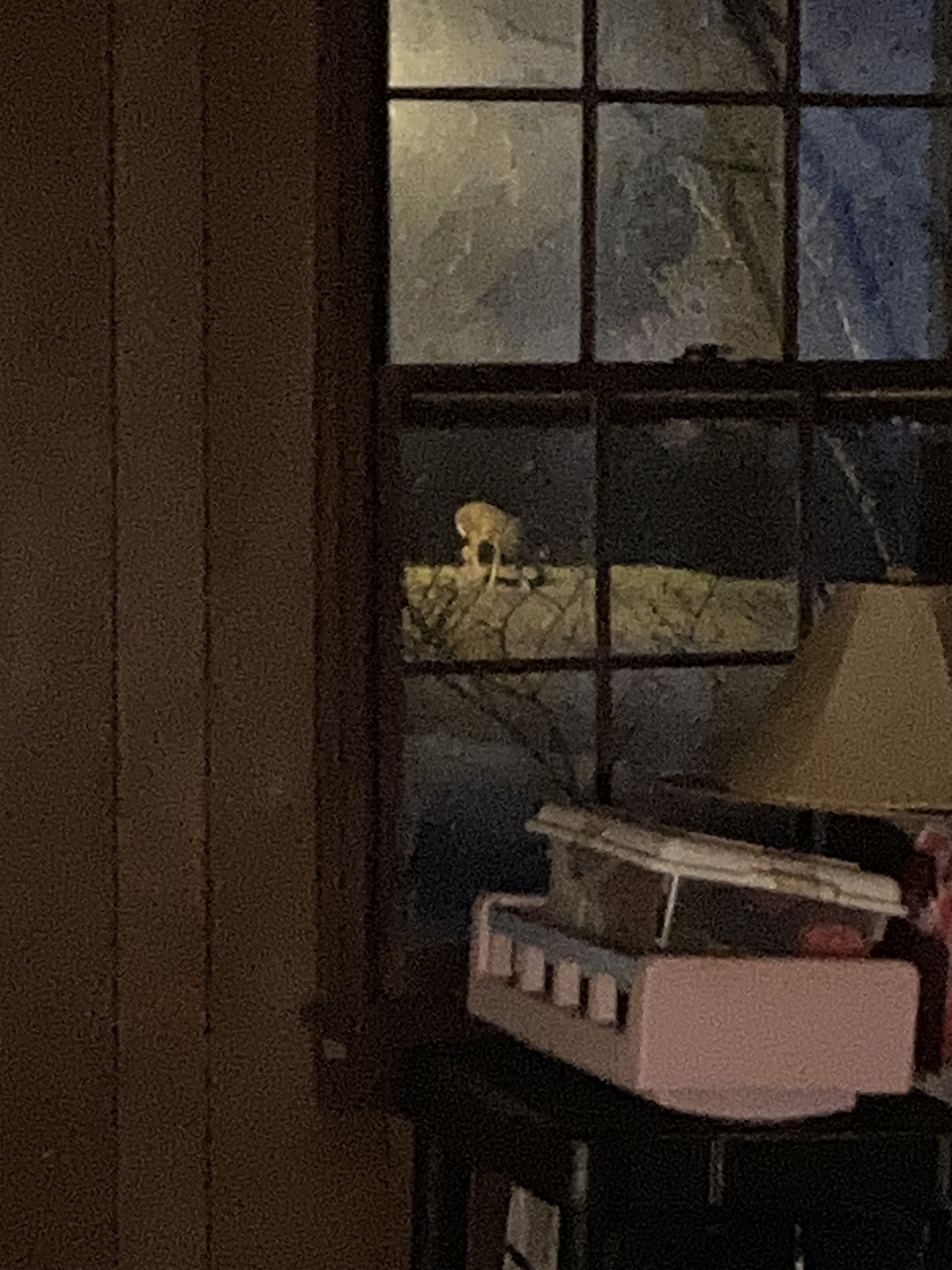
The first glimpse, out the garage window.
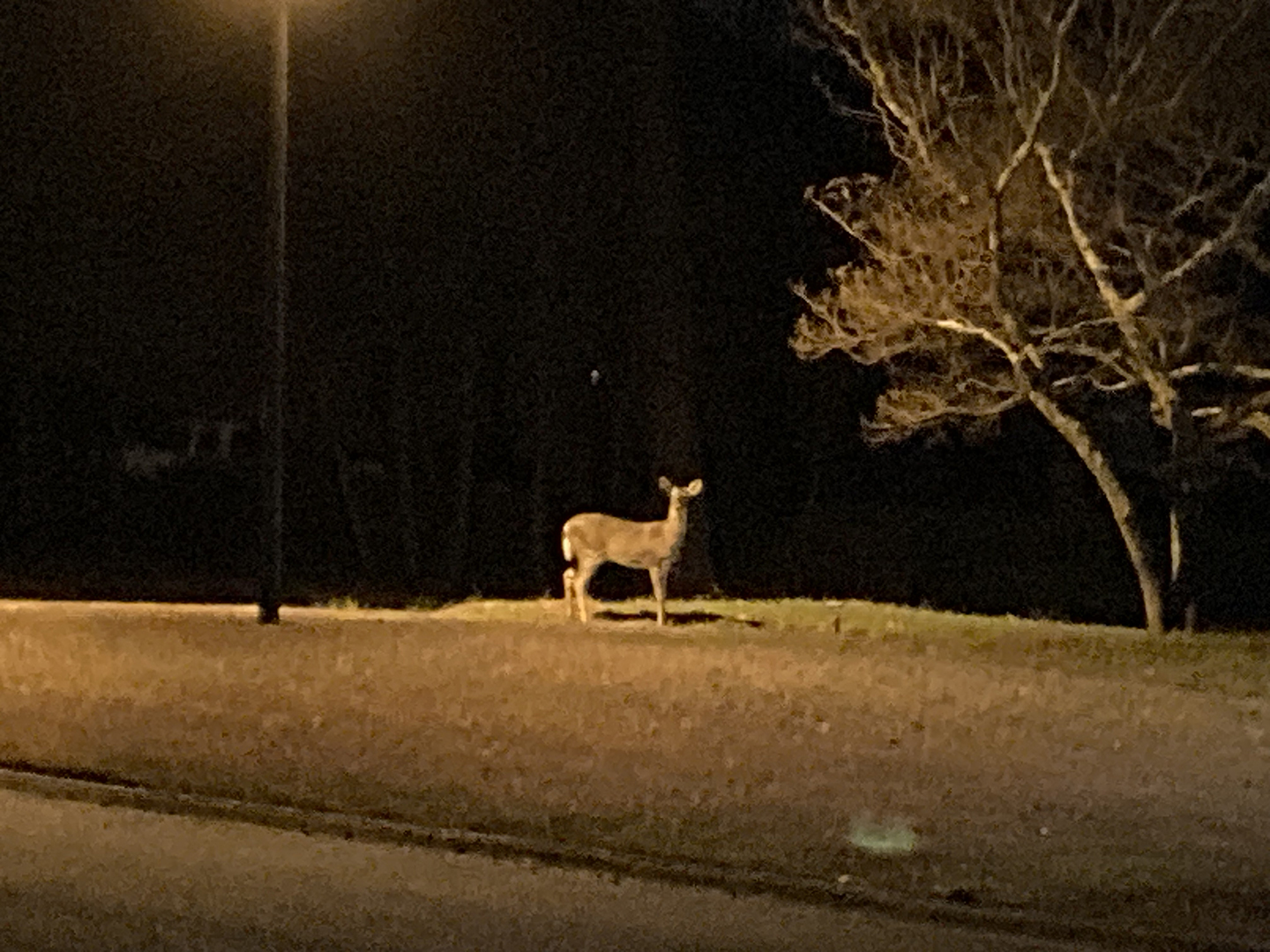
There was a deer standing on the corner of my neighbor’s lot, directly under a streetlight, peacefully and calmly grazing on the lawn.
Deer are not a miraculous sight in our neighborhood. They leave hoofprints in my wife’s garden, letting us know who’s been feasting on the vegetables. Occasionally, one will streak across the street, running from one clump of trees to another — and then be gone.
But this one might as well have been standing in the Garden of Eden — peacefully, without any sort of nervousness, enjoying the natural bounty available in that spot. It was safe, unthreatened, unconcerned.
I quickly shot a grainy picture through the window. Then I slipped out, as quietly as possible, through the garage — fortunately the door was still open, so I didn’t have to activate the noisy opener — and out into the yard, moving carefully into a spot where my driveway light wasn’t on me, and my profile wouldn’t stand out from the creature’s perspective.
And I got another couple of pictures — something I’ve never had time to do before when deer have briefly appeared.
And then, the deer looked up, and looked directly at me. Or rather, at the something that it sensed out there in the darkness, beyond the pool of light in which it stood. Then, she turned her body in my direction.
She… it (I took it for a doe, but what do I know? It could have been a young male, without antlers. Perhaps one of you can tell me)… considered this unseen manifestation. She turned her head one way, considering me as a quizzical dog might do. Her tail twitched. She leaned her head the other way. She was in no nervous hurry. She felt safe to consider the situation at leisure. Her tail twitched again.
At one point, I thought I detected a slight movement in one of her front legs that meant she was starting to walk in my direction, and, transfixed, I wondered what I should do. Should I stand and wait for her, or should I move toward her myself, given her a chance to see what I was and take evasive action if the spell was broken and she felt the need? What would panic her the least? What was the right way to respond to this moment?
A few long seconds later, it was over. She reacted to the car coming down the street behind her, and turned, and took off into the darkness.
I went in, and woke up my wife, to share the experience. I wasn’t sure how she would react to that, but fortunately she got it, and didn’t mind.
She thought it was pretty cool, too…