Category Archives: Government restructuring

Cindi Scoppe’s righteous rant this morning

Cindi had a column this morning on the new post of cybersecurity chief that the Legislature is adding to the state payroll (maybe the title could be, “Officer in Charge of Closing the Barn Door after the Horses have Run Off”) — or rather, on the outrageous fact that they want this person to be immune from firing by the governor.

As she correctly points out, we have too many state employees like that already — people who don’t really “work for” anyone, since no one can fire them.

There is zero reason to make this particular person independent — unlike, say, the attorney general or the inspector general. Arguments can be made for those. Not for this new post.

Cindi and I have been fighting the Legislature’s aversion to accountability for a lot of years now. So she can be forgiven for winding up into a bit of a rant at the end:

Frankly, I’m willing to trust that politics will keep the governor in line on this one. It’s tough enough for a governor to have to explain that 6.4 million individuals’ and businesses’ Social Security numbers and bank records were hacked because her agency director either didn’t know about or ignored concerns from his own IT people. She certainly doesn’t want to have to explain that we had another breach because she fired the state cybersecurity chief, or cowed him into backing off basic protections.

Truth be told, I’d be more concerned that a governor wouldn’t be aggressive enough if a cybersecurity chief gets out of control.

As much as some legislators are fond of saying that no price is too high to secure our personal information, the fact is that there is always, always more that can be done to provide security, be it for our computer networks or our cities or our businesses or our homes. The fact is that some prices are indeed too high, and it’s the job of our Legislature and our governor, or whoever a cybersecurity director reports to, to balance the risk against the cost, in money and in time.

If you’re going to give union-style job protections to the cybersecurity chief, then why not give them to the governor’s lobbyists — since she might not like it if they tell her that legislators don’t like her? Or to the prison director — since she might not like it if he tells her how much it’s going to cost to keep the prisons safe?

In fact, why not just go back to the way we did things when I moved to South Carolina, when the governor couldn’t fire the directors of any state agencies? When those directors reported to part-time board members who, even if the governor could appoint them, couldn’t be fired.

For that matter, if S.C. governors are that untrustworthy, maybe we ought to go back to the old system whereby the Legislature elected the governor. After all, what’s the point of bothering voters with the matter of electing a governor if the governor has no power to carry out the agenda those voters elected her to carry out?

Or maybe, just maybe, we could decide that government officials should be held accountable for their actions. Maybe we could decide that it’s better to trust that a governor won’t abuse her power over powerful officials than it is to risk that those officials will either get too comfortable in their jobs or else let their power go to their heads, and be less aggressive, or more aggressive, than they ought to be, because they don’t have a boss — and they know they’ve got a job for life.

Amen to all that.

I’ll take piecemeal reform over none at all, Vincent

I see that the bill to have the governor appoint the state superintendent of education — or rather, to have a referendum so voters can make that constitutional change — is coming along in the Senate, but Vincent Sheheen isn’t satisfied:

Sen. Vincent Sheheen, D-Kershaw, wants to abolish two constitutional officers, the Secretary of State and the Comptroller General, while allowing the governor to appoint two others: the Adjutant General and the Commissioner of Agriculture.

“It doesn’t make sense to do piecemeal reform,” Sheheen said Thursday, after the Senate gave the bill second reading by voice vote only, agreeing to take up the proposed amendments at the next reading…

Well, I’m not satisfied with just doing the superintendent reform, either. Every one of those other changes should have been made long, long ago, starting with the adjutant general. Of all the strange cases of separately electing officials in SC, that one is the most bizarre.

But… since I’ve waited so many years already, I would not demand that we hold up the superintendent bill, if we can pass that, to wait on the others. That’s because several years ago, opponents of reform used the fact that all the constitutional officers were under consideration to pull a fast one. Each defender of the status quo voted for some of the changes and not others, with the precise offices being voted against varying from senator to senator. That way all of them could say they voted for reform, but each office came up short of the two-thirds majority needed. So we got no reform.

Yes, we should approved all of this changes, and do it not just today, but 20, 30, 60 years ago. But if we can get one of them done, let’s do it. Let’s do even if we know that there is so much support for the governor appointing the superintendent mainly because Republicans believe they will usually win the governor’s office, but might lose the superintendent’s.

Let’s just take a step in the right direction. Because this fragmentation of government has never served us well.

Fortunately, the DOA bill wasn’t (DOA, that is)

One morning last month, I ran into Nikki Setzler at the Cap City Club, and asked him what was happening over in the Senate that day.

One of the things he mentioned in answering me was that they’d be working on “DOA.” I asked what that was, since to me that meant “Dead on Arrival.” He said it was the Department of Administration bill, which would replace the Budget and Control Board with an actual executive agency answering to the governor.

As acronyms go, that one was appropriate, since the proposal has indeed been DOA in the Senate, year after year.

But now, only five years after Vincent Sheheen introduced the proposal in the Senate, and a full 21 years after we started pushing hard to get rid of the B&CB at The State, senators have sent a bill to the House. This is from a release from the Senate GOP caucus:

On Thursday, the Department of Administration bill was passed. The bill will eliminate the powerful state Budget and Control Board and create a Department of Administration answering directly to the governor. The bill will also create a State Fiscal Accountability Authority made up of the Governor, Comptroller General, Treasurer, Ways and Means Chairman, and Senate Finance Chairman. Deficit Recognition will now be handled by the General Assembly, when in session, and a new Legislative Services Agency will now be responsible for all fiscal and revenue impact statements. In addition, the bill will create a Rural Infrastructure Authority, which will assist rural counties and local governments to improve their infrastructure to help attract economic development. Senate Republican Majority Whip Shane Massey, who led GOP efforts on the Senate version of the bill, is urging the House to take it up and pass it as soon as possible…

I’m not sure I like the sound of all of that, but it sounds to me like a step in the right direction. And such steps are rare in the SC Senate.

Yes, SC has 500 problems worse than election commission

For more than 20 years, I’ve taken every opportunity to apprise South Carolinians of just how amazingly fouled-up their system of government is. Whenever something that touches on the fact is in the news, I try to tell people. And while I was editorial page editor, the editorial board did so as well.

And the two remaining associate editors continue to do so, as Cindi Scoppe did in today’s column. An excerpt:

BY S.C. standards, the byzantine arrangement that produced perhaps the worst election debacle in modern state history — an inexperienced elections director hand-picked by state legislators who thought they reserved unto themselves the exclusive ability to fire her but in fact did not, and might or might not have given that authority to a commission that they also hand-picked and can’t fire, and an elections office over which the county council has absolutely no control but must fund at a level set by an almost certainly unconstitutional state law — is practically a governmental best practice.

After all, there are only 46 of these legislative delegation-controlled/uncontrolled election commissions, each one covers an entire county, and they don’t meddle in anybody else’s business.

For a truly remarkable example of legislative meddling gone mad, consider South Carolina’s special-purpose districts, each of which provides a single service, mostly to tiny segments of the population, most of which are operated by people who are at least two steps removed from even the theoretical possibility of accountability to the public, some of which have been disguised to make voters think they have some say, when they actually don’t.

They are the tail that wags our legislative dog: These legislative creations are among the most potent political forces at the State House, capable of stymieing an array of reforms that would make local government more efficient and effective and accountable to the public. Which they do.

Did I mention that there are more than 500 of these independent fiefdoms? Which means that, when you add them to all the counties and cities and towns and school districts, we have 900 local governments in South Carolina? Talk about fragmentation…

You should read the rest of it. Cindi, and I, have pointed these facts out many times in the past. And we keep hoping that one day, people will pay enough attention to demand change.

Anyone? Anyone? Bueller?…

Garrick completely unsatisfied by hearing on Richland County voting debacle, and so am I

This latest release from Rep. Mia Garrick reminds me that I had meant to post something about yesterday’s fairly useless hearing on the Richland County voting debacle, but got sidetracked:

After yesterday’s “legislative fact-finding,” the public can now add a plethora of excuses to this real-life “reality TV” drama.  From the nameless subordinate who screwed everything up to the mysterious numbers in red that just magically appeared, we can blame this debacle on broken voting machine batteries and phantom PEBs…but alas, there we were 20 days and a grueling 3.5 hours later, and very few new facts, if any, were revealed.

Here’s what we knew before Monday’s meeting:

  • The Richland County Election Commission broke the law on Election day, by deploying an inadequate number of machines at most Richland County precincts.
  • No one, including the Director, can tell us why.
  • Many Richland County voters stood in line for 3-6 hours or more, braving cold, harsh conditions regardless of age, physical conditions or disabilities
  • Many Richland County voters were not able to cast their ballots because of the extensive waits and were effectively disenfranchised.
  • Although these Ivotronic machines have been in use across SC for 8 years now, only Richland County had the types of issues we faced on Nov. 6.  The other 45 counties executed their elections without significant incident.

Here’s what Monday’s 3.5 hour fact-finding hearing revealed:

  • The Richland County Election Commission broke the law on Election day, by deploying an inadequate number of machines at most Richland County precincts.
  • No one, including the Director, can tell us why.
  • Many Richland County voters stood in line for 3-6 hours or more, braving cold, harsh conditions regardless of age, physical conditions or disabilities.
  • Many Richland County voters were not able to cast their ballots because of the extensive waits and were effectively disenfranchised.
  • Although these Ivotronic machines have been in use across SC for 8 years now, only Richland County had the types of issues we faced on Nov. 6.  The other 45 counties executed their elections without significant incident.

The technical aspects of how the machines work shouldn’t have been our primary focus and yet, the first half of our meeting was devoted to technical information that is of little or no value to voters who only want assurances that they can exercise their rights to vote and that their votes will be counted.

But this hearing wasn’t really about the voters of Richland County, was it?  If it had been, members of the legislative delegation wouldn’t have been forced to “sign-up” like school kids, just to ask questions of the Director and Commissioner. What’s the purpose of having a “legislative fact-finding” hearing if legislators can’t ask probing questions?  Why would any legislator be chastised for suggesting, as I did, that the delegation also give the public/voters an opportunity to be heard?

Yesterday’s meeting seemed to be more about confusing or minimizing the facts, rather than “finding” them.  Like many of you, I don’t think they were ever “lost.”  And although I’m one of the delegation’s newest members, I don’t need permission to host a public hearing in my District.  I’ve already hosted several in the 2 years I’ve served and will host more over the next 2 years.

But this Election Day disaster was not unique to House District 79.  In fact, every Richland County voter was impacted.  So I simply argued that our legislative delegation should want to hear from every voter who wants to be heard.  After all, we’re elected to represent you, so shouldn’t you be an integral and important part of this so-called fact-finding mission?

This is not about “throwing the Director (or anyone else) under the bus.”  It’s about holding those responsible for this debacle, accountable.  And even more importantly, it’s about the hundreds, perhaps thousands, of voters across Richland County who faced unprecedented and unnecessary impediments while trying to cast their ballots. It’s about the Richland County voters who were disenfranchised and denied their fundamental rights on that day.

Maybe some of my colleagues in the delegation didn’t witness the devastation of voters who were disenfranchised on Nov. 6th, but I did.  And I’ll never forget it.

After 20 days, we’re left with more questions than answers, more apologies, more confusion and more blaming.  And yet, there’s no accountability and admittedly, no plan for moving forward.

That does absolutely nothing to restore my confidence in the county’s election commission leaders or its electoral process.  So tell me…what does it do for yours?

Sounds like Rep. Garrick has a problem with delegation chairman Darrell Jackson, among others.

I agree that it’s absurd that we are still waiting for satisfactory answers as to how this happened, and more importantly, how it will be avoided in the future.

Keep watching, folks. This is what it’s like when a legislative delegation — an entity made up of people who were elected individually and separately for an entirely different purpose — tries to run something. Accountability is well-nigh impossible.

From a member of the Richland County legislative delegation…

… which, as you will recall, in our bizarre SC mockery of Home Rule, is responsible for the county election commission. Mia Garrick sent this out at about 6 a.m. today:

Friends,

I would like to take a moment to personally apologize for the reckless and unconscionable conditions so many of you encountered at Richland County polls on Election Day.
Like you, I’m livid about the senseless waits, poor preparation and other infractions that only seem to get more egregious with each passing day.

Just last evening, we learned that more uncounted ballots are still being “discovered” by the Richland County Election Commission and like you, I want answers.

You deserve accountability, transparency and every assurance that your fundamental right to vote will never again be compromised.  Thank you for your phone calls and emails. I hear you. I’m with you. And I won’t let up until your confidence in the integrity of Richland County’s electoral process is restored.

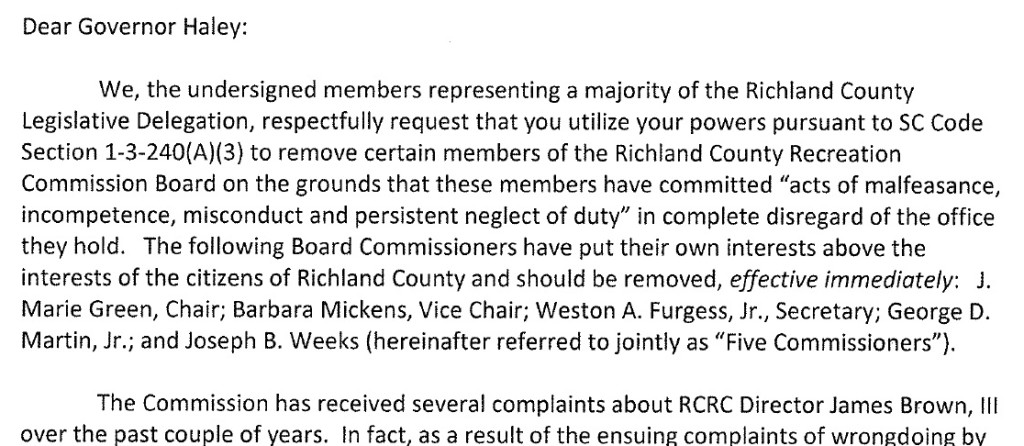
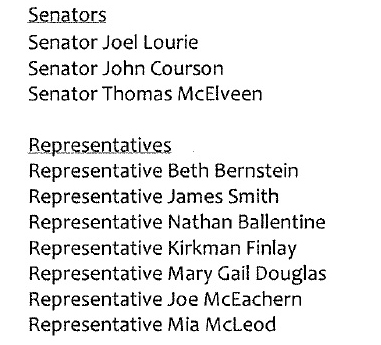
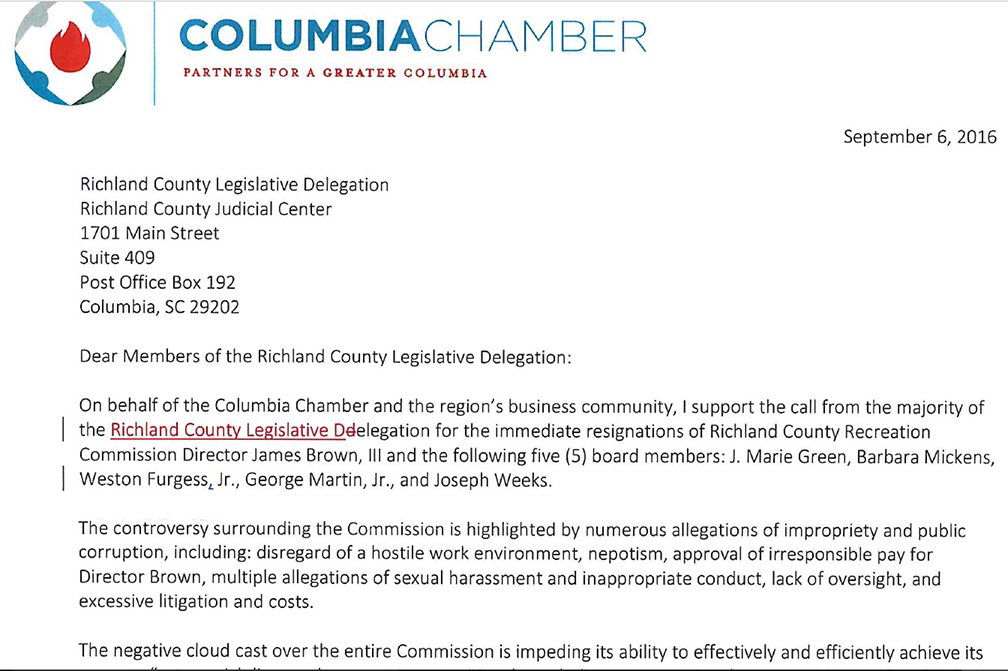
Take a look at my letter to our legislative delegation and let’s continue to fight for what’s right, together…

About that Gov Lite amendment

I received this email last week…

Long time reader of your blog.

Could you comment on your blog about the Lt. Governor Constitutional Amendment vote, set for next Tuesday? I’ve seen very little written about this, anywhere in the state.

I am generally for it, but for the life of me, I can’t figure out what the point of the job of Lt. Gov. if it passes. I’ve long thought if we have to have the office, why not fold up and combine the Sec. of State into the Lt. Gov’s office?

As it is, if this passes, the next Lt. Gov. will essentially be an elected staff member of the Governor’s office, with no role in Senate. I guess that is fine, especially after watching the candidates for the office two years ago throw themselves around the state, spending millions, for a part time job. But the amendment could be better thought out.

… and decided to wait for Cindi Scoppe to explain it, which she did quite adequately on Sunday, in what we used to call a “steak and steak” presentation — both an editorial endorsement, and a column that elaborates upon the same subject.

To answer the reader’s questions from my own perspective:

  • There isn’t any point to the lieutenant governor’s office, beyond being prepared to take over if the governor dies.
  • That’s different from the duties of the secretary of state.
  • There’s no reason for a member of the executive branch to preside over the Senate. Cindi explained very well Sunday how how nonessential the gov lite is in that role.

Basically, it has never made sense for the person a heartbeat away from the governor’s office not to have run on the same platform as the governor. It means that if the governor dies or otherwise leaves office, the position will be filled by someone who in no way shares the characteristics or goals or vision that the voters opted for in electing that governor.

Basically, this change gives the position a purpose it had lacked, and shows greater respect for the wishes of the people as expressed in elections.

It’s not a big deal. It’s really not much of a reform, nothing like what South Carolina needs. (It’s one of the least consequential things we pushed for with the Power Failure series in 1991, and ever since as an editorial topic.) But as Cindi said, it’s something. And more than that, it’s one tiny thing that the status quo worshipers in the Legislature have allowed us to vote on. If we say no to it, I assure you, they will wave that around as proof that we don’t really want reform in South Carolina.

Words from another time, another universe

Back in the days of typewriters, dictionaries were a great obstacle to my developing what my detractors call “time-management skills.” I couldn’t look up one word without running across another that fascinated me, which in turn caused me to look up another, then three more, and one and on, each word opening the floodgates of dopamine in my brain as I utterly forgot what I had set out to do.

The Web is a dictionary taken to the nth power.

Today, I stuck up for our Founders’ vision of a republic rather than a democracy, which caused Bud to say fine, if that’s what you want, then let’s return to precisely their vision. That caused me to say that I was for repealing the 17th Amendment. Then, when I went for a link to explain to readers which amendment that was, I started reading about the debate at the time over this “reform.” I saw that William Jennings Bryan (you know, the guy Clarence Darrow took apart at the Monkey Trial) was for the change, and Elihu Root opposed it. Thinking Mr. Root was perhaps a man after my own mind, I went and looked him up.

And I read on Wikipedia this excerpt from a letter he wrote to The New York Times in 1910, while serving as a U.S. senator from New York:

It is said that a very large part of any income tax under the amendment would be paid by citizens of New York….

Elihu Root

The reason why the citizens of New York will pay so large a part of the tax is New York City is the chief financial and commercial centre of a great country with vast resources and industrial activity. For many years Americans engaged in developing the wealth of all parts of the country have been going to New York to secure capital and market their securities and to buy their supplies. Thousands of men who have amassed fortunes in all sorts of enterprises in other states have gone to New York to live because they like the life of the city or because their distant enterprises require representation at the financial centre. The incomes of New York are in a great measure derived from the country at large. A continual stream of wealth sets toward the great city from the mines and manufactories and railroads outside of New York.

Wow. Wow. Wow. Imagine that. A serving politician who actually wrote not only in favor of an income tax when there wasn’t one, but told his own constituents why they should shoulder a particularly large portion of that burden. Now there’s a man of principle for you.

You will ask now whether he was re-elected. Well, he didn’t run again.

But it’s not like he retired. He went on to serve in several prominent capacities. In 1912, he was awarded the Nobel Peace Prize, for “his work to bring nations together through arbitration and cooperation.” Nevertheless, he would later oppose Woodrow Wilson’s initial position of neutrality as WWI broke out. He believed German militarism must be opposed.

He was a reluctant candidate for the Republican nomination for president in 1916. Charles Evans Hughes won the nomination, and went on to lose to Wilson.

I think I might have voted for Root, given the chance.

Sheheen thinks it’s time for a state constitutional convention. I’m still not there yet.

Actually, he’s not the only one who thinks so. But Vincent is the one I had lunch with yesterday, and the one who told me about this article that he and Tom Davis co-wrote for the Charleston Law Review (starts on page 439).

By the way, in case you wonder: He doesn’t know whether he’s running for governor again yet. Nor does he have a firm idea who else will be running. There was a fund-raiser held for him recently in Shandon. He says he told the guys who wanted to host it that he hadn’t made a decision. They said they wanted to have the event anyway, and all he had to do was show up. So he did. (I suspect either he or James Smith will run, but not both of them.)

We talked extensively about the 2010 race, and what might or might not be different in 2014. He pointed out that last time around he got more votes than any other gubernatorial candidate in South Carolina history (630,000) — except of course Nikki Haley, who got more. But only slightly more, and that as a result of the one-time Tea Party surge. So while he hasn’t made up his mind, you can see how he’d be considering another run.

Back to the constitutional convention idea… It came up because we were talking about how Tom Davis, who has always been among the most reasonable of men to speak with one-on-one, has been going off the deep end lately in his bid to run to the right of Lindsey Graham and everybody else in the known universe. That got Vincent to mention an area of agreement, which brought up the article, which begins:

South Carolina’s citizenry last met in a constitutional convention in 1895.  Prior to the Convention of 1895, the people of South Carolina saw it fit to meet together to perfect their form of government on multiple occasions—1776, 1778, 1790, 1861, 1865, and 1868.  When our last convention occurred in 1895, of the 162 members present, only six were black.  The convention was in part called so that newly re-ascendant whites could undo work that the Reconstruction government had created.  The convention also had a goal of re-centralizing power in the state government away from the emerging local governments.

I fully appreciate all of the reasons why Tom and Vincent see the need for a convention. As I’ve written so often for more than two decades, our state government needs to be rebuilt from the top down (or the bottom up, if you prefer — just as long as the result is the same).

In fact, the initial idea for the Power Failure series I conceived and directed in 1991 came from a series of three op-ed pieces written for The State by Walter Edgar and Blease Graham in 1990, which argued for a constitutional convention.

While not being prepared to leap to that conclusion, I was fascinated by the analysis of what was wrong with our state government (some of which I had glimpsed, but imperfectly, as governmental affairs editor), and how it had always been thus, stretching back to before South Carolina was even a state, back to the Lords Proprietors. In fact, all of those constitutions Tom and Vincent mention in the lede of their article essentially preserved the same flaw of investing power almost exclusively in the Legislature, to the exclusion of the other branches, and of local government. There might have been odd little innovations here and there, such as the direct election of a strange array of state officials (which served the purpose of fragmenting what little power was vested in the executive branch), but the core ill was the same. It was a system created to serve the landed (and before 1865, slaveholding) elites of the state, not the people at large.

But here’s the thing: I didn’t trust our elected leadership to appoint people to a constitutional convention who would go into it with a thorough understanding of the problems, and a commitment to making it better. I felt about it the way Huck Finn felt about telling the truth: “it does seem most like setting down on a kag of powder and touching it off just to see where you’ll go to.”

Today… well, today, our state government is worse than it was. I can’t remember the last time anything significant came out of our State House that made good sense and that was designed to move our state forward rather than backward. So on the one hand, I’m tempted to say things couldn’t be worse, so let’s set off that “kag” and see which way we’ll go.

But on the other hand… In the years since “Power Failure,” the quality of elected leadership in this state has declined precipitously. Back then, as bad as the structure was, there were people in charge who understood this state’s challenges and were sincerely committed to make things better. Carroll Campbell was governor, and Vincent’s uncle was speaker of the House. And even though he had his doubts about the very limited restructuring Campbell managed to push through in 1993, Bob Sheheen was a smart guy who could be reasoned with, and he did his part to make it happen.

Back then, we had our share of chuckleheads in office, but it was nothing like today. Back then, government wasn’t in the hands of nihilistic populists who not only oppose the very idea of government, they don’t understand the first thing about how it works.

Would you trust the folks in charge now to set up a constitutional convention that would leave us better off than before? The office-holders who understand the things that Vincent and Tom understand about our system are few and far between.

I must admit, I’d have to go back and research what it would take to set up a constitutional convention. At this point, I’m not familiar with the procedures. Maybe there are ways to do it that I would find reassuring. But before I could say I favored having one, I’d have to hear a lot of assurances as to who would attend such a convention, and what they’d be likely to do.

SC judicial selection remains far from what it should be

“We ain’t what we ought to be; we ain’t what we gonna be, but, thank God, we ain’t what we was.”

That quote, which Martin Luther King attributed to a preacher who had been a slave, came to mind in perusing this report at The Nerve.

Basically, it tells you what we told you in the “Power Failure” series more than 20 years ago, and many times since in The State: That while our method of choosing judges in South Carolina isn’t the worst system in the country (the worst would be direct popular election, which is employed in far too many jurisdictions), it’s far from what it should be.

Back when we first wrote about it the SC bench was one of the best examples of the gross imbalance of power in SC, which we (after V.O. Key and others) called “The Legislative State.” Judges were chosen completely by and at the discretion of the Legislature, and whether you made it to the bench depended on how many friends you had among lawmakers.

Today, lawmakers still retain complete control over the selection of the judiciary, and it is to my knowledge accurate to characterize the system as The Nerve does:

Once a judicial candidate has been approved by the 10-member, legislatively dominated Commission, he or she goes on to a joint session of House and Senate for a majority vote. The vote, however, isn’t simply for or against the one candidate; it’s for one candidate over against others. That’s because the Judicial Merit Selection Commission is required to nominate up to three qualified candidates for each position (assuming there are three qualified applicants). If they want the job, therefore, judicial nominees must curry favor with legislators – “curry favor” meaning schmooze, glad hand – in order to secure the requisite number of votes. Lawmakers, for their part, have in the past been quite open about the fact that they’ve got to “get to know” candidates before they’ll support their candidacies.

What this means, in effect, is that by the time a judicial nominee becomes a judge in South Carolina, he or she is personally and professionally beholden to state lawmakers in unhealthy ways. Can judicial independence really exist in such a system? The fact that the question can be seriously asked is a problem.

All true, near as I can tell — not having been personally present for a judicial election in awhile.

I’ll say one thing in the current system’s defense, though — it does produce better results than it did when we first started writing about it. That’s because, with Glenn McConnell’s leadership, that Judicial Merit Selection Commission was formed, and has done a pretty fair job since then of making sure those candidates that lawmakers are allowed to vote for do have real-world qualifications. So now, you still might have to be the most popular candidate among lawmakers, but you have to be the most popular among a small group of qualified candidates.

That’s a big improvement. Of course, it came about because Sen. McConnell wanted to preserve the current system. So he just made the current system better, to blunt legitimate criticism. It’s good that we have better-qualified candidates ascending to the bench. And this system is much better than direct popular election.

But it’s not as good as what we should have. The system most likely to produce a qualified, independent judiciary that stood as a full, coequal branch would be one like the federal system — the executive nominates, and the legislative provides advice and consent. That way, a judge is not the creature of any particular part of the political branches.

As to when we might get something like that, The Nerve is also accurate when it says we shouldn’t hold our breaths waiting for the Legislature to make the change willingly.

Michael Rodgers’ letter to the editor

Since I am no longer paid to do so, I seldom read letters to the editor any more. So I appreciate that our own Michael Rodgers took time to call attention to his letter in The State yesterday, so that I might share it. Here it is:

Modernize our S.C. government

Cindi Scoppe’s Thursday column, “Why Haley won some, lost some budget vetoes,” correctly declares that Gov. Nikki Haley’s request to change budget numbers would upend what a governor is. However, with the way our state government functions, Gov. Haley’s request is actually a clever response. In effect, she is asking for one seat at the table with the six-member legislative conference committee.

This is turnabout as fair play, because the Legislature gets two seats at the five-member executive committee called the Budget and Control Board.

Obviously, having an executive legislate is as wrong as having legislators execute. By separating the powers, we can modernize our state government. The Legislature should set the mission (general tasks) and the scope (total budget not to be exceeded), let the governor and her agency heads execute, and vet the results by having oversight hearings. Thus the Legislature will give the executive branch the flexibility needed to accomplish legislative goals more efficiently.

Michael Rodgers
Columbia

And here’s my favorite excerpt from the column to which he was responding:

USED WELL, THE line-item veto is a powerful weapon to fight budgetary logrolling. In fact, used well, it can empower legislators as much as it empowers governors.

Although House members can reject individual spending items when the House debates the budget and senators can reject individual items when the Senate debates the budget, the final version of the budget often bears little resemblance to those early plans. It is the work of a conference committee of three representatives and three senators, and it is presented to the House and Senate as a package: Lawmakers can accept the entire thing, or they can reject the entire thing. They can’t amend it.

The governor can amend it by deletion — within reason. She can’t strike words out of provisos to change their meaning, and she can’t change the numbers, as she now says she should be able to do, but which would upend the whole idea of what a veto actually is. And what a governor is.

But she can eliminate entire spending items and provisos, which set forth the rules for some of the spending. And by doing that, she gives legislators the opportunity to consider those items individually, without having to worry that voting against them would result in a government shutdown.

This doesn’t automatically bust up the vote-trading coalitions — you patronize my museum, and I’ll love your parade — and in fact it can strengthen them if a governor goes after too many parochial projects, as then-Gov. Mark Sanford discovered. And rediscovered. And never quite learned. But sometimes it shines enough of a spotlight on ill-considered expenditures to force legislators to back down…

SC DOT: One example of how SC constantly underfunds basic functions of government

This post should be seen as the background to this little drama over the governor’s vetoes, to provide some perspective. What seems to have been missing on most, but not all, of Nikki Haley’s vetoes has been a clear explanation of what she would spend the money on instead.

Her ideology prevents her from setting out powerful arguments for alternative spending plans, because she, like the governor before her, lives in a fantasy land in which the government of South Carolina simply spends too much in the aggregate. That South Carolina bears no resemblance to the one in this universe.

The truth is that South Carolina appropriates far too little for some of the most fundamental functions for which we rightly look to the public sector. And the deficit between what we spend on those functions and what we should in order to have the quality of service other states take for granted is sometimes quite vast, involving sums that dwarf the amounts involved in these vetoes that you hear so much fuss about.

What is needed is a fundamental reassessment of what state government does and what it needs to do, to be followed by the drafting of a completely new system of taxation to pay for those things. Our elected officials never come close to undertaking these admittedly Herculean tasks. But they should. The way we fund state government needs a complete overhaul, and spending time arguing about, say, the “Darlington Watershed Project” doesn’t get us there.

This is something I’ve long understood, and often tried to communicate. I was reminded of it again at the Columbia Rotary Club meeting on Monday.

Our speaker was SC Secretary of Transportation Robert C. St. Onge Jr. He’s a former Army major general, having retired in 2003 — until Nikki Haley asked him to take on DOT in January 2011. Some of his friends congratulated him at the time. Those were the naive ones. The savvy would have offered condolences.

Normally, public speakers like to inspire with phrases such as “From Good to Great.” Sec. St. Onge’s talk was far more down-to-Earth, far more realistic. He entitled it “Getting to Good.” And once he laid out what it would take for SC to get to “good enough” — to get all of the roads we have NOW up to snuff, much less building any roads we don’t have but may need for our economy to grow — it was obvious that we aren’t likely to get there any time soon.

The secretary started out with some background on how we have the fourth-largest state-maintained highway system in the country, after Texas, North Carolina and Virginia. He didn’t have time to explain why that is, but I will: It’s because until 1975, county government did not exist in South Carolina. Local needs were seen to by the county legislative delegation, one of the more stunning examples of how our Legislature has appropriated to itself functions that are not properly those of a state legislature. When we got Home Rule, supposedly, in 1975 and county councils were formed, many functions that had been done on the state level stayed there. So it is that roads that would have been maintained by county road departments in other states are handled by the state here. It’s not that we have more roads, you see — it’s that more of them are the state’s responsibility.

He also noted how woefully underfunded our system is. Georgia, for instance, has less road surface to maintain, but twice the funding to get the job done — and three times as many employees per mile. He alluded to why that is, and I’ll explain: We have the most penny-pinching state government I’ve ever seen, with lawmakers who (contrary to the fantasies you hear from the likes of Mark Sanford and Nikki Haley) would rather be tortured than raise adequate money to fund a decent state government. OK, so the retired general didn’t explain it that way. He just mentioned the fact that we haven’t raised the inadequate gasoline tax that funds his department since 1987 (the year I arrived back in SC to work at The State). Add to that the fact that the tax is levied per gallon rather than per dollar spent, and you have a recipe for a crumbling road system.

Here’s the secretary’s full PowerPoint presentation if you want to look at it. If you don’t, at least look these representative slides, which sketch out the basic challenges…

Above compares us to neighboring states. Note that only North Carolina has our bizarre problem owning responsibility for most of the roads.

This is a breakdown of the categories of roads SC maintains at the state level. Note that almost half are secondary roads for which the state gets no federal funds. This is where the state is squeezed the hardest.

Above is what it would take to get just the interstates in SC up to “good” condition, and keep them there.

This is what it would cost to fix up and maintain all those secondary roads, which make up most of the state’s responsibility.

This is the most important slide. This is what South Carolina needs to spend, and has no plans to spend, to get the roads it has NOW up to good condition, and maintain them in that condition.

Gov. Haley could arguably justify ALL of her vetoes by saying, “We need to put it all into our crumbling roads.” Then, after she had eviscerated all of those agencies as being less important than our basic infrastructure, she would have to turn around and call for a significant increase in the state gasoline tax, to come up with the rest of what is needed.

But our elected state leaders never go there. They either don’t understand this state’s basic needs, or aren’t honest enough to level with us about them. They’d rather truckle to populist, unfocused, unthinking resentment of taxes, and government in general, than be responsible stewards of our state’s basic resources.

That’s the money picture. Beyond that, here are some small things that in the aggregate add up to a big problem. If our governor won’t take on fully funding our state roads system, maybe she could work with the Legislature to get rid of some of the worst white elephants that DOT is saddled with:

This is a parking lot in Fairfield County that DOT is required to maintain. Sec. St. Onge would like to get rid of it, but can’t.

Ignore the dirt road, and look at the cemetery that DOT is required to maintain in Saluda County. Sec. St. Onge would like to get rid of that, too, but he can’t.

Here’s a road leading to a church in Florence County, which DOT is also required to maintain. The church is the only thing that the road leads to. Sec. St. Onge would like to give it to the church, and the church’s pastor would like to have it. But guess what? They can’t make it happen.

So… I’ve given you examples here from but ONE agency illustrating how we tolerate the intolerable, and refuse to fund the necessary, in our state government. THIS is the sort of thing we should be discussing, instead of having unnecessary culture wars over the Arts Commission.

A couple of last thoughts: Before any of you who think like Nikki Haley’s base start trying to dismiss all this by quibbling about what “good” means, or going on a rant about how these government bureaucrats just always exaggerate the need for funds in order to pad their fiefdoms, consider the following:

  1. This is Nikki Haley’s chosen guy to run DOT, not some “career bureaucrat” she inherited.
  2. This is a retired general officer — a guy with a very comfortable, generous retirement package — who did not have to take this job, and does not need it to improve his lot or to define himself. He’s about as objective and practical a source you can find for leveling with you about such things as this.

Warren’s absolutely right, Moe

What caused him to change his mind?/Photo by Brett Flashnick

I certainly hope Moe Baddourah read Warren Bolton’s column this morning, and took it to heart. Excerpts:

WHILE COLUMBIA City Councilman Moe Baddourah will take his first formal vote at today’s council meeting, it’s doubtful that many of his official votes loom as large as an unofficial decision he made following a May 8 public hearing.

That was the day he back-tracked on what had been a strong stance in favor of allowing voters to decide whether the city should change its form of government from council-manager to strong mayor. Up until then, it seemed evident that when Mr. Baddourah and Cameron Runyan joined the council — they both were sworn in last week — the seven-member body would have a majority in favor of putting strong mayor on the ballot.

As a matter of fact, some had questioned whether the council seated in May should even have voted, knowing that it could make a decision very different from what the new council that assembles today would make. It was generally thought that there was a 4-3 split against strong mayor at that time…

When Mr. Baddourah visited with our editorial board prior to the April city elections, he was emphatic in saying that Mayor Steve Benjamin needed more authority. “I think Columbia is ready for that,” he said.

“We need a (full-time) mayor for the city to bring business in,” Mr. Baddourah said. “I’d love for Benjamin to be a full-time mayor. I think he’s a really good face for the city.”

So, imagine my surprise as I watched the public hearing, held during a council meeting, live online only to see Mr. Baddourah do a 180 when he and Mr. Runyan were put on the spot as to how they might vote once they joined the council.

Maybe it was the pressure of the moment. Or maybe he genuinely changed his mind. Whatever the case, it was abrupt and damaging to the effort to allow voters to have a say as to what form of government they choose to live under…

I’m not much of one for campaign promises. I generally think candidates should keep their options open for what they encounter in office. I even think when they do make the mistake of promising something, they should be free to change their minds — as long as they can make a good case for it.

But come on. In this case, Moe had just been elected, and had been elected not only indicating he’d support letting voters decide, but asserting strongly that he favored a certain outcome from that public vote.

And then, without having been through any discussion or other discernment process that was visible to the voters, he announces that he won’t even let the voters themselves decide the issue, and does it before he even takes office? Really?

It’s as shocking and as sudden and as premature a turn-around as I’ve ever seen.

This is indeed a case in which a mind so easily changed should carefully consider changing back. And then he should explain fully to the people who elected him what caused him to make such a strange announcement between the election and taking office.

Actually, they didn’t believe in factions, period

I have to take issue with this Independence Day message put out by Vincent Sheheen:

Independence day is a time to remember what our forebears fought for and believed in.  They believed in an independent country where citizens could join together in a government of the people, by the people, and for the people.   They did not believe in a government dominated and controlled by one faction.

Unfortunately, that’s what we have here in South Carolina.  And all I can say is – a government controlled by one party dominance in the Governor’s office, House, and Senate does not work.

Sheheen

Instead of working on improving public schools, these people are fighting to take away public money and send it to private schools.

Instead of fighting to protect the environment, these people are working to undermine it.

Instead of trying to bring the citizens of South Carolina together, black and white, rich and poor; they are continuing to divide us.

While regular people have been struggling to make ends meet, our state government has been using public taxpayer dollars and time to fly all around the country and world.

Instead of seeing honest leadership, South Carolina has continued to see scandal at the highest levels of government.

Nothing will change unless we change it.  Let’s all work together, Democrats and Republicans, for common sense solutions.

I am still a believer in America and South Carolina.  Happy July 4!

Actually, Vincent, they didn’t believe in ANY factions. In other words, the “healthy” two-party system you seem to be invoking here was not their aim.

Of course, they turned right around and, practically in the same breath, created two parties that ripped into each other with a viciousness that we would recognize today.

But, in terms of what the Framers thought right for the country (before Madison and Hamilton became the driving forces behind our first bout of hyperpartisanship), they wanted as much as possible to limit the influence of parties:

Madison

Madison

AMONG the numerous advantages promised by a well-constructed Union, none deserves to be more accurately developed than its tendency to break and control the violence of faction. The friend of popular Governments never finds himself so much alarmed for their character and fate, as when he contemplates their propensity to this dangerous vice. He will not fail, therefore, to set a due value on any plan which, without violating the principles to which he is attached, provides a proper cure for it. The instability, injustice, and confusion introduced into the public councils, have, in truth, been the mortal diseases under which popular Governments have everywhere perished; as they continue to be the favorite and fruitful topics from which the adversaries to liberty derive their most specious declamations. The valuable improvements made by the American Constitutions on the popular models, both ancient and modern, cannot certainly be too much admired; but it would be an unwarrantable partiality, to contend that they have as effectually obviated the danger on this side, as was wished and expected. Complaints are everywhere heard from our most considerate and virtuous citizens, equally the friends of public and private faith, and of public and personal liberty, that our Governments are too unstable; that the public good is disregarded in the conflicts of rival parties; and that measures are too often decided, not according to the rules of justice, and the rights of the minor party, but by the superior force of an interested and overbearing majority. However anxiously we may wish that these complaints had no foundation, the evidence of known facts will not permit us to deny that they are in some degree true…

Thus spake “PUBLIUS.”

Sadly, it didn’t work out that way. In fact, it SO didn’t work out that way that it’s a bit hard to believe that James Madison, who would so soon be the chief hatchetman of the Democratic Republicans, wrote those words.

Oh, as for wishing us all a happy Fourth: One of the Founders I regard as most consistently sincere in despising faction, John Adams, thought we’d celebrate on the 2nd, which after all is when the Congress voted for independence. Which makes sense. But I suppose I’m picking nits here.

Adam uncovers a blast from the past

Adam Beam of The State Tweeted this over the weekend:

Adam Beam
Adam Beam
@adambeam

@BradWarthen Look what I foundpic.twitter.com/7V5M1vlr

Adam must have been spending Saturday at the office going through old drawers in the newsroom. There are a number of these scattered about here and there.

This is the special reprint we did early in 1992 of the Power Failure series that I had spent most of the previous year directing.

Power Failure was something I dreamed up in 1990. As governmental affairs editor that summer, I had been going nuts keeping up with an unbelievable string of scandals in and around state government, the most memorable of which was the Lost Trust investigation, which led to indictments against a tenth of the Legislature.

In the midst of it all, then-executive editor Gil Thelen stopped by my desk one day to wonder, What could we do to give our readers a positive way to respond? What could be done to make state government better, rather than just wallowing in the bad news day after day?

The answer I came up with was a project highlighting all of the deep, structural flaws in South Carolina’s system of government — flaws that set South Carolina apart from every other state. Flaws that made our system particularly resistant to change.

These flaws are difficult to summarize briefly, but all of the problems — the weak executive, weak local governments, centralization of authority, fragmentation of that central authority, almost complete lack of accountability (in terms of anyone being able to hire and fire key officials), and on and on — were vestiges of a constitutional system originally designed to put all authority in the hands of the landed, slaveholding antebellum gentry, and to fragment that power across that whole class of people, so that no one person could make important decisions. For instance, not only did departments that in other states reported to the governor (an official elected by all of the state’s people) report to a separately elected official, or to a board or commission appointed by the Legislature, but even decades after the passage of Home Rule, lawmakers still retained a surprising degree of control over local government services.

As I said, it’s difficult to summarize briefly, although we tried with the tagline, “The Government that Answers to No One.” To explain it, I conceived of a 17-installment series, each installment filling several full pages of newsprint (back in the day when pages were much bigger than they are now), totaling well over 100 articles. Gil and Paula Ellis, then the managing editor, essentially laid the resources of the newsroom at my disposal for most of 1991. Reporters came and went from the project, depending on which subject area we were dealing with at the time.

Were there results? Yes, but nowhere near what we were seeking. A partial restructuring of state government in 1993 put about a third of the executive branch under the governor. That third of a loaf, though, was great success when you consider that huge areas that were just as important — Home Rule, education governance, reducing the number of statewide elected officials — were pretty much ignored.

As for me — I was ruined as a governmental affairs editor, since the project was an unprecedented sort of news/editorial hybrid — for instance, I had written opinion columns advocating all of these changes throughout the series. I spent a couple of years supervising this or that non-political team (although I retained control of the Washington Bureau) until I made the move to editorial at the start of 1994 — where I spent the next 15 years continuing to advocate these reforms. Most of the items I listed in my last column for The State, “South Carolina’s unfinished business,” was to a great extent a recap of Power Failure.

Recently, we saw one tiny piece of the reform picture fall into place, with the legislation putting the governor and lieutenant governor on the same ticket advancing. Hoorah for small victories.

It’s been frustrating, but hey, this system had been in place in one form or another for 300 years — and the one great characteristic that it possessed all that time was a profound resistance to change. That is still the hallmark of government in South Carolina.

City council’s strong-mayor debacle

It’s a great shame that Columbia city council voted not even to ask voters whether they would like to inject accountability into city government by moving to a strong-mayor form of government.

But it was predictable that they would do so. I feared that outcome when I saw that the council planned to vote right after a public hearing.

The proposal would have a chance put before the electorate — particularly in the fall, when a much more representative swath of the city’s voters will turn out, as compared to actual city elections.

But the kinds of people who turn up at hearings before council happens to be much the same set of people who passionately oppose such a change — even to the point, apparently, of not wanting their neighbors to have a chance to vote on it.

This is always the way. The people who are most opposed to a reform — or, to use more neutral language, a change of any kind — in the form of government are the very people most invested in the current form. And people who regularly go to council meetings tend to be people who have become comfortable with and accustomed to the current form. They’ve learned to make the existing system stand up and do what they want, so they don’t want it replaced.

I saw this on a much larger scale when we first started pressing for changing the form of state government in the early 90s. We were pushing for a more accountable system in which the will of the electorate would be more likely to be expressed in the way the executive branch of state government was run. We were seeking to replace a bewildering set of mixed-up governing arrangements that varied greatly from agency to agency (and still exists over most of state government).

The system was (and remains) far too complex and fragmented for the average citizen to understand or engage effectively. But what that meant was that the people who DID know how to make it work — experienced lawmakers, skilled bureaucrats, interest-group advocates and lobbyists — had a tremendous advantage in dealing with it. And consequently did not want it to change.

With city government, it’s more likely to be people who are very active in neighborhood associations who oppose a change that would make city administration accountable directly to one person elected citywide, rather than a hodgepodge of at-large and district representatives (with the district people having the majority).

Anyway… Columbia has missed yet another opportunity, and continues to be in the grip of a decades-long rear-guard action against progress.

A postscript… I was quite indignant that council did not wait for new members to join, since I knew that both Cameron Runyan and Moe Baddourah favored strong mayor. It seemed that anti-change incumbents were forcing a vote now to avoid losing.

But then I read in Clif LeBlanc’s report this morning, “Baddourah, who replaces Gergel, said he’s had a change of heart and would not support holding a vote this fall.”

Which really blew my mind, because I saw him on local TV news, either last night or the night before, stating his unequivocal support for strong mayor.

Clif needs to do a full, exhaustive, separate story on what in the world just happened there…

Oh, get over yourself, governor

Again, our governor seems to have been Facebooking under the influence… of something. Strong emotion, perhaps.

Did you see this in the paper today?

The Senate approved a constitutional amendment that would have gubernatorial candidates and candidates for lieutenant governor elected on the same ticket, just as the president and vice president are elected now. Voters would have to approve the change in November.

But senators made sure the change would not take effect until 2018, when Haley’s term as governor, if she is re-elected in 2014, will expire.

Haley immediately took to her Facebook page to criticize the Senate, asking voters to call lawmakers and pressure them to change the effective date.

“I’m not the one taking it personally, they are,” Haley said Thursday in an interview with The State. “This is a reform I pushed for all through the campaign. … To have it go in front of the Senate, and then have them push it through, because they know it’s the will of the people, only to say, ‘Oh, no, we don’t want the girl to have it. We want to wait until 2018’ – they are the ones taking it personally.”…

Which raises a couple of points:

  • First, why would she care? What possible difference could it make to her whether this goes into effect in 2014 or 2018? Did she have some sort of grand scheme in mind, and this messes it up, or what? She’s going to have enough trouble gaining re-election (if she even seeks it) without worrying about who the lieutenant governor is.
  • Second… “This is a reform I pushed for all through the campaign…” Well, whoop-te-do. Some of us have been pushing it a lot longer than that — like since you were in school. I’ve been pushing this for more than 20 years. (As have a lot of other people.) But you don’t see me getting bent out of shape because I’m not given credit for it.

Maybe I should. Maybe this is what one does now. Maybe I should run over the Facebook and throw a total snit…

Memo to Harvey Peeler and Senate Republicans: ‘Conservative’ means you SUPPORT status quo

This artwork came with the release.

This release from Wesley and the Senate Republicans is intriguing on a couple of levels:

From today’s Associated Press:
State treasurer, House speaker oppose restructuring bill

There have been some unfortunate developments with the Senate’s bill eliminating the Budget and Control Board, with “The state treasurer and House speaker opposing the Senate’s version of a bill restructuring state government.”

“Senate Majority Leader Harvey Peeler shot back that the Senate’s version is more conservative than what the House passed last year. He accused the two of supporting the status quo.”

If you support conservative governance, and real restructuring, NOW is the time to stand up to the failed status quo.

Contact the Speaker’s Office and the Treasurer’s Office TODAY, and tell them to support the Senate version of the Department of Administration bill, and to support elimination of the Budget and Control Board.

First, you have the Senate Republicans attacking the Republican House and Republican Treasurer. In a nostalgic sense that’s not weird, because historically the biggest, nastiest split in SC was not between Democrats and Republicans, but between Senate and House. But that was when senators identified themselves primarily as senators, and not as R and D. Now that they think of themselves as Republican senators first and foremost (and this is being sent by the “South Carolina Senate GOP”), it comes across as odd.

Then, there are the really strange words that Harvey chooses to express his disagreement with the House and Loftis: “Senate Majority Leader Harvey Peeler shot back that the Senate’s version is more conservative than what the House passed last year. He accused the two of supporting the status quo.”

Senator, to the extent that language has meaning, if you are “more conservative” than someone else, that means that you support the status quo more than the other person does. By definition. Go look it up. OK, I’ll save you the trouble. When I Google the word “conservative,” the first dictionary definition that comes up is the one at Dictionary.com, and the first sense of the word is: “disposed to preserve existing conditions, institutions, etc., or to restore traditional ones, and to limit change.”

(I would quibble a bit with that definition. If you want “to restore traditional ones,” you are “reactionary.” But the rest is fine.)

Sheheen proposes joint gov/gov lite ticket

This just came in from Vincent Sheheen, the most consistent and insistent advocate for government restructuring in the Senate (a body not exactly overrun with such) in recent years:

Sheheen Calls For Joint Governor-Lt. Governor Ticket

Columbia, SC  – State Senator Vincent Sheheen (D-Camden) today called for change in the way SC elects its Lieutenant Governor. Under legislation that is pending in the state Senate, Governors and Lieutenant Governors would run on a ticket.

Senator Sheheen made the following comments:

“Recent events have demonstrated the critical need to modernize our government. The instability of government during the Sanford and Haley eras has highlighted the chaos that can be caused by bad leaders under our current system. Let’s put this legislation on the fast track and get it passed this year.  The people deserve it.”

H. 3152 –  http://scstatehouse.gov/billsearch.php?billnumbers=3152&session=&summary=B

###

It’s certainly been proposed many times before. Maybe, given recent events, the idea’s time has arrived.

Will the Budget & Control Board really go away?

It would be nice to think so. Senate Republicans are rightly touting that possibility:

Columbia, SC – February 16, 2012 – The South Carolina Senate today passed the most significant piece of restructuring legislation in the past two decades, passing a bill that completely eliminates the state Budget and Control Board.

The new bill puts most of the functions of the Board under a new, Cabinet-level Department of Administration, and devolves the rest of the Board’s functions elsewhere. The end result is a more efficient, accountable structure for the state’s administrative functions, rather than the current system of having a five-member board control those functions. The bill had been a top priority for Gov. Nikki Haley, and now goes back to the House for approval.

“There’s an old saying that when everybody is in charge, no one is in charge, and that’s been true for too long with too much of state government,” said Senate Majority Leader Harvey Peeler. “This bill will let the people of South Carolina hold their leaders accountable for the results of state government.”

The bill’s two primary Republican sponsors, Senators Tom Davis and Shane Massey, issued the following statements:

“This bill has been a long time coming, and it’s gratifying to now see it so close to the finish line,” Davis said. “Our government has been plagued by an unaccountable structure that breeds inefficiencies. Today, we took a significant step toward correcting that.”

“This bill strikes a good balance between giving the executive branch control and accountability over administrative functions, while requiring the legislature to perform critical oversight,” Massey said. “This bill is all about a better, more efficient government that allows voters to hold elected officials accountable.”

Of course, since it’s a party document, it conveniently ignores that the most insistent advocate of replacing the Board with a department of administration in recent years has been Democrat Vincent Sheheen.

Oh, well. It’s not like the idea was anyone’s personal property. The release says, “The bill had been a top priority for Gov. Nikki Haley.” Well, yeah. And Mark Sanford. And The State newspaper, since at least the point when I started writing about it in 1991. And Carroll Campbell. And anyone who respects the American concept of separation of powers, which the Board’s existence blatantly violates.