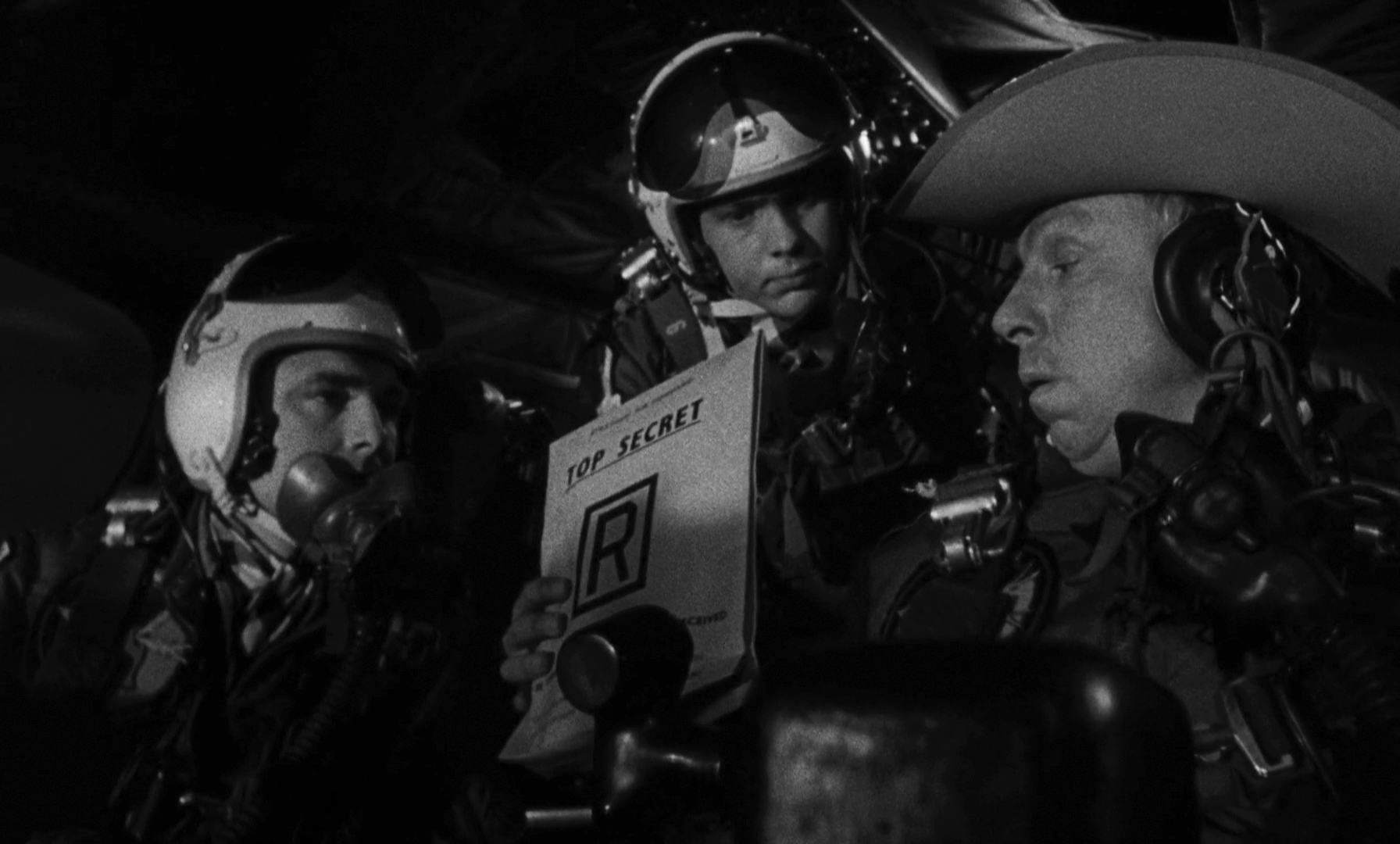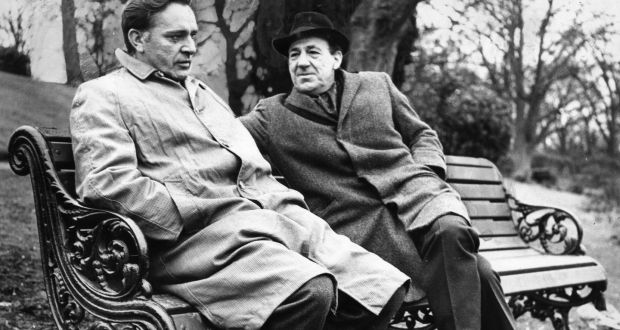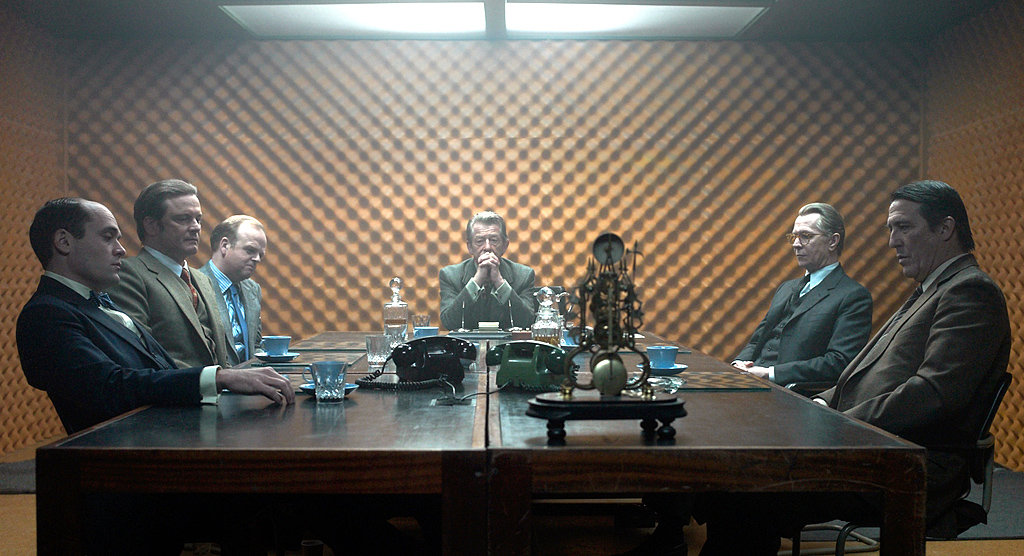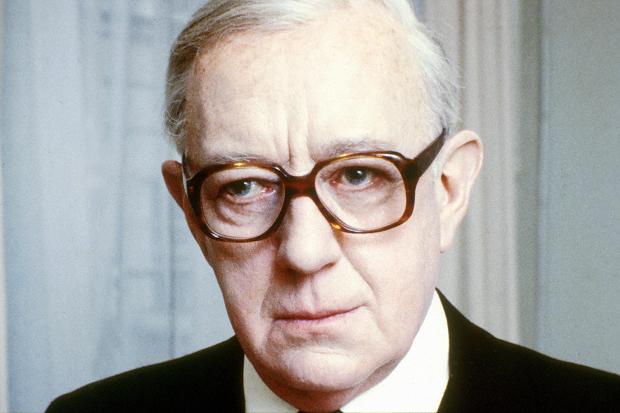
Smiley’s People – The sequel to Tinker, Tailor. I have both series on DVD at home.
Game, Set and Match – A series cobbled together from the first three novels in a Len Deighton trilogy of trilogies. It took some liberties, and I seem to recall hearing that Deighton hated it. This is possibly because the character that Ian Holm created for the series was quite different — a more tormented, stressed-out character — from the Bernard Samson in the novels. But I enjoyed the series anyway.
The Missiles of October – Worth watching if only for Martin Sheen’s version of Bobby Kennedy.
The Day After – A huge TV event at the time when it came out. Sort of the Cold War equivalent of “Roots.”
There’s sort of a lack of variety in this list, I’ll admit — the first three are spy series, and two by le Carre with the same chief protagonist. But I have to work with what TV gives me. And I really believe the first two are among the best things ever made for the tube.
The Central Intelligence Agency is expanding its role in the campaign against the Syrian regime by feeding intelligence to select rebel fighters to use against government forces, current and former U.S. officials said.
The move is part of a U.S. effort to stem the rise of Islamist extremists in Syria by aiding secular forces, U.S. officials said, amid fears that the fall of President Bashar al-Assad would enable al Qaeda to flourish in Syria.
The expanded CIA role bolsters an effort by Western intelligence agencies to support the Syrian opposition with training in areas including weapons use, urban combat and countering spying by the regime.
The move comes as the al Nusra Front, the main al Qaeda-linked group operating in Syria, is deepening its ties to the terrorist organization’s central leadership in Pakistan, according to U.S. counterterrorism officials. ..
Maybe we can’t prevent a bad outcome there. The al Qaeda types could win out in the end. But we should be doing something to put our thumb on the scales and try to tip them toward a better outcome.
And this seems like a better role, to me, for the CIA than running our drone program. We haven’t really had a discussion about the proposal to move that to the Pentagon, but I think it’s probably the right thing to do. Y’all?
I had thought that the official GOP position was that “Zero Dark Thirty” was the result of an unholy relationship between the filmmakers and the Obama administration, meant to aggrandize the latter.
I had seen Sen. John McCain’s criticism of that film as overlapping somewhat with that position, although I also saw it as consistent with his principled, and very personal, opposition to torture.
I was vaguely inclined toward emphasizing the latter reason for McCain’s objections over the former, because I had heard that Democratic Sens. Dianne Feinstein and Carl Levin were joining McCain in his criticism of the movie.
You know it’s a bad day in America when Hollywood seems to have a better grip on intelligence issues than the Chair of the Senate Intelligence Committee and the top two Members at Armed Services. The film depicts the “enhanced interrogation techniques,” or EITs, used on the detainees held at the CIA’s so-called black sites, and hints that the interrogations provided at least some of the information that led to bin Laden’s killing.
What Ms. Bigelow intended by depicting the EITs is not for us to explain: This is an action flick, not a Ken Burns documentary. Yet the mere suggestion that such techniques paid crucial intelligence dividends—as attested by former Attorney General Michael Mukasey and former CIA Director Michael Hayden, among many others—has sent Mrs. Feinstein and her colleagues into paroxysms of indignation. They even have a 5,000-plus-page study that purports to prove her case…
One day, perhaps, some of our liberal friends will acknowledge that the real world is stuffed with the kinds of hard moral choices that “Zero Dark Thirty” so effectively depicts. Until then, they can bask in the easy certitudes of a report that, whatever it contains, deserves never to be read.
So, in the never-ending partisan argument, which requires that everyone take one of two (and only two) directly opposing positions, apparently opposition to the movie is officially a Democratic, liberal position, and John McCain’s agreement with that position is designated as just one of his “maverick” positions.
Whatever. I still sympathize with McCain’s objection to our nation embracing torture on any level.
The hulk of the Varyag before it was turned into the Liaoning.
Mike Fitts, whom I can rely on to keep me apprised as to foreign military intel, particularly of a naval variety, calls my attention to this report about China beginning flight operations on its first aircraft carrier:
While we here at Killer Apps were enjoying the last day of our Thanksgiving holiday, the Chinese navy was busy conducting its first ever takeoffs and landings from its brand new aircraft carrier, the Liaoning, with brand-new J-15 fighter jets.
“We are aware of media reports that the Chinese successfully landed an aircraft on the deck of a carrier,” said Pentagon press secretary George Little during a briefing with reporters this morning. “This would come as no surprise. We’ve been monitoring Chinese military developments for some time…
Which is impressive, until you read this:
The Liaoning was built with the hull of an incomplete Soviet carrier that China bought from Ukraine in 1998, claiming that it would be turned into a casino or something. Instead, China completely refurbished the ship, installing new engines, modern electronics, and sensor systems, turning the old hulk into a “starter carrier.”…
Really? China is this gigantic economic powerhouse with superpower ambitions, and yet they had to buy their first carrier third-hand, and spend 14 years tinkering with it before the first plane lands on its deck?
This got me to thinking — how many built-from-scratch carriers did little old Japan next door have in during WWII — seven decades ago? Looks like about 25 that were actually commissioned, from various sources I’ve glanced at. (Burl, help me out.)
And when was the first time a pilot landed on a carrier? An American did it in 1911. Of course, the ship wasn’t moving. The first to land on a moving warship was Squadron Commander E.H. Dunning of the Royal Navy, in 1917. The first purpose-built aircraft carrier (as opposed to a repurposed hull) was Japan’s Hōshō in 1922.
It is believed that China will commission its first homemade carrier in 2015 or 2016 — as much as 94 years after the first Japanese flattop. It will be sometime after that before the Chinese navy has worked itself up into having an effective naval air operations force.
Yeah, I know — these new ships will do things that would look like magic from the perspective of 1922. But still. As fast as China is running to catch up, it’s rather stunning to consider how very far that nation is behind in the simple fact of naval aviation.
CIA Director David Petraeus resigned Friday, citing an extramarital affair and “extremely poor judgement.”
In a letter released to the CIA work force on Friday afternoon, Petraeus disclosed the affair, and wrote: “Such behavior is unacceptable, both as a husband and as the leader of an organization such as ours.”
President Obama “graciously accepted my resignation,” he wrote…
I’m bracing myself for an onslaught of bad jokes playing on the word “surge.”
This is a sad thing for all involved. Petraeus has done a great deal for his country, and it’s terrible for his career to end in such an ignominious manner.
I’ll even refrain from noting that this is the way an honorable man behaves when he has fallen, by contrast with such people as Bill Clinton and Mark Sanford, who stay in office and drag the world through the sordidness with them.
OK, maybe I won’t refrain. But I won’t go on about it…
BENGHAZI—Four people have been arrested in connection with the attack against the American consulate here that resulted in the death of the U.S. ambassador to Libya and three other Americans, a Libyan official involved with the manhunt for the militants said.
Libyan security sources have a larger group of people under surveillance, the official said,
The Libyans have organized a multiagency task force, combining all available resources to hunt down the suspected Islamic militants, including intelligence, defense and interior officials, said the official. He declined to say how many suspects that the Libyans were watching, citing sensitivities of the continuing investigation.
“There is a group now that is under our custody, but there is a group we’re following to know who’s connected to them, and they are monitoring their phone calls,” the official said….
OK, guys, we’re right behind you, so remember: Don’t use your phones or anything. We’ll keep putting this out in the media so you’ll know…
Those ex-intel/Special Forces guys who made the anti-Obama video ought to do a Libyan edition, seeing as how they’re all about operational security.
I had to groan when I saw the headline saying that the Obama campaign was accusing political opponents of using “Swift Boat tactics.” That’s because, not having been in a coma the past eight years, I know that when Democrats say those words, they’re not referring to the use of light watercraft to fight the Viet Cong in the Mekong Delta. If only they were.
Instead, as we all know full well, they’re invoking charges brought by a group called “Swift Boat Veterans for Truth,” which raised questions about John Kerry’s war service. Democrats to this day so deeply resent what that group did that they have turned “Swift Boat” into a verb, one that refers to actions they regard as mean, nasty, unethical, uncalled-for and generally beyond the pale.
I am unable to agree with Democrats on this because, well, that group raised questions I was wondering about myself (such as, where are the scars from those wounds that sent him home?). But as a nonveteran, I felt I had no moral standing to raise them. I mean, maybe he did get to go home quicker than other veterans, but he was still there longer than I was.
So I initially sort of appreciated veterans publicly asking those questions, no matter with whom they were affiliated. But in the end, that discussion got into a lot of petty back-and-forth accusations about exactly what happened when and who did what to whom, and the whole thing wasn’t really helpful, and just left a general sour taste behind. And I’d just as soon not have such things front-and-center in a presidential election.
But I don’t see it the way Democrats do. So I groaned when I saw the words.
But then I read on, and saw what elicited the phrase.
The Special Operations OPSEC Education Fund seems to exist primarily to call into question, as we head into the home stretch of the election, any credit the President might received for killing Osama bin Laden. (That is far from the only question it raises, but that’s the one with the emotional punch.) And that is just beyond cheesy. It’s too petty for words.
This is nursery-school playground-taunt territory. Clearly, whoever was president at the time this happened gets a certain amount of credit for what happens on his watch — just as he gets the blame when it goes wrong. Jimmy Carter didn’t make that Iran rescue mission fail, but he certainly took the rap for it.
Mr. President, you did not kill Osama bin Laden, America did. The work that the American military has done killed Osama bin Laden. You did not.
It’s easy to believe, in the moment he says that (at 6:55 into the above video), that this guy has been a Tea Party spokesman. He evinces that certain disdain-that-dare-not-speak-its-name that TPers seem to reserve entirely for this particular president.
But aside from the tone — I mean, come on. Nobody in the country is stupid enough to think the president personally suited up, went along on the mission and shot bin Laden himself, and no one in the country has tried for a second to make anyone think that. The simplest voter in the country would laugh at the proposition. So in what way do you suppose that the president is in any way trying to take anything away from the super-soldiers who carried out this amazing raid? Perhaps the most laudable thing the president is congratulated for having done was choosing to send in the SEALs as opposed to copping out with a bombing raid. And if you don’t think it took political courage to make that decision, you don’t know anything about politics or special ops, whatever your resume says.
I go further than that. My initial reaction was that hey, that Obama is a lucky guy to have been in charge on this particular watch. But as I learned more and more about the decision-making process that preceded the operation, I saw multiple points at which the wrong decisions could have been made, and POTUS made the right calls, even when very experienced smart people in his administration were doubting that was the way to go.
The bin Laden operation, furthermore, fits within an overall pattern that had distinguished the Obama administration well before that night in Abbottabad — a sharp increase in aggressively pursuing our nation’s enemies, in Pakistan and wherever else they hide.
Of course, the fig leaf this group is offering for its pettiness is that it is objecting to the very fact that I know as much about the long-term operation as I do. It’s accusing this administration of leaking government secrets for the purpose of its own political aggrandizement. (Which presents an interesting contradiction: If the administration is leaking actual, true intel, and that information shows the president in a good light, then how do you say the president doesn’t deserve credit for what happened?)
That’s a serious charge. I’ve seen no evidence that national security has in any way been compromised in this instance — but of course, I don’t have enough access to classified information to know for sure.
But I do know this: As I mentioned above, this president has been far more aggressive than any recent predecessor in using deadly force to take out terrorists, making George W. Bush look almost timid by comparison. While I have applauded the president for this, I acknowledge such an unprecedented pattern of aggression calls, in a liberal democracy, for a certain amount of sunshine. We need to know, at least in general, about the way the president makes decisions.
By the way, I’m not outraged at the parties who appear in this group’s video, which is the centerpiece of the campaign. I don’t doubt their sincerity. There is a fundamental cognitive disconnect between people who devote their lives to serving their country in the more sensitive parts of our national security apparatus, and people who are elected and directly accountable to the voters of this country. The national security types live by operational security, and have a tendency to see any kind of public disclosure of what they do as a close cousin to treason, rather than the exercise of political accountability. Political figures can indeed go too far in the service of self-interest. But even legitimate disclosure, the kind of thing a political leader should disclose, will not be acceptable to people who, just as legitimately, define their success in large part by their ability to keep secrets.
My beef is with the people who put this piece of emotionally-charged propaganda together, and released it at such a moment. The release of this video, at this time, would make the charges in the video itself about the president’s timing in announcing bin Laden’s death rather laughable. Except, you know, there’s nothing funny about it. (And I don’t even quite follow the logic that it was somehow politically advantageous to the president to announce the success of the operation immediately. If he’d done it a week later, as they suggest, he’d have gotten just as big a political boost.)
The amount of information that is appropriate for keeping a president accountable will always be debatable, and we should engage in it energetically, to the extent we can do so without damaging the very security we seek to protect (ah, there’s the ironic rub).
Security officials and members of both parties in Congress have sharply criticized leaks about classified operations under Mr. Obama, and some Republicans have complained about news briefings on the Bin Laden raid and assistance to filmmakers making a movie about the operation.
The next sentence reminds us of something else the group pointedly ignores:
But the administration has also overseen an unprecedented number of prosecutions for press disclosures, and in June, Attorney General Eric H. Holder Jr. directed two United States attorneys to investigate leaks discussed in the Opsec video.
The petty way this group has gone about conducting its political offensive makes me less inclined to take it on faith that they know things that I do, and those things make the president look bad.
Perhaps the verb for this, going forward, should be “Opsecing.” No, that doesn’t look right. “Opsecking?” Nah. Still needs work…
Jonah Lehrer’s new post at The New Yorker details some worrying research on cognition and thinking through biases, indicating that “intelligence seems to make [such] things worse.” This is because, as Richard West and colleagues concluded in their study, “people who were aware of their own biases were not better able to overcome them.” Being smarter does not make you better at transcending unjustified views and bad beliefs, all of which naturally then play into your life. Smarter people are better able to narrate themselves, internally, out of inconsistencies, blunders and obvious failures at rationality, whereas they would probably be highly critical of others who demonstrated similar blunders.
I am reminded of Michael Shermer’s view, when he’s asked why smart people believe weird things, like creationism, ghosts and (as with Sir Arthur Conan Doyle) fairies: “Smart people are very good at rationalizing things they came to believe for non-smart reasons.” If you’ve ever argued with a smart person about an obviously flawed belief, like ghosts or astrology, you’ll recognise this: their justifications often involve obfuscation, deep conjecture into areas you probably haven’t considered (and that probably aren’t) relevant, and are all tied together neatly and eloquently because she’s a smart person…
Interesting proposition.
Here’s how I responded to it…
Well, I think there is little doubt that smart people are better at rationalizing a bad position.
I’ll also agree with the proposition that it is harder to argue a smart person out of a position if he is wrong. But only because it is harder to argue a smart person out of a position whether he is wrong OR right.
I’m going to strain your credulity by using myself as an example, even though that requires you, solely for the sake of argument, to consider me to be a smart person (but hey, I consider this to be a community of smart people — dumb people would be watching TV rather than debating ideas in writing, right?).
People — smart people — on my blog get frustrated sometimes with their inability to talk me out of a position. It’s not that I’m incapable of changing my mind on something. I sometimes do so quite abruptly. But usually not on the kinds of things we talk about on the blog. That’s because I have spent SO much time over the years honing my positions on those issues. And much of that time has been spent thinking about, and one by one knocking down, the arguments that might be offered in an effort to change my mind.
It’s not that I’m smarter than any of y’all. It’s that it was my job, every day for many years, to write my opinions for publication. When you do that, you take much greater care than most people do with their opinions. (I was very surprised to realize, over time, how much more carefully considered my positions on issues were after a couple of years on the editorial board. Before that, my opinions were private, and therefore largely untested. After I joined the board, every opinion I had went through the wringer before and after being expressed, and I took greater care accordingly.) You obsess about everything that could be wrong in your position, and raise every possible objection that you can think of that the hundreds of thousands of folks out there likely to read your opinion — including people more knowledgeable than you about the particular subject under discussion — might raise to knock it down. You work through each and every one of them before you finish writing and editing your opinion piece. Add to that the fact that it won’t get into the paper until it’s been read, and potentially challenged, by other people who do the same thing for a living, and go through the same daily exercises.
It makes for positions that, once fully formed, are hard to shake — whether they are wrong or right. I also believe that the process helps one be right, but whether wrong or right, shaking it takes some doing.
So basically, I admit that I could be wrong. It’s just that the process I went through in arriving at my wrong answer was sufficiently rigorous that even if you’re smarter than I am, you probably aren’t willing to invest the time it would take to dismantle the constructs upon which my position rests.
But I do hope you’ll keep trying. I like to think there’s hope for me…
This morning was one of those moments when several threads came together for me, providing a small insight into the shape of the world in which we live.
It’s related to a moment of revelation I experienced in about 1996. I was attending one of a series of monthly meetings that our then-new publisher, Fred Mott, had instituted to brief employees in general about the state of the business side of the newspaper. I was probably sitting there trying not to let my eyes glaze over too obviously when he said something that cut through. Something that should have been obvious, but was not until that moment.
He observed — I forget exactly how he said it, but this was what I got out of it — that Walmart had shifted the ground upon which the business model of newspapers had been built. The key element was “everyday low prices.” Everyone knew that Walmart was the place to get the lowest prices available locally on anything they sold. And they sold everything. If everyone knows that you have low prices every day — and not now and then, in the form of sales events — you have nothing to communicate, on a regular basis, through advertising.
To show how that affected but one of the newspaper industry’s key advertising constituencies… people were used to reading about all the grocery stores’ specials — which changed if not day to day, then at least week to week — in the newspaper. But what’s the point in that if you can get all those same groceries — same brands and everything — cheaper at Walmart? And every day. So beyond some general branding, which it does mainly through television, reminding people of said everyday low prices, what does Walmart have to communicate? There is no news to pass on. That gives it yet another competitive advantage over those regular advertisers, because it saves the ad costs. To try to compete, those advertisers cut back on their ad budgets, and so forth.
And since Walmart sells practically everything a mass market wants, there is no retailing area unaffected. Department stores, appliance stores, clothing stores — everybody is competing against an adversary that doesn’t have to advertise to the extent that they traditionally had done.
That was just a piece of what was strangling newspapers, but a significant piece. Hence the expense cutbacks and hiring freezes that were already a monotonous part of newspaper life. The next year, Fred made me his editorial page editor, and shortly thereafter, as a measure of his confidence in me and his perception of the importance of the editorial mission, I was able to grow my department by one FTE. That was it. From then on, every budget year was an exercise in doing it with less. And less. And less. Until, two publishers later, it was decided to do without me.
In the postwar years, he pioneered discounting through his chain of stores called E.J. Korvette. This required challenging the “fair trade” price-fixing laws then in place in many states:
Retail price-fixing in the United States—often packaged for popular consumption as “fair-trade” laws—was a Depression-era concoction. Launched in California in 1931, it was quickly copied by state legislatures across the country. These statutes were premised on the idea that manufacturers retain a legal interest in the price of their products even after actual ownership has moved downstream to retailers. The laws were written so that once a single retailer in a fair-trade state agreed to observe the manufacturer’s proposed retail price list, it would in effect impose those prices on all other retailers in the state.
Conceived as a means of protecting small, independent merchants against predatory chains, fair-trade laws were pushed through state houses by legislators beholden to the influential retail chambers of commerce. The big manufacturers, especially appliance makers like GE, Westinghouse, RCA and Motorola, usually lent tacit support. It was easier for them to deal with a multitude of small customers through their wholesalers than to directly confront retailers big enough to muscle them for price concessions and promotional allowances…
I had never heard of E.J. Korvette stores, but I got to thinking, when was the first time I experienced discount store shopping? I realized that it was when we moved to New Orleans in 1965, after having lived in South America since late 1962. One of the elements of modern American culture that made an impression on me that year was the local Woolco store, a short drive from my home.
Anybody remember Woolco? They went out of business for good in the 80s, but this one was thriving in 1965.
Then there was this passage in the oped piece this morning about Ferkauf:
In the end, the demise of fair-trade laws didn’t help E.J. Korvette. Ventures into high-end audio, home furnishings, soft goods and even supermarkets made E.J. Korvette considerably bigger but also shakier financially. In July 1962, Ferkauf was on the cover of Time magazine, hailed as the PiedPiper of the new consumer-centered retailing. Four years later he was ejected from his company, which by 1980 went into final bankruptcy. Ferkauf’s legacy, though, was secure. He had finally killed off legally protected price fixing.
Something about that year. A cusp of sorts. A changing of the guard, as retailing pivoted.
In his awesome book The Catalog of Cool (and if you can lay hands on a copy, you should buy it — although you may want to go the used route, since Amazon prices new copies at $127 and more), Gene Sculatti published an essay titled “The Last Good Year.” An excerpt:
Sixty-two seems, in retrospect, a year when the singular naivete of the spanking new decade was at its guileless height, with only the vaguest, most indistinct hints of the agonies and ecstasies to come marring the fresh-scrubbed, if slightly sallow complexion of the times. On the first day of that year, the Federal Reserve raised the maximum interest on savings accounts to 4 percent while “The Twist” was sweeping the nation. A month later “Duke of Earl” was topping the charts, and John Glenn was orbiting the good, green globe. That spring Wilt Chamberlain set the NBA record by scoring 100 points in a single game and West Side Story won the Oscar for Best Picture. The Seattle World’s Fair opened, followed five weeks later by the deployment of five thousand U.S. troops in Thailand. Dick Van Dyke and The Defenders won Emmys, and Adolph Eichman got his neck stretched. By that summer, the Supreme Court had banned prayer in public school, Algeria went indy, and Marilyn Monroe died of an overdose…
No mention of a major shift in retailing, though, as I recall.
One last tidbit, which you may consider to be unrelated…
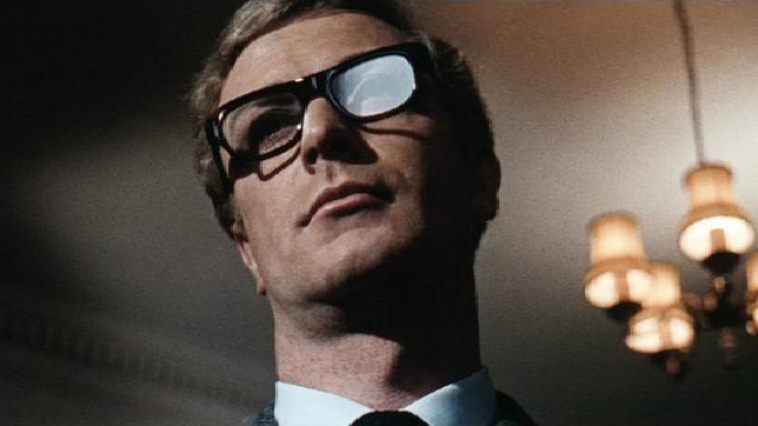
Recently, I picked up several old paperbacks for 50 cents each at Heroes and Dragons on Bush River Road. One of them was The Ipcress File, which is what originally turned me on to spy fiction. You may recall the 1965 film, with Michael Caine — who expressed the cooler, hipper side of the 60s, as opposed to the mass-production James Bond.
In it is a passage in which the protagonist has a conversation with an American Army general who points out that the essential difference between the United States and Europe was this: A European develops a ballpoint pen, and sells it for a couple of quid and makes a modest living from it. An American, he said, invents the same thing and sells it for 5 cents a pop and becomes a millionaire.
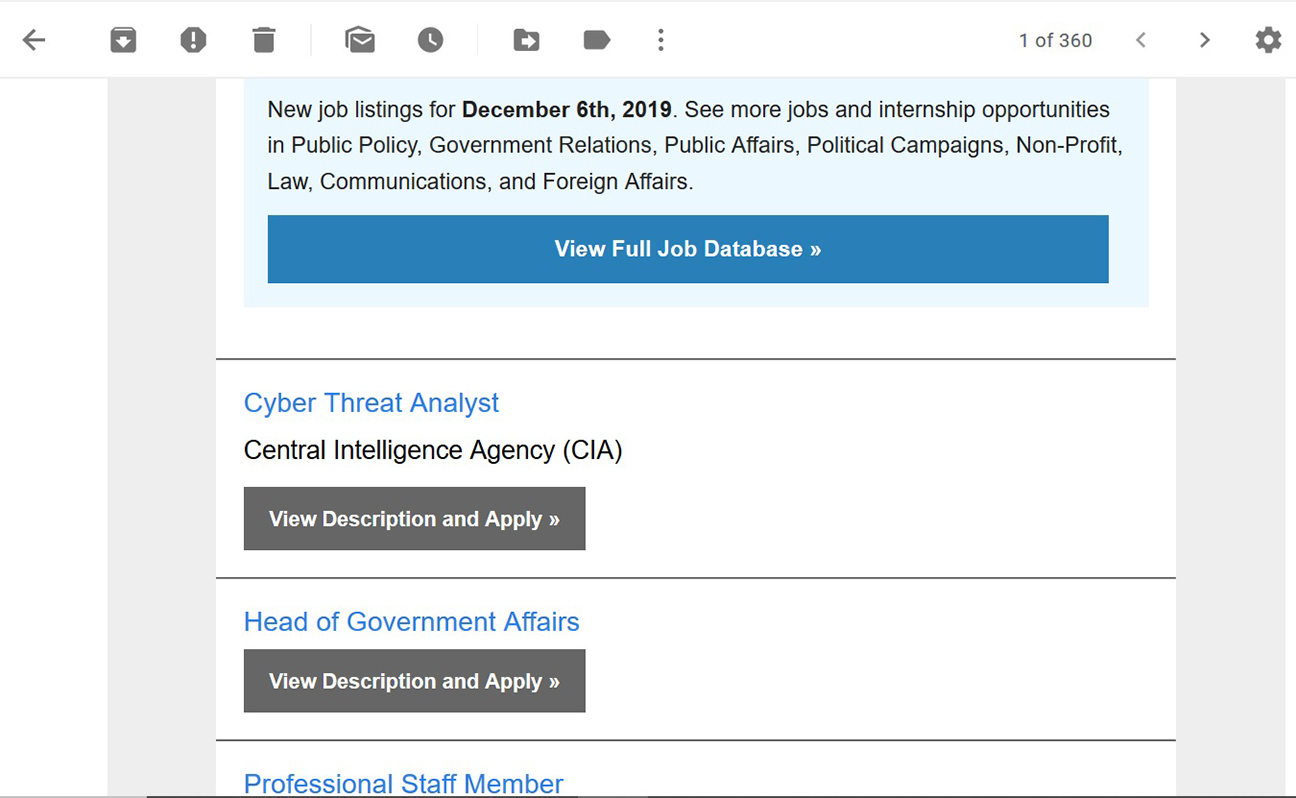
The Central Intelligence Agency is looking for a few good men and women, and what’s more, it wants the next generation of spies to be more diverse.
The highly secretive organization has reached out to big shops on Madison Avenue to evaluate whether they may be suited for working with the CIA down the road on its recruitment advertising campaigns. According to an unclassified document obtained by Ad Age: “The Central Intelligence Agency seeks to build on its existing brand identity and be positioned as the No. 1 employer of choice for a variety of career paths by reaching and engaging with prospective employees.” The document added, the CIA “seeks to optimize its marketability to this audience by focusing on creative and innovative advertising.”
Responses to what the CIA is calling a “market survey” are due back this week. Depending on the answers the agencies provide, it could lead to an official request for proposal.
One key goal of the CIA’s recruiting messages seems to be attempting to attract a more diverse workforce. The document sent to agencies said the CIA is focused on “increasing the percentage of officers from ethic and minority backgrounds, as well as those with relevant foreign languages.”…
I’ve gotta think that there’s nothing new in the CIA looking for “diversity” in its recruiting. The job requirements have always called for it. Yeah, I think I once read that in the postwar period it was kind of heavy on Irish Catholics (or was that the FBI?), but it seems I’ve also heard that field officers tend to be people who had spent extensive time in their youths in foreign cultures.
Or have I gotten the wrong impression?
There was a time when I might have been a good prospect — but I let my Spanish slide after living in South America in my youth.
At one point when we lived in Guayaquil, Ecuador, my parents considered the possibility of sending me to the local school for German expatriates, at which all classes were taught in that language. I didn’t much like the idea then, but that would have been awesome — a working fluency with German at the same time that my day-to-day life was making Spanish second nature to me. I thought and dreamed in Spanish in those days. No more. (Although I suspect it would come flooding back with total immersion, I don’t know that.)
I’ve wondered what course my life would have taken if I’d seized that opportunity to be trilingual.
Oh, well. Even if I had the languages, they’d really have to embrace diversity to hire me. As in, accept trainees over the age of 55…
Looking at Foreign Policy‘s recommendation of a book titled “Confront and Conceal: Obama’s Secret Wars and Surprising Use of American Power,” I’m reminded of something I read in the WSJ this morning.
The administration has made little secret of its near-total reliance on drone operations to fight the war on terror. The ironies abound. Candidate Obama campaigned on narrowing presidential wartime power, closing Guantanamo Bay, trying terrorists in civilian courts, ending enhanced interrogation, and moving away from a wartime approach to terrorism toward a criminal-justice approach. Mr. Obama has avoided these vexing detention issues simply by depriving terrorists of all of their rights—by killing them…
Of course, he goes on to criticize, likening Obama’s personal selection of enemies to kill to LBJ’s micromanagement of bombing targets in Vietnam. He also accuses the administration of politically motivated intelligence leaks way worse than those laid at Scooter Libby’s feet.
The P.M. flashes his famous V-for-Victory sign. We can't tell, from this photograph, whether he was flashing an "E" sign with the other hand.
After The Times played down its advance knowledge of the Bay of Pigs invasion, President Kennedy reportedly said he wished we had published what we knew and perhaps prevented a fiasco. Some of the reporting in The Times and elsewhere prior to the war in Iraq was criticized for not being skeptical enough of the Administration’s claims about the Iraqi threat. The question we start with as journalists is not “why publish?” but “why would we withhold information of significance?” We have sometimes done so, holding stories or editing out details that could serve those hostile to the U.S. But we need a compelling reason to do so.
– Bill Keller, then-executive editor The New York Times June 2006
The apology came a bit late for Kennedy, who died in a traffic accident in 1963.
This is not to confuse him with another Kennedy who also died in 1963, and had earlier persuaded The New York Times to back off the Bay of Pigs story for national security reasons. (See Keller quote above.)
The icing on this tale came today, when we learned that the AP knew last week that the United States was closing in on Underwear Bomber II in Yemen — but withheld the news at the request of the government. That’s what the WSJ reported this morning, anyway:
U.S. officials had known about the plot for about a month, and President Barack Obama was briefed on the plot in April. White House officials had persuaded the Associated Press, which had an account of the plot in hand as early as last week, to hold off on publishing because the intelligence operation was still under way.
This is fascinating. It was one thing to stand shoulder-to-shoulder with government censors in 1945, when the entire country was united in the all-out effort to win WWII, and cooperation with the censors was reflexive.
But today? When it is fashionable to call the War on Terror the “so-called War on Terror”? When, as Keller mentions above, the leftward side of the political spectrum persists in excoriating the media for not being skeptical enough prior to the Iraq invasion? For a major media entity to respond with a snappy salute to a government request to be discrete is decidedly remarkable.
This will no doubt spark dark rumblings — and probably already has; I’m not bothering to look — among Republicans about whether the AP would have agreed to this request if it had come from the Bush administration.
Interesting question.
What do you think about all of this? Oh, you want to know what I think. Well, I don’t know enough to have an opinion yet. I’d like to know what the AP knew, and what it was told before it made the decision to hold back on the story. The default position for a journalist is to report a story when you know it’s true, as Keller reported. But this sounds like it’s one of those rare cases in which lives may have been saved by holding back — which would justify the decision to wait.
President Barack Obama makes a point during one in a series of meetings in the Situation Room of the White House discussing the mission against Osama bin Laden, May 1, 2011. National Security Advisor Tom Donilon is pictured at right. (Official White House Photo by Pete Souza)
OK, my Corleone metaphor aside, let’s address the actual political question before us: Does Barack Obama deserve any particular credit for “getting” Osama bin Laden, or would “anyone have done what he did?”
This is actually a very important question. When deciding who should be one’s president going forward, there is no more important question than whether he would be an effective commander in chief (or in the case of the incumbent, whether he is an effective commander in chief).
Republicans, including some who should know better, are essentially saying Obama did nothing that anyone else wouldn’t have done. They are wrong. I initially thought as they did — not that I wanted to take anything away from the president, but because I thought it was true — but as I read and learned more about the decision-making process leading to the raid on Abbottabad, I changed my mind.
Last night, I inadvertently saw a few seconds of TV “news.” John McCain was saying that of course Mitt Romney would have done the same thing, or something along those lines.
Well, as it happens, we have strong reason to believe that Jimmy Carter would have ordered such an operation. He actually did order a roughly comparable one. It failed, as military operations sometimes do. (The one Obama ordered could have failed, too, at a number of critical points. That’s one reason he deserves credit for having the guts to give the order.) But he ordered it. It was a big deal that he ordered it. His secretary of state resigned over it.
But would “anyone else” have done the same? There is little reason to think so. It would have been Bill Clinton’s M.O., for instance, to have flipped a couple of cruise missiles in that direction. And as we saw in Kosovo, he had a predilection for air power rather than boots on the ground. But… and this is a huge “but”… is it fair to make the assumption that the real-life Bill Clinton of the 1990s would have been as reticent, as cautious, post-9/11? It’s impossible to say.
What we do know is that in real life, there was sharp disagreement and debate in the Obama administration over how to proceed — whether to believe the assumptions based on incomplete intelligence (for doing that, George W. Bush earned the never-ending “Bush lied” canard), whether to act on them at all, whether to send in troops at all or simply bomb the compound, whether to send a joint force or a coherent Navy team, whether to notify the Pakistanis or just go in, whether to try to capture bin Laden or go in intending to kill him, whether to bring back his body or send it to sleep with the fishes.
And when I say debate within the administration, I don’t mean between what the Republicans would characterized as the Democratic sissy politicos, but among the professionals — the generals and admirals and Sec. Gates.
And at critical stages, the president and the president alone seems to have made very tough calls. And the right ones. Most importantly, he decided to send in men rather than just bombs. That way, he could make sure, he could minimize collateral damage — and the U.S. could reap an intelligence bonanza.
That took nerves not everyone would have. So many things could have gone wrong doing it this way — and nearly did. In what had to feel like a replay of Jimmy Carter’s debacle, we lost a helicopter. But having learned that lesson, we had backups.
Some Republicans would have you believe that giving Obama credit would take away somehow from the superb, almost superhuman job that the SEALs and the rest of the military and CIA team did. Nothing could be further from the truth. It stands as one of the most amazing coup de main operations of the past century. They performed as brilliantly as the Israelis did at Entebbe, for instance. But they had their roles to play, and the commander in chief had his. And all involved did their jobs remarkably well.
I refer you to two posts I wrote last year, as I came to the conclusion that Barack Obama personally deserved credit for the leadership calls that led to our killing bin Laden. Here they are:
In invite you to go back and read them, to see how I reached a conclusion very different from the line we’re hearing from Republicans now.
There is no way of knowing whether Mitt Romney would have made the same calls. I suspect that he might have erred on the side of caution, but I could be completely wrong about that. He might have acted in exactly the same manner. But what I know is that Barack Obama did – and that what he did is not just “what anyone would have done.”
President Barack Obama and Vice President Joe Biden, along with members of the national security team, receive an update on the mission against Osama bin Laden in the Situation Room of the White House, May 1, 2011. Seated, from left, are: Brigadier General Marshall B. “Brad” Webb, Assistant Commanding General, Joint Special Operations Command; Deputy National Security Advisor Denis McDonough; Secretary of State Hillary Rodham Clinton; and Secretary of Defense Robert Gates. Standing, from left, are: Admiral Mike Mullen, Chairman of the Joint Chiefs of Staff; National Security Advisor Tom Donilon; Chief of Staff Bill Daley; Tony Binken, National Security Advisor to the Vice President; Audrey Tomason Director for Counterterrorism; John Brennan, Assistant to the President for Homeland Security and Counterterrorism; and Director of National Intelligence James Clapper. Please note: a classified document seen in this photograph has been obscured. (Official White House Photo by Pete Souza)
SPEAKING two languages rather than just one has obvious practical benefits in an increasingly globalized world. But in recent years, scientists have begun to show that the advantages of bilingualism are even more fundamental than being able to converse with a wider range of people. Being bilingual, it turns out, makes you smarter. It can have a profound effect on your brain, improving cognitive skills not related to language and even shielding against dementia in old age.
This view of bilingualism is remarkably different from the understanding of bilingualism through much of the 20th century. Researchers, educators and policy makers long considered a second language to be an interference, cognitively speaking, that hindered a child’s academic and intellectual development.
They were not wrong about the interference: there is ample evidence that in a bilingual’s brain both language systems are active even when he is using only one language, thus creating situations in which one system obstructs the other. But this interference, researchers are finding out, isn’t so much a handicap as a blessing in disguise. It forces the brain to resolve internal conflict, giving the mind a workout that strengthens its cognitive muscles….
Set aside the fact that this NYT piece is written by one Yudhijit Bhattacharjee, who probably speaks at least two languages, since this is written in English. It fits with what I’ve read and heard elsewhere — aside from the fact that it stands to reason.
It also gives me a clue as to why I used to feel so much smarter when I was a kid than I do now. When I was a kid, I spoke Spanish as easily and smoothly as English. I thought in Spanish, I dreamed in Spanish. I learned the language at what was probably the last possible moment for learning it as easily as I did — when I was 9.
I learned it the best way, in a sense — from being forced to speak it. From the time my family arrived in Guayaquil, Ecuador, most of the people I encountered spoke no English. I did take Spanish as a course in school, but that had little effect, as I recall. Probably a bigger factor was that I took half of my courses in Spanish — including history, geography and science. That was at the Colegio Americano. I was in the Clase Especial, which didn’t quite mean what it means here. There, it meant I was in the one class in my grade that was for native English speakers, and that the classes I took in Spanish were actually a grade-level behind my English classes. Near as I could tell, that didn’t put me behind my peers when I got back to the states. And I certainly knew a lot more than the other kids back home about Latin American history. Not that anybody up here cares about that.
I learned a lot of my Spanish at home as well. My Dad at the time was a lieutenant commander in the Navy, which made us modestly middle class at home. But there, we had two maids, one of whom lived with us 24 hours a day. And no, it wasn’t like Downton Abbey. But the maids had no English, and I interacted with them constantly — I had to, to get through the day. The first word I remember learning from them by way of context happened the first couple of days we were in the country. One of the maids started working for us while we were still staying in the Humboldt Hotel on the waterfront. She took us for walk one day along the quay (with me probably fuming because, at 9, I felt no need for a babysitter), holding my little brother’s hand. He was only 3, and of course he wanted to touch everything. She would pull him away, saying in an urgent, admonitory tone, “Sucio!” It wasn’t hard to figure out that that meant “dirty.”
Anyway, when we came back to the states two-and-a-half years later, I had this ability that I was seldom called upon to use. I only took Spanish once in school subsequently, and of course aced the course — even though my grammar going in wasn’t so hot (the result of having learned the language naturalistically, and sometimes from people whose own language skills weren’t the best). When I went to college, my skills were still good enough for me to test out of having to take any foreign language at all.
But since then… it’s been slipping away from me.
About a decade or so ago, we started having masses in Spanish at St. Peter’s. I became one of those who would read the Gospel in Spanish at mass. To do this, I read it aloud multiple times before I leave home, just to warm up the necessary muscles in my tongue and mouth — otherwise, I can’t do the accent. My accent still isn’t perfect when I get up there and read (to my critical ear), but it’s better than that of people who learned as adults. It’s good enough that folks who have no English come up to me after Mass and ask me questions, which only embarrasses me and causes me to say, “Lo siento, pero necesitas hablar con María…” and refer them to our Hispanic Minister.
Because the thing is, I can hardly understand a word they’re saying to me. When I do speak the language (and I only fully understand what I’m reading if I look up some of the words), it’s very halting. And to my mortification, whether speaking or listening, I have to translate the words or idiomatic phrases in my head — which would never have been necessary when I was a kid.
So I think being bilingual made me smarter — I remember the couple of years after I came back as a time when everything, from school subjects to popular culture, gave me a fantastic rush in my brain as I soaked it all up.
House Speaker John Boehner spoke with theWall Street Journal’‘s Peggy Noonan and implied there are some members of Congress who should not be in leadership positions. “We got some of the smartest people in the country who serve here, and some of the dumbest,” Boehner said. “We got some of the best people you’d ever meet, and some of the raunchiest.”
Rep. James Smith and former Blue Cross CEO Ed Sellers were the recipients. It was James (a.k.a. Capt. Smith) who, in his acceptance speech, called Petraeus “the Eisenhower of our generation.” I concur. There’s no general officer in recent years who combines Ike’s strategic vision, diplomatic skill and leadership qualities to the extent that Gen. Petraeus does.
For his part, Petraeus praised not only James and Ed, but the troops he has felt privileged to lead before joining Central Intelligence. He called them “our new greatest generation.”
Those who serve certainly deserve that sobriquet. The difference is that they are only a tiny sliver of an actual generation, unlike the one that overcame the Depression and beat Hitler and Tojo.
Which only underlines how much the rest of us owe to them, each of them, from the commanding general to the lowliest buck private.
To get to the bottom of things, I had my assistant Una dump McDaniel’s state IQ numbers into a spreadsheet, weight them by population, and then divide them into three groups: red for states consistently choosing Republicans in the last three presidential elections; blue for always voting Democratic; and purple for swing states.
Result: average IQ for red states vs. blue states was essentially the same (red 99, blue 99.5). Conclusions: Are liberals smarter than conservatives? Some social scientists sure think so. Are blue states smarter than red states? Sadly for us cyanophiles, no.
But here’s the most significant data point, I think: in the purple states — the ones that swung back and forth — the average IQ according to Una’s spreadsheet was 100.9, appreciably above that for either the blue states or red states. In other words — and this has the shock of truth — the people in the purple states weren’t rigidly liberal or conservative, but rather had enough on the ball to consider the choices before them and occasionally change their minds.
So, it comes down to what I’ve been telling y’all over and over: We swing voters are the people who actually think about our votes. It stands to reason that places where we predominate would be smarter.
I’ll bet his assistant, Una, is one of us. Bet she’s good-looking, too.
This inspires a possible tagline for the UnParty: “We’re way smarter than the rest of y’all.”
OK, so it could use some work. For instance, the word “y’all” might be over the heads of folks in blue states.
Well, I finally got to see the film I’d awaited for a year, and which opened in Britain in September, and in other parts of this country in December. Thanks to the Nickelodeon for bringing it here (you can still see it there through Thursday).
And the verdict? It was good, very good. You should definitely see it, whether you’ve read the book or not, and whether or not you, like me, own the 1979 TV series on DVD.
Was it as good as that, the Alec Guinness version? No. Still, that leaves a lot of room to be very good indeed. (The series was one of the best things ever made for television.)
The film was slicker, certainly, with more impressive production values. But that’s to be expected. Everything I had read about the film’s effective evocation of mood was true. I don’t know what sort of process the film was run through, but it seemed to have been subjected to something akin to what was done with “Saving Private Ryan.” Only there is a rustiness to the scenes, rather than the greenish cast.
And Gary Oldman is wonderful, as usual. Afterward, my wife was asking where she had seen him before. She couldn’t recall. Was it just that the actor is such a chameleon? Yes, he is (as you can see here and here and here and here and here). Which makes him perfect to portray the forgettable, unremarkable George Smiley. In his own way, perhaps even as good as Guinness.
On the whole, a very good job was done in spite of not having the six hours that the TV series had to do it in.
That said, I have a number of objections, and they are mostly of the pedantic, fanboy sort. They have to do with inexplicable changes in the stories, and the characters — changes that are not excused by the demands of brevity or limitations of the medium. Changes that in some cases unnecessarily complicate the story, even making it less credible.
I’ll warn you now with a SPOILER ALERT, but ask you to return and review my list after you’ve seen the film:
Why on Earth does Control send Jim Prideaux to Budapest, rather than Czechoslovakia? Why make the alleged contact Hungarian? A totally gratuitous change. No harm, but unnecessary. As I viewed the scenery, I wondered whether it was easier to get establishing shots of Budapest that looked as they did in the 70s. But so what? The action, in the book (and the TV series), took place near a cabin out in the woods. There was NO need for an establishing shot, as the locale was generic. It could have been shot anywhere.
Why, indeed, was Jim shot in an urban setting? Just so we could be horrified by the unnecessary death of a particularly vulnerable innocent bystander — an incident completely missing from the original story?
Why did Colin Firth get so little to do in the film? I had assumed that he signed on because the role of Bill Haydon was such a meaty one. Haydon was not only the critical character in the story, he was a particularly charismatic and tragic figure, the hero to a generation of intelligence officers, a flamboyant and brilliant presence, a source of cuttingly ironic remarks, the cynosure of regard by all. And yet, except for a couple of obligatory scenes, he is hardly drawn for the audience at all. (This is one thing that perhaps could be explained by the need for brevity, of course, although it’s an insufficient excuse.)
Given that there is so little time to explain what must be explained, why is a scene added that does nothing but tell us that one of the characters is gay? A character who, by the way, is not gay — to the extent that one respects the book. (Another key character was bisexual — which is accurately touched upon in the film.) Peter Guillam is perhaps the closest to a “James Bond” type you find in the novel — a relatively uncomplicated tough guy (head of the department of tough guys, Scalphunters) with a penchant for fast cars and beautiful young women (something you see more clearly explicated in later books). Why do this? It advanced the story in no way.
For that matter, why was Guillam not portrayed as Smiley’s close friend? The first thing we hear him say to George is to address him as “Mr. Smiley.” In the book, Peter takes George out drinking after Smiley is fired. In this film, George’s sacking is portrayed as a long walk out of the building with Control, who was close to no one. Peter is just one of the people who watch him go. This is no minor detail. In the film, you are left to wonder why Peter is the one person still at the Circus whom George trusts. In the book, you knew why. He was like a Watson to George’s Holmes.
You are particularly left to wonder about that because, in the film, Peter is not that critical to setting the action in motion as he was in the book. And THIS is the biggest unnecessary flaw in the production, one that actually matters. For some bizarre reason, we are asked to believe that a mere phone call from low-level Scalphunter Ricki Tarr to senior bureaucrat Oliver Lacon (one of the few in Whitehall with keys to the secret kingdom) causes Lacon to contact George and launch him on his hunt for the mole. (Lacon hadn’t believed Control when he had alleged the same thing; it is utterly incredible that he would take such extraordinary steps on the word of the mercurial, untrusted Tarr.) We are halfway through the film when Tarr emerges from hiding to tell Smiley his story. This is completely absurd. In the book and series, Tarr contacts his boss, Guillam, who then contacts Lacon (because he is senior enough to do so and be heard), and his detailed story is what convinces Lacon, Guillam and Smiley that there is a mole at the Circus. Without that, there is no credible basis for the investigation that is the plot of this story.
A side casualty of this strange twist is that what should be the tensest scene in the film is missing something critical. When Percy Alleline calls Guillam on the carpet and accuses him of consorting with Tarr (officially regarded as a defector), Peter lies masterfully in the original. In this film, he doesn’t have to lie, because he has not seen Tarr.
Yesterday I mentioned that an unlikely actor was chosen to portray Jerry Westerby. Having seen the film, I wonder why the character was even given that name. In the film, they essentially call Sam Collins “Jerry Westerby.” I understand combining characters in movies, but this isn’t a combination; it’s a substitution. The part the character plays in the story is in every detail Sam Collins, and he in no way does or says anything that Westerby did or would have. Strange. Now that they have confused things to this extent, it will be even harder to make a sequel out of the next book in the series, in which Westerby is the title character.
Then there is all the gratuitous depiction of violence, twisting credibility in order to show blood. Pure Hollywood, I suppose. There’s quite a list, starting with the nursing mother who is accidentally shot in Budapest. Tufty Thesinger is brutally murdered in his office (which is also in the wrong country, by the way — why Istanbul, instead of Lisbon?). So is Boris. Tarr actually sees the brutally beaten Irina carried onto a ship on a stretcher (in the book, he persuaded a witness to tell him of seeing a woman placed on a plane). Irina is shot, shockingly, in front of Jim Prideaux during his interrogation, instead of being eliminated far from anyone’s view in a cell at Dzerzhinsky Square (in the book, Prideaux would never have met Irina, or known she existed). Then there was the implied violence of Toby Esterhase being threatened with immediate extradition — the realization of what he had done should have been enough, as it was in the book and series, to turn him.
Speaking of violence, there is the completely unnecessary change in how the mole Gerald meets his end. Is it really that much more appealing to movie audiences to see a man killed at long distance with a rifle than to get his neck broken with his killer’s bare hands? I wouldn’t complain, except that it makes the mole’s last-second recognition of his killer (which is important to the arcs of the characters) a little harder to believe.
One tiny, last detail — in the TV series, they at least showed George Smiley living on Bywater Street. In the film, it was somewhere else. Probably no one but me would be bothered by that. And it’s forgivable. Perhaps the neighbors wouldn’t allow it; I don’t know.
But other than all that, it was great. Don’t mind me. Just go see it. In fact, if you are a le Carre fan you must see it; excuses will not be tolerated. I look forward to discussing it with you.
Outside Smiley's house on Bywater Street. No need to knock. George knows I'm here. And where's he going to go? It's a cul de sac. It's over, old friend.
I’d been holding this back for when the movie comes out, but now that it’s passed me by (although I look forward to its being at the Nickelodeon next month), I am much embittered and have decided to go public with the whole story — the Official Secrets Act be damned. See how they like it when it’s all laid out in the papers. Perhaps I’ll go with The Guardian; that should sting. Let Parliament launch an inquiry. Let them connect me to the notorious Rebekah Brooks, for all I care. (After all, I’ve done a freelance job for that same outfit, in the time since they cast me out.) I’ve been a good soldier, put in my time, watched and waited. All for naught. Here’s my story…
As you know, I went to the UK a year ago, ostensibly as a tourist. That wouldn’t fool a real professional, of course, but one keeps as low a profile as one can. I have my own tradecraft for this sort of thing — I make a big splash, publicize my whereabouts… what spy would do that?
It was quite a challenge. George hasn’t been seen since 1982. And the original location of the Circus, now that MI6 has the River House (all mod cons, as Bill Haydon would say), is shrouded in service legend. It’s not something you’d assign to some probationer straight out of Sarratt.
First, we spent a couple of days settling in, establishing patterns. One assumes that tiny Toby Esterhase‘s lamplighters are everywhere, so you need to paint them a picture, let them get complacent. This we did — from Heathrow to Swiss Cottage (the very spot where General Vladimir would have been picked up as a fallback, had he not been killed on Hampstead Heath), then all over the city on the Tube, aimlessly. Trafalgar Square, St. James’s, Fortnum’s, Buckingham, the Globe, the Tate, the Cabinet War Rooms, the Tower, hither and yon in the City.
Finally, at the end of our third full day, after night had fallen, we ambled up Charing Cross Road, affecting to be interested in bookshops. We almost missed it, but then there it was — the Circus itself. There was the Fifth Floor, and even Haydon’s little hexagonal pepperpot office overlooking New Compton Street and Charing Cross. Quick, I said, get the picture. It took a couple of tries, the way these things do when you need to hurry. Thank heavens for our “tourist” cover; it excuses all sorts of odd behavior. Then on up the street, and an hour or so of browsing at Foyles to check our backs. Found a couple of decent-looking biographies of Lord Cochrane, but didn’t buy one. (They had shelf after shelf of naval history; it went on and on.) Then we wandered about in the West End, to clean our backs as much as possible, before heading back to Swiss Cottage.
One thing down. Hardest part to come.
By this time, I had decided not to risk the actual modern HQ of the SIS. Mix fact with fiction like that, and it’s like mixing matter and antimatter. Could blow you clear across the universe, or at least to Brixton, and who wants to go there, really? That’s why they put Scalphunters there.
Then, it was our last day in London. Had to go to Oxford the next day, and check on Connie. Connie is high-maintenance. So it was do-or-die time. We opted to do.
We thought that twilight would be the best time to descend on George. Vigilance is low. Everyone’s tired then; time for tea and meet the wife. So we went to that general part of town. Spent several hours at the Victoria and Albert. Loads of statues and the like.
We took the Tube to Sloan Square, a good half-kilometer from Bywater Street, and went the rest of the way on foot. We entered the cul de sac as night descended (which it does before 4 p.m. at that time of year). There wasn’t a soul on the narrow street. Everything went smoothly. When we got to the part where Smiley lives, I tried to throw the watchers off by shooting pictures of houses other than his. In a way, though, they were all relevant. George lives at No. 9, of course. But the 1979 TV series was shot at No. 10. And No. 11 has a Banham security system, which the book describes as being on George’s house. No. 9 has an ADT system.
Anyway, after doing what I could to distract any lamplighters in the vicinity, I had J (her workname — best watcher in the outfit, is J) quickly shoot a happy snap of me in front of No. 9. She was a bit nervous, because there were lights in the basement-level windows. She said people who lived there would wonder what we were doing. I muttered no, they wouldn’t: “They know exactly what we’re doing.” The thing was to get it over with quickly, so we did. Given the hurry we were in, I’m struck, as I look at the image, by how placid and dispassionate and, well, Smileyesque I look in the image. Like I was channeling him in that moment.
I can hardly remember the next couple of hours, but I can’t forget the stroke of luck that befell us later. Nothing short of a miracle, it was.
We had decided to case Victoria Station and its environs, because we knew we had to catch a coach there for the trip to Oxford next morning, and it’s good tradecraft to reconnoiter these things ahead of time. We got a bit turned-around there, and ended up touring the whole station before we discovered that the coach station was on the next block. On one aimless pass through the vicinity of the ticket windows, I looked up and there he was. George himself. Right out of the first paragraph of this passage:
He returned to the railway station… There were two ticket counters and two short queues. At the first, an intelligent girl attended him and he bought a second-class single ticket to Hamburg. But it was a deliberately laboured purchase, full of indecision and nervousness, and when he had made it he insisted on writing down times of departure and arrival: also on borrowing her ball-point and a pad of paper.
In the men’s room, having first transferred the contents of his pockets, beginning with the treasured piece of postcard from Leipzig’s boat, he changed into the linen jacket and straw hat, then went to the second ticket counter where, with a minimum of fuss, he bought a ticket on the stopping train to Kretzchmar’s town. To do this, he avoided looking at the attendant at all, concentrating instead on the ticket and his change, from under the brim of his loud straw hat…
Apparently, our appearance at Bywater Street had sent him on the run, but we had stumbled into him anyway. I left him alone, except for grabbing this picture. You doubt that’s George Smiley? Look at this picture, and this one and this one, and then tell me that. ‘Course it was him. Stuck out a mile.
But now that I’d found him, what was the point? He was just my old friend George. I could hear Toby’s triumphant voice in my ear: “Brad! All your life! Fantastic!” But I ignored him. I got the picture, and moved on. I didn’t even look to see whether he had left Ann’s lighter on the floor.
My mission had been accomplished, and then some… Why did I not exult? All I felt was the urge to polish my glasses with the lining of my tie. But I wasn’t wearing a tie…
Longest queue in the world, waiting at Heathrow to get into the country. Trying following me in THIS, Toby!
There were many dangers on this mission; not all of them were this obvious.
On the way to Trafalgar to establish my tourist cover, I stopped at a Virgin store for a couple of cheap mobiles, just for this mission.
This lass tried to pass for “Mrs. Hudson” at The Sherlock Holmes Museum. Wouldn’t fool a child. When I tried to get her picture, she ran.
The coat Nelson wore at The Nile. He was a LITTLE guy…
Make like a tourist, keep the camera clicking…
Astride the Prime Meridian, in the rain. The real tourists were queued up to pose before a plaque, for some reason.
I posed for the usual tourist snaps, so the important pictures would seem natural.
The Circus itself, looming darkly back behind the bus.
Killing time, watching our backs at Foyles. They have two whole shelf sections of naval history.
After the Circus, we went underground, to the Cabinet War Rooms. These chaps are made of wax. Permanent stiff upper lips.
These “Chelsea fans” affected to be interested in something else as they followed us to that part of town.
Getting lost among the statues at the Victoria and Albert, preparing to make our final move.
This shot from inside the museum captured my mood as the do-or-die moment came.
Outside Smiley’s house on Bywater Street. No need to knock. George knows I’m here. And where’s he going to go? It’s a cul de sac.
As I looked up at the Christmas lights in the trees on Sloane Square, they were as blurry as the stars in a Van Gogh.
A phone-booth sized loo at Sloane Square. Note that the building in the background looks eerily like the Circus.
At Victoria Station, suddenly, there was George himself!
I’m sad to see that Christopher Hitchens is no longer among us. On a trivial level, I’m sorry because reading him was such a guilty pleasure, as he sliced and diced viewpoints — and people — with whom he disagreed.
On a deeper level, I have the traditional regret, as a Catholic, for the loss of an unshriven soul. Not that I wanted to see Hitchens make a deathbed conversion. That would have seemed cheap theatrics, and it would have sent the wrong message — that our relationship with God should be based on existential terror. I just wish he’d changed his mind at some point, before now.
It was always impressive to see the way his mind worked, fairly crackling through any subject you may like, and totally unapologetic for opinions that were unpopular. And I don’t just say that because he agreed with me on Iraq, which probably distressed a lot of his free-thinking friends.
But I mourn the fact that his incisive, energetic mind always came up with the wrong answer when it ran the God equation. He would have been a good one to have on the other side. You know, the side of the angels, as they say.
As a believer, then, it falls to me to say, May God have mercy upon his soul. And I mean it. I wish him the best in the life he did not expect.