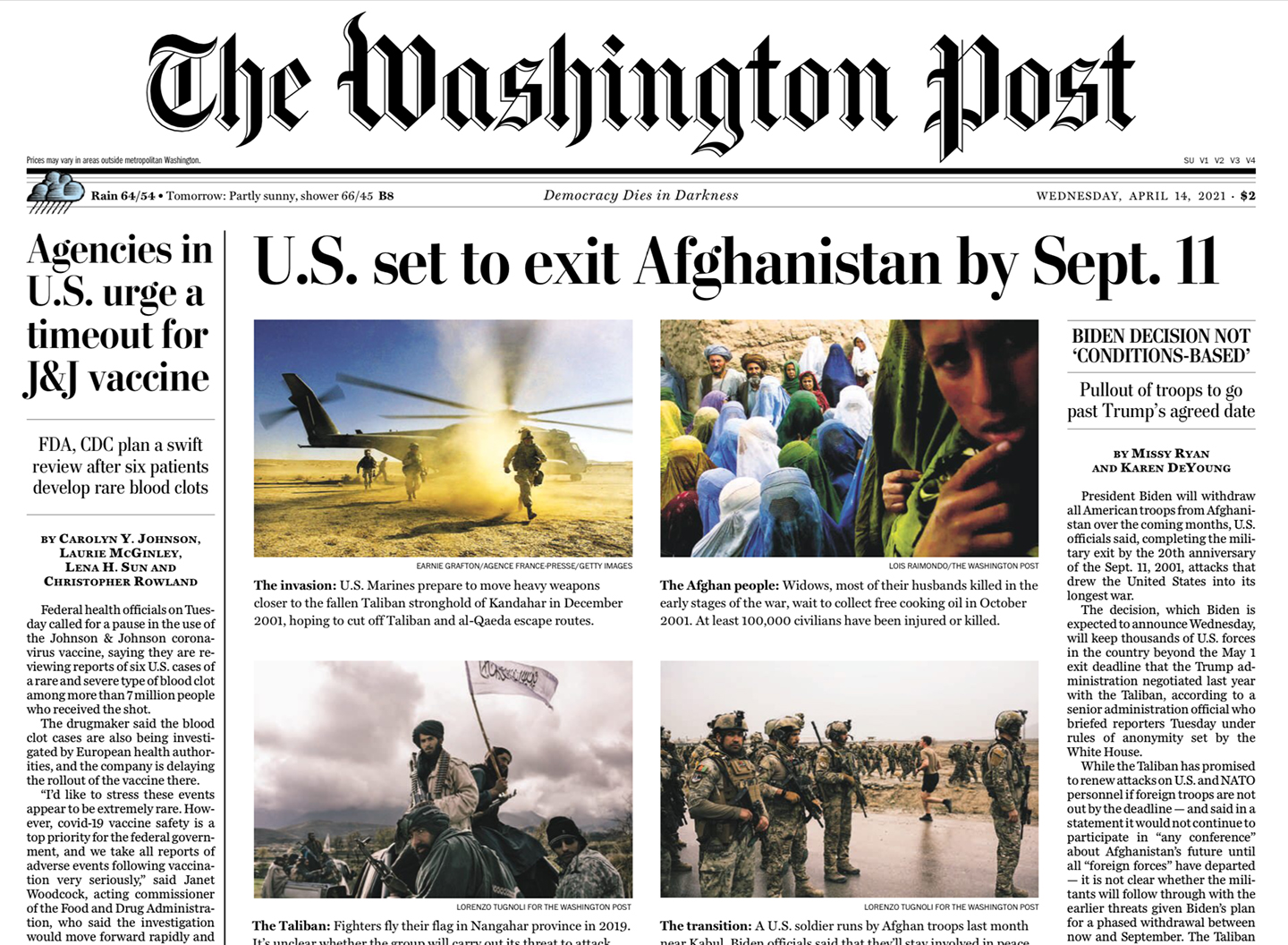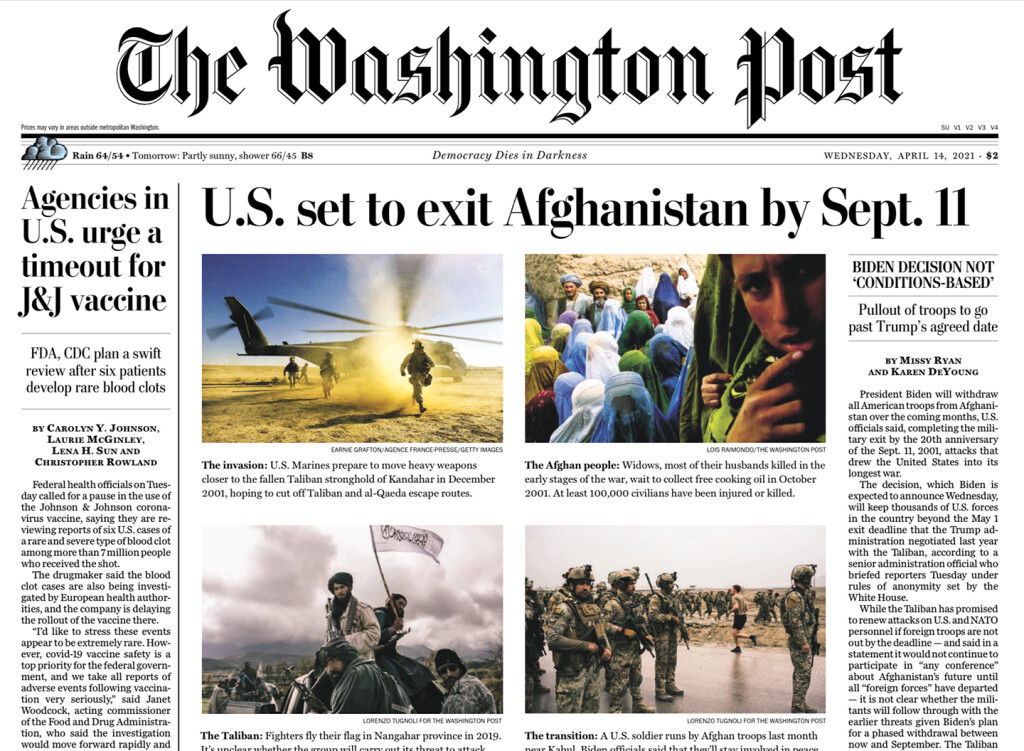
The Post’s print edition had the Afghanistan story presented with proper perspective. But how many people still read the Post this way? I don’t.
I could go on about this all day, for many thousands of words, and it would bore you to death, so I’m going to try and say it as quickly as I can.
Back when there was such a thing as newspapers (by which I mean healthy, adequately staffed newspapers in cities across the country), senior people with many years in the business would spend considerable time each day meeting to hash over what they had for the next day’s paper. They argued vociferously over the relative weight to be given to each story, to decide first whether it would made the front, and once there, would be accurately played to reflect its relative importance in relation to the other stories on the page. (There was never much time for the senior group to discuss relative play in the rest of the paper; such decisions were made at a lower level.)
During a certain part of my career — when I was the news editor in Wichita — I was in charge of this process. The assigning editors from each area (and I, in the case of national and international news) would present what was available that day and what was known about each story at that point, and then we’d discuss what to do with each — what would make the front, and how it would be played in relation to the other 1A stories. Then, since production of the front page was the most prominent of my many duties in that job, I would go out and implement the plan.
Our executive editor at that paper, Buzz Merritt, had very definite and detailed ideas about how things should be presented on the front page. I’ve written about this before. He had such an arcane set of rules we should follow that the designers who worked for me were frustrated and intimidated, always sure they’d do something wrong and draw his ire, and far too often, I just went ahead and handled front page and A section production myself. This was a personnel problem I never succeeded in solving at that paper — I did it because I understood what Buzz wanted, but others did not. (They tended to see his system as a set of unworkable principles about the length of the book of Leviticus.) So I found myself spending the rest of the night down in the guts of the machine doing the work, rather than supervising the process. It was a mess.
I don’t blame Buzz for this. I agreed with his views about what the front should be. And I labored mightily to explain it to my unconvinced subordinates. But for this discussion, I’ll just focus on one, simple concept, sort of the Great Commandment of Buzz: He insisted that a lede (here’s a brief explanation of what a lede story was, as he defined it) should communicate one thing very clearly to the reader, even the casual reader, whether consciously or not: Is my world safe?
So much of what we did centered on that. The lede was the most important thing happening in the world, although it might not be a particularly interesting story — in which case it would have a very small headline, and the reader could glance at the part of the page where, under Buzz’ rules, the lede always was, and know: My world is safe enough that I don’t even need to read the lede story unless I want to. I’ll move on to something that interests me more.
That’s a small thing, right? But it translates to a huge service provided to society — that the most reliable and comprehensive news source available to citizens every day (and that’s what the daily paper was, in communities across the country) gives everyone a sense of perspective on the world.
Nobody does that any more, at least not in a way that it provides a shared perspective for a significant portion of society to work from. Which is one of many reasons why we’ve gone from living in a world in which we could all agree on what reality was, and then argue over what to do about it, to a world in which there is little general agreement about the situation before us. So the tribes of liberals and conservatives and all the smaller tribes can’t (and won’t) talk with each other meaningfully about what do DO about reality, because they have different realities.
I’m not blaming anyone for this; everyone’s doing the best they can under the circumstances. And I have no prescriptions: I’m not at all sure that anything can be done about this loss, given the current state of technology and the media marketplace in which we now dwell. (I’m not going to try to explain why that is the case here because I’d never get up from my keyboard, although maybe I’ll elaborate some if y’all are interested in a discussion), but I’m just making the observation that we have this problem. And I’m thinking about it today because of a particularly clear example of it that stands before me.
Which is the actual point of this post.
At one point yesterday, the news broke that Joe Biden planned to withdraw entirely from Afghanistan, without conditions, by Sept. 11. And The Washington Post, which still has many senior, serious editors overlooking the process (for which we can thank Jeff Bezos I suppose), led their browser-based interface with a very large headline to that effect (sorry, I didn’t do a screenshot at the time that I can now show to you, and I can’t now because it no longer exists).
Anyway, that was the right call, for the moment. Not a hard one to make. That’s pretty much a consensus call: Were we back in the ’80s when I was handling the front page of the Wichita paper under the watchful eye of Buzz, I assure you that would have been the lead story on the front of just about every metropolitan-or-larger daily in the country — with some deviation from that norm in markets where there was a huge, overriding local story that day.
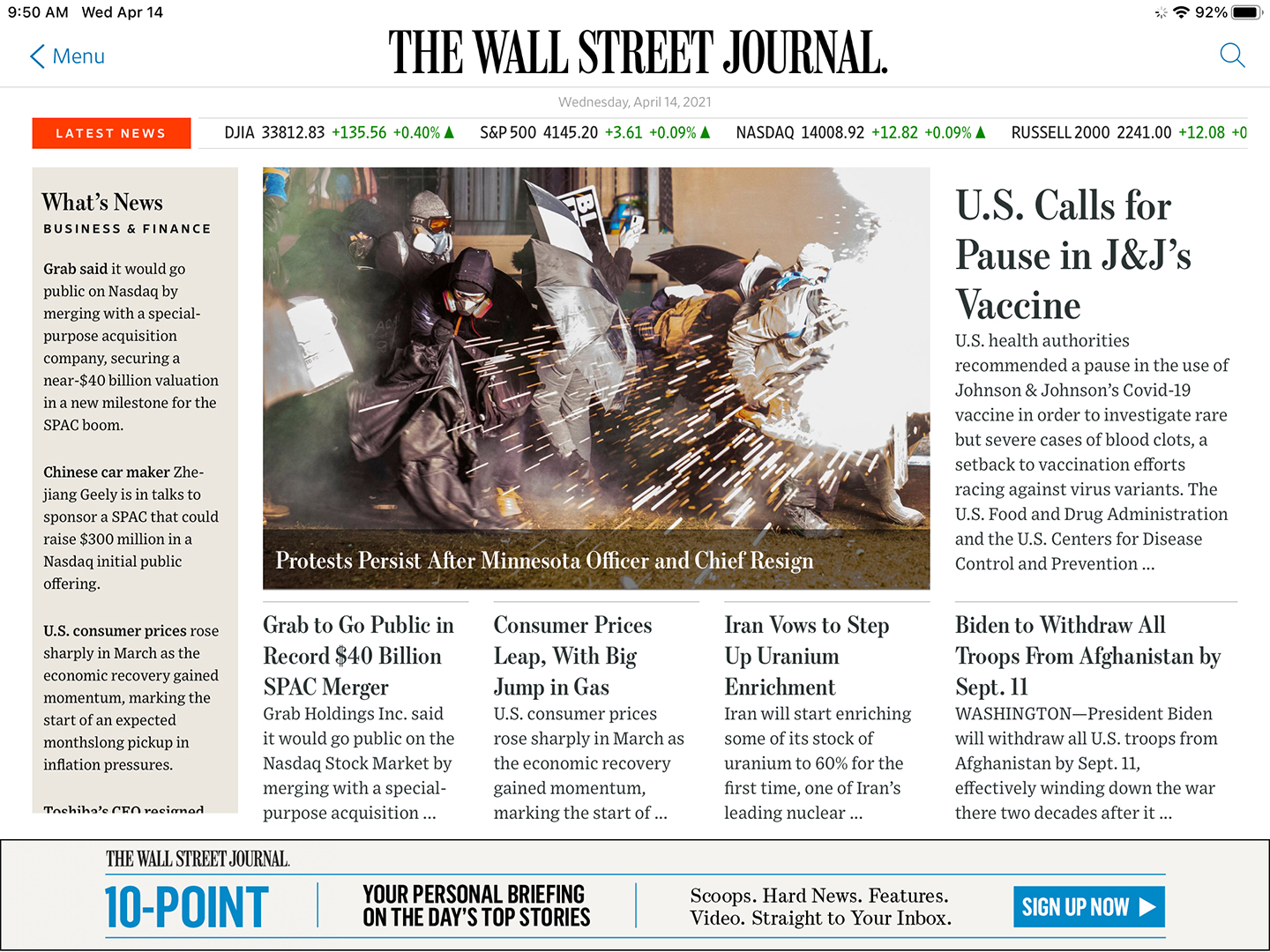
But then this morning I was looking at my Wall Street Journal app, and noticed something: They had the Afghanistan story prominently displayed, but it wasn’t the lede. They went with the pause on the Johnson & Johnson:

On the one hand this is significant because the WSJ‘s app, unlike a lot of apps, pretty much apes the makeup of a print page, and it doesn’t change during the day (they have a separate interface on the app for the latest news). Of course, the Journal — while it has become more and more conventional in its approach to news play in recent years, is still somewhat idiosyncratic, causing it to play business news (its old wheelhouse) bigger than other things. And Johnson & Johnson is, after all, a business.
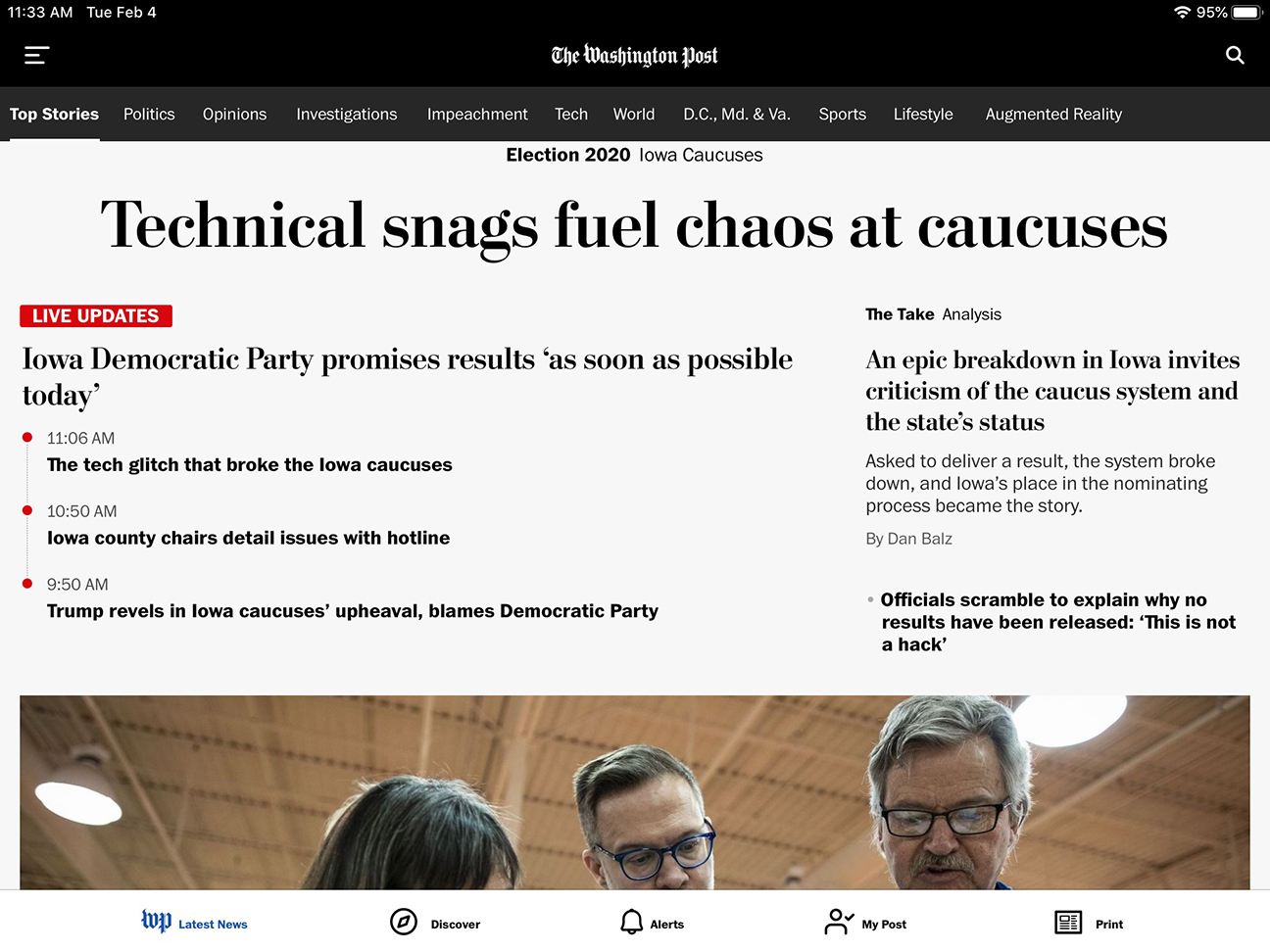
So I went to look at a more conventional paper, the Post — which, if you’ll recall, was leading with Afghanistan yesterday when it first happened. Here’s what I found:

No mention of Afghanistan on the first screen — it’s all J&J and the Chauvin trial.
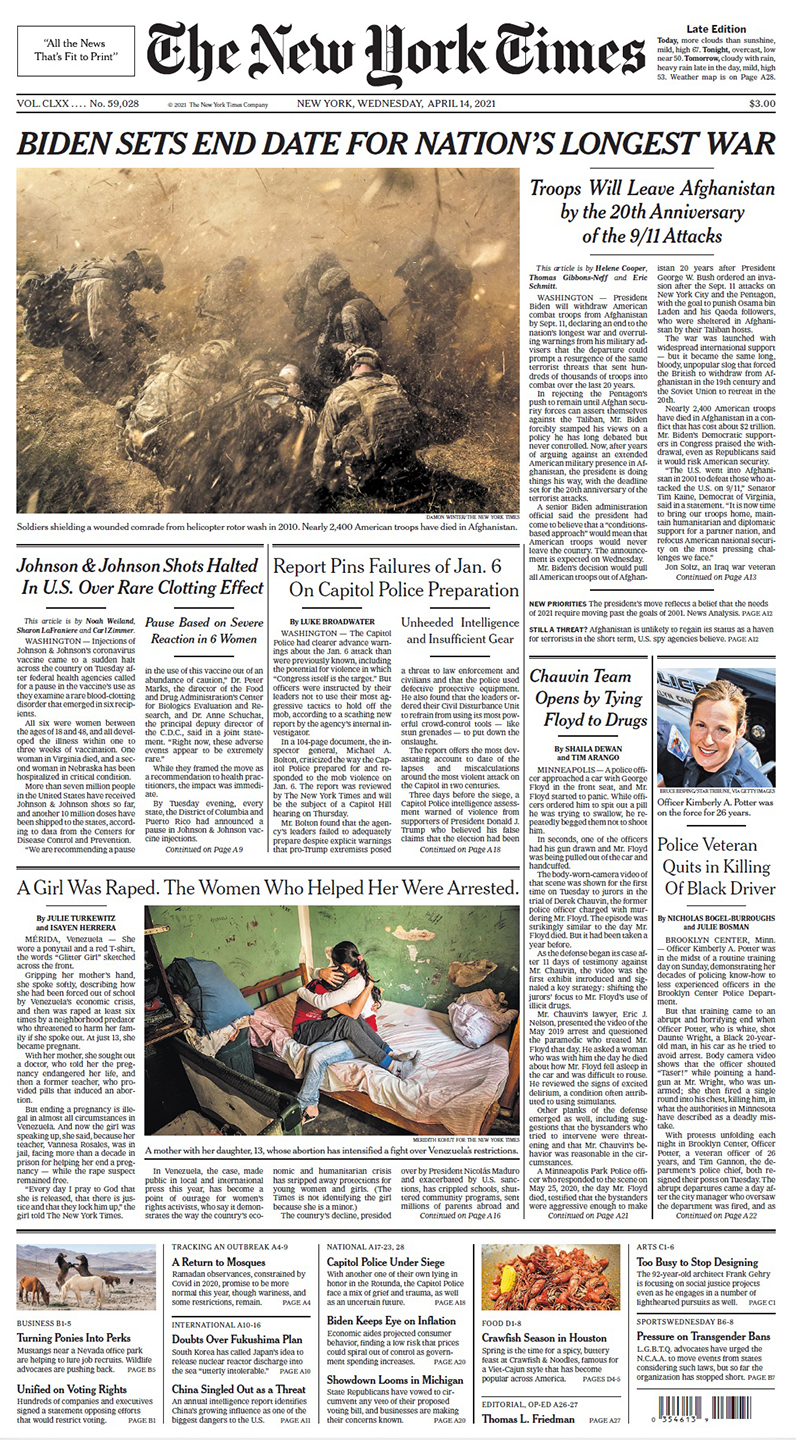
That’s the way things are done now. To see the way the Post would have done it in the old days, you look at the actual print product that was delivered this morning to the homes that still take it. It’s at the top of this post. Not only is Afghanistan the lede, but it’s a big lede — four columns, with only one other headline above the fold — a single-column hed on J&J.
Anyway, it’s like looking at an artifact from another time: The morning newspaper, putting the entire previous 24 hours into global, historical perspective. You can read it today, or look back at it 20 or 100 years from now, and it will clearly and unambiguously tell you what was most important among the things that happened on April 13 in the Year of Our Lord 2021.
Which is a fine, solid, reliable and helpful thing to have, if you want to be well-grounded in what was happening on Tuesday. But who will benefit from it? How many people will even see the print version? For that matter, I sincerely doubt that those people looking back 20 or 100 years from now will be looking at the print version, unless they possess the kind of esoteric, geeky understanding of the way newspapers worked a few years ago — and still do, on the print version, when they have the people to do it. That last point is a qualification that few papers can boast today. And even those that can do it, only do it on the print version.
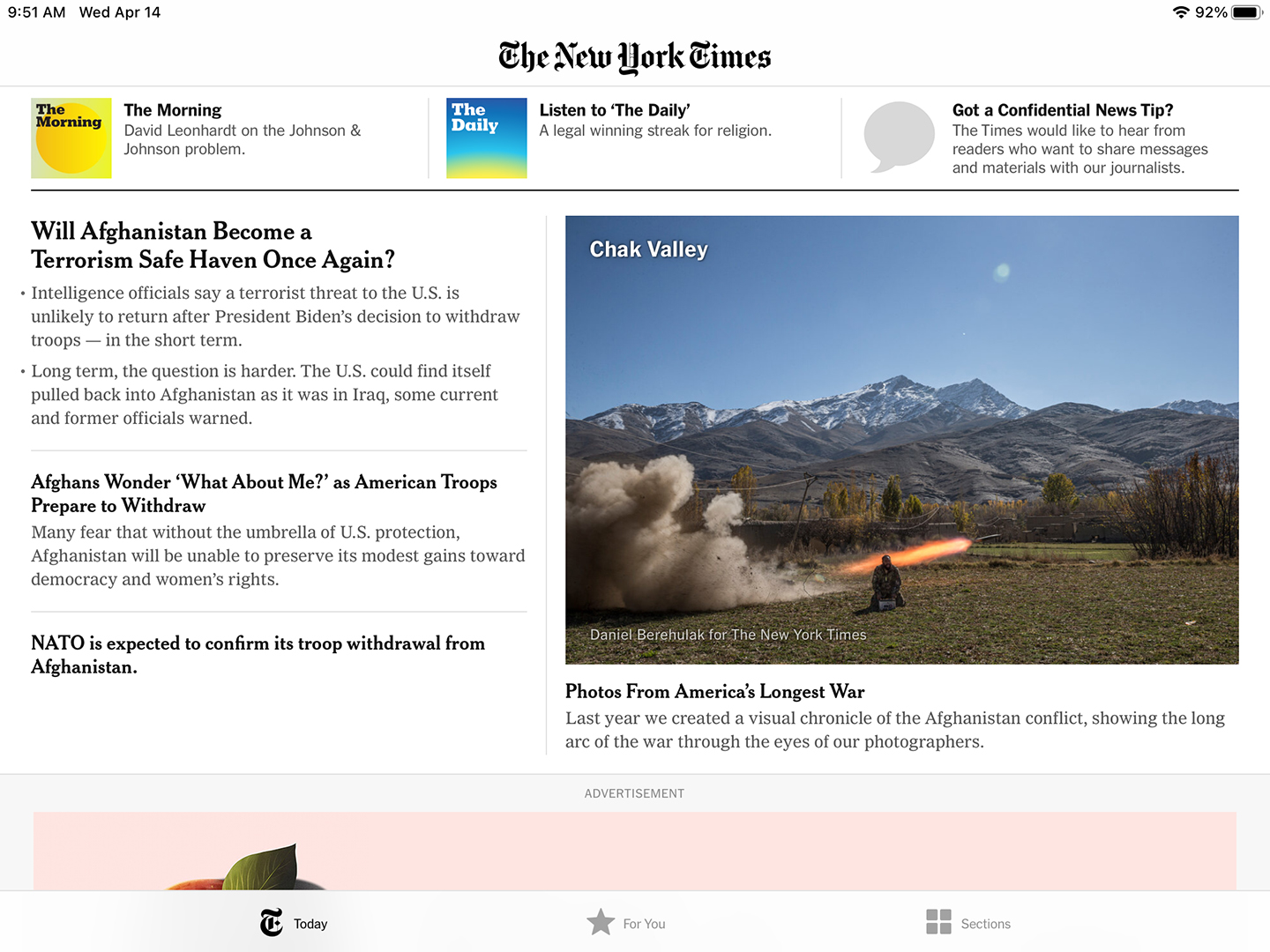
But, I’ll end on a higher note: The New York Times found a way today to keep today’s proper lede at the top even on their iPad app — while still reflecting that in proper 21st-century fashion, time moves on quickly:
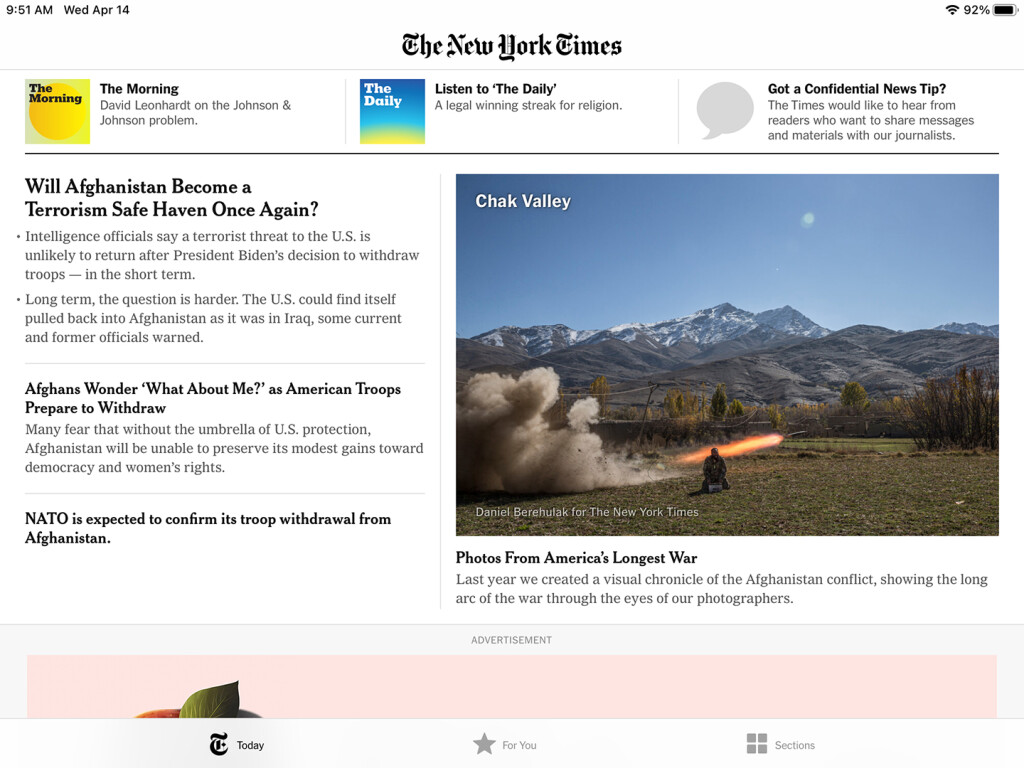
Of course, they did it with a second-day hed. No ringing, historic “U.S. to exit Afghanistan by Sept. 11.” Assuming you know that already, they go with the analysis story: “Will Afghanistan Become a Terrorism Safe Haven Once Again?” They go on to, “What happens next?” So they’re readers, particularly the younger ones, don’t think they’re a bunch of old fuddy-duddies who don’t know how a smart phone works.
I’m impressed, but not a bit surprised. The New York Times is the most conservative major newspaper in America. This may confuse some people, but remember I’m a geek. I’m not talking ideology. I’m saying that for my entire career, the Times has been the most reliably Old School paper around, the very epitome of the kind of steady, reliable approach to presenting news that Buzz embraced, and aspired for the Wichita paper to achieve. I know this because every night when I was agonizing over my front page out in Kansas, I would see the advisory the Times put on the wire stating what they were planning for their front. If it was close to the calls I was making at that point, I’d feel some reassurance. If it wasn’t, I’d take a harder look at my own plan. It might stay the same — they were serving a different readership — but I’d think harder about it anyway, because they were that good at news play. That was something I had never fully realized until I had that job, and a boss like Buzz, and spent that much time looking at what everybody else was doing night after night — and thought hard about it.
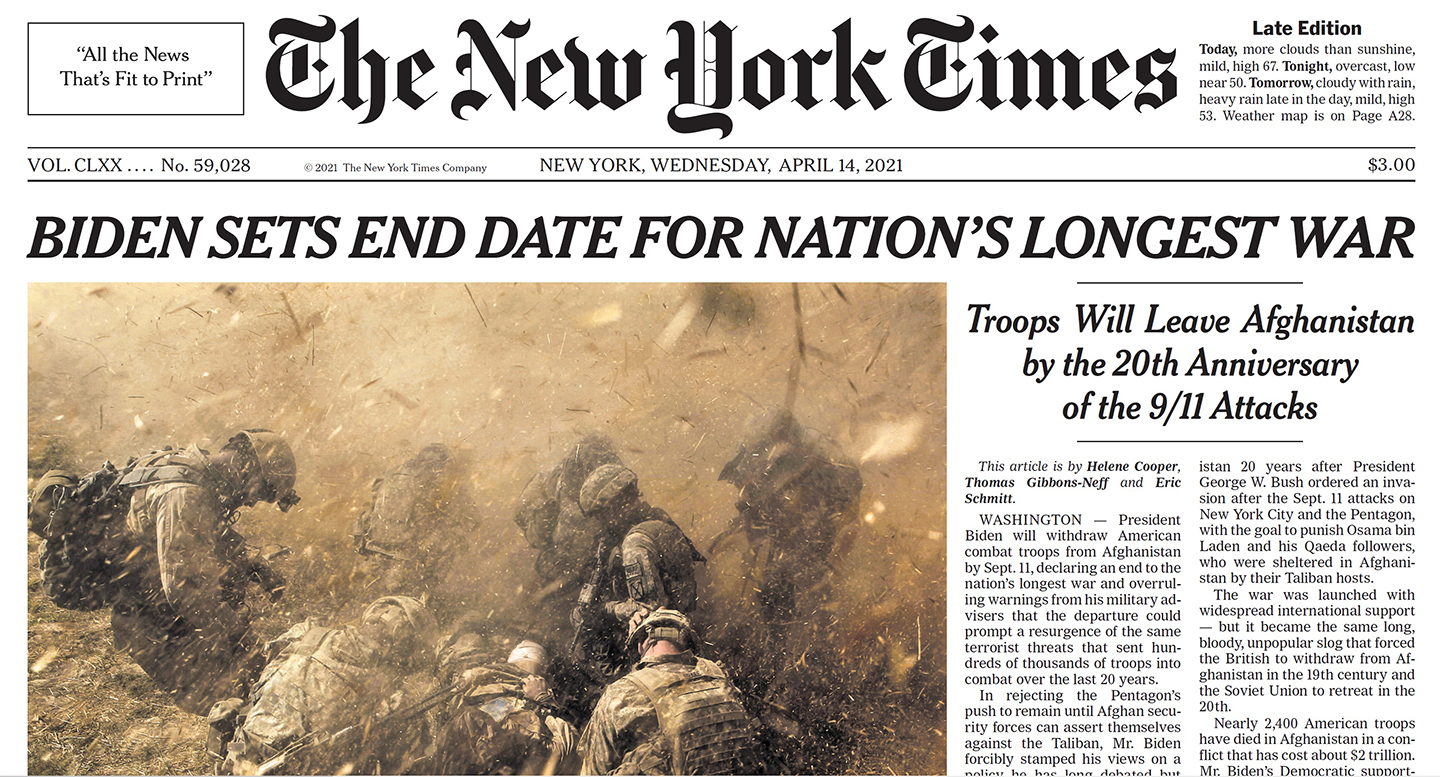
And the NYT is still that good at front-page play. Here’s the top of their print version this morning, which is perfect, because this was indeed a banner-headline-lede day:
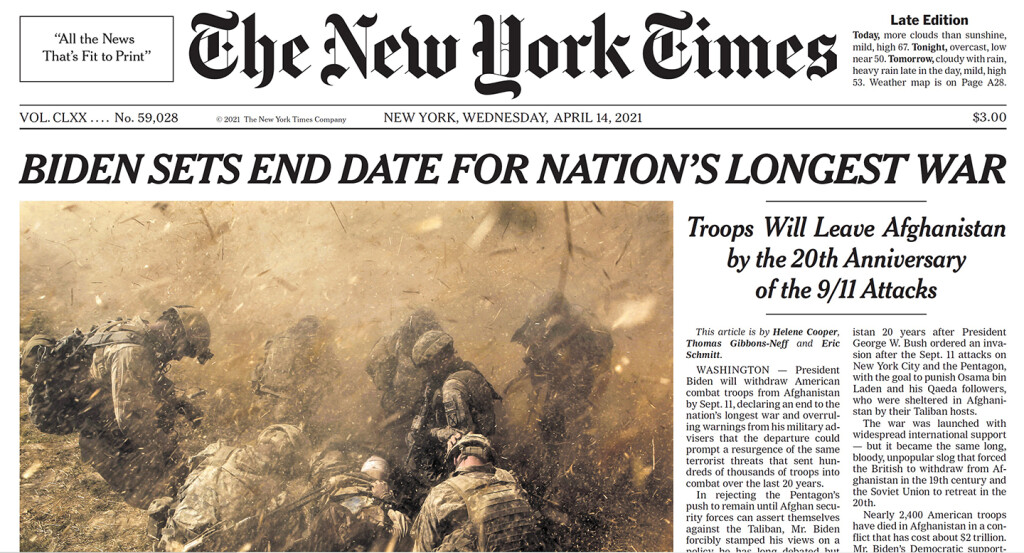
Note that the NYT hed is even more historic in the feel of its headline than the Post‘s print version. But both papers served history well, within the bounds of their own respective design styles.
For the dwindling number of people who see the print version, that is.
Why does any of this nit-picking by the old editor matter? Well, you know how I keep agonizing over the Rabbit Hole thing — which I finally decided recently explains the Trump phenomenon (by which I mean the fact that unbelievably large numbers of American adults are fully ready and willing to believe some really crazy s__t these days), as well as the decade or so of increasingly wild partisanship that preceded 2016. (If you don’t know what I’m referring to, look back at posts I’ve labeled in recent months with the Rabbit Hole designation, starting with this one.)
But it’s not just about the way various social media — Facebook, YouTube and many others — cater to readers in a way that leads them farther and farther down often bizarre ideological dead ends. (You liked that? Well then you’ll love this, the algorithm says to the user, over and over, in order to keep you on the site.)
Even the most reliable, staid, responsible print media outlets, the ones we should rely on the most if we’re thoughtful, responsible consumers of news, now present that news in a way that creates separate realities. One of us sees an app or a browser page at one moment, and one thing is the most important in the world, and another thoughtful person checks the same site five minutes later and gets a different take on the world.
And nobody’s doing anything wrong. In fact, editors would be grossly neglectful of their duty to their readers if they didn’t take advantage of this wonderful technology that allows us to update everything over and over throughout the day. I used to daydream in the ’80s and early ’90s about how wonderful it would be if, the moment I hit send on a story I had finished editing, it went straight to the reader. Well, now it does, and that’s great.
But it leaves us all living in a very fragmented, nerve-wracking news environment. Few of us ever experience that moment that used to be common to the American reader — when they opened their papers in the morning (or better yet, when the afternoon when those papers still existed) and saw the world laid out before them in a way that said, OK, here’s what you need to know most urgently about today’s real world, and here are some other things that will interest you as well, presented in order of significance.
(And before someone gives me one of those populist rants like “You mean, what you danged liberal editors say is important,” allow me to tell that person that he doesn’t know what he’s ranting about. I’m not offering an opinion on today’s news. I might do that in a separate post, since this is an opinion blog. It’s important whether you like it or hate it, whether you hold this ideological position or that one.)
By the way, doing it right meant playing all the news right. To keep this absurdly long post as short as possible, I just concentrated on the lede, and I chose to do it on a day when there would have been broad consensus among professionals as to what the lede was (on lighter-news days, you’d have seen more variation from paper to paper).
But to give you the broader picture, handled the way it should be by Old School standards, below is the entire NYT front page of today. They did a great job all the way down the budget; Buzz would approve…
We’ll all be better off as a society when someone figures out a way to give you the best virtues of the old way combined with the fantastic advantages provided by new technology (both carefully discerned perspective and immediacy, to oversimplify a bit). Unfortunately, almost no one is doing a great job of that so far…