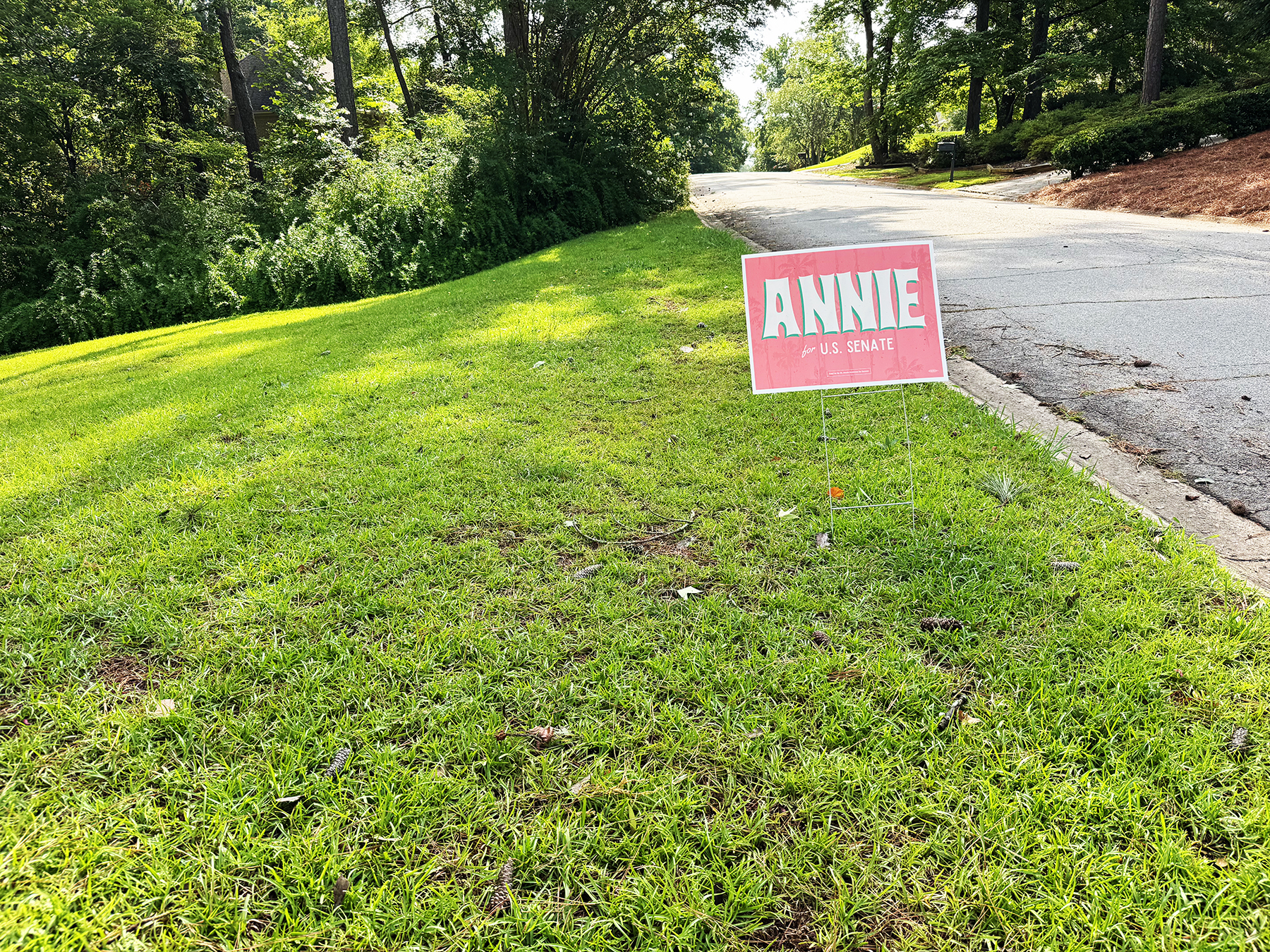
Not much to look at, is it?
Well, I put out that Annie Andrews sign this morning. Here’s the way it looks from my home office window (and here’s a better angle from before I took it down upon Lindsey’s death). Doesn’t look like much, does it? And I see it already needs straightening. I also need to get those pine needles off the bit of roof in the lower left corner of the image. It’s always something. No wonder I don’t blog much anymore.
Anyway, as you know, back before our senior senator’s sudden death, I allowed a friend and neighbor to put an Andrews sign in our yard. She had no chance of getting elected at that point, but some years ago we got to the point at which Sen. Graham, whom I had long respected and admired, was no longer a fit candidate. You know the details. So while she had no chance, the sign was there to say that someone other than him should replace him.
I wasn’t really prepared to say much more than that, because I didn’t know enough about Annie Andrews to know whether I wanted to actively support her, personally. That’s because, like her opponent, she has no experience holding public office. I’ve had no opportunity to observe her in that arena. And once the factor of our late senator was removed, I wanted to study the situation for awhile. So I took down the sign.
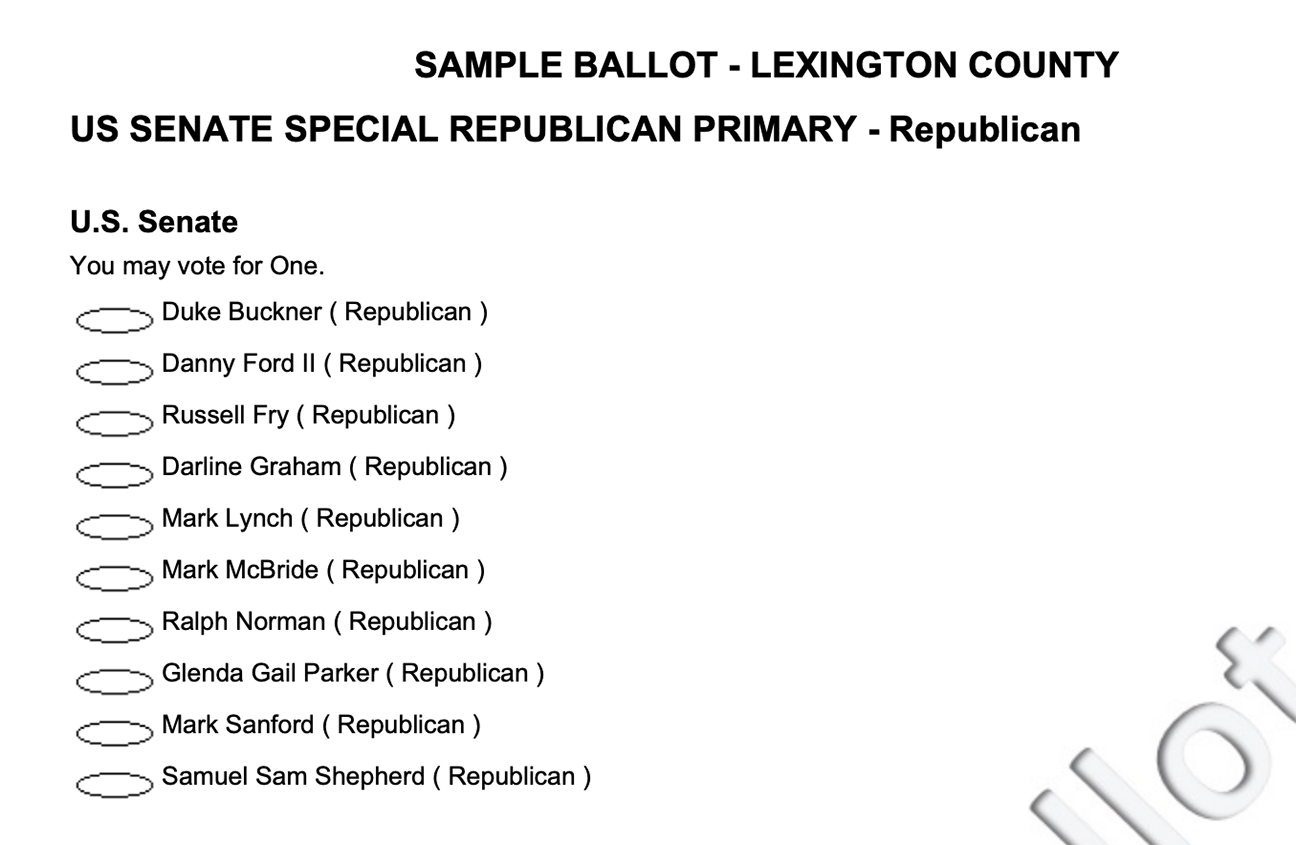
(At this point, I am moved to explain the difference between voting for someone — and I have intended to vote for “Annie” since the special GOP primary, barring some shocking news arising — and placing a sign in my yard. But I won’t. To me, as one who has spent so much of his life agonizing over public endorsements, the difference between that and a private vote is obvious. And in some ways, placing a sign represents a bigger step than endorsement. I’ll explain further if I must, but for now let’s get back to our story…)
Of course, since then, the Republican nominee has demonstrated that she is stupendously unsuited to public office — and particularly this public office. I mean, amazingly unsuited. I’m not sure I’ve ever seen a Senate candidate so unsuited. As time has passed, Dr. Andrews has not done that, so she now has more than my vote.
One thing that has taken me some time on this is the lack of helpful input. I know a lot of people think editorial page editors (which is my formative role regarding such things) just fire from the hip with whatever happens to strike them. Well, it’s not like that. A great deal — a great, agonizing, obsessive deal — went into endorsement decisions. Ditto with this new task (which I have undertook only since 2018) of putting out signs.
Trouble is, one of the things that was critical to that process, back in the days of newspapers, was the input of other very thoughtful, informed people sharing their most careful thoughts about each candidate. I’ve written a lot about that process. The most immediate part of that was the editorial board — the team of smart folks I met with every morning. I might go in with one idea, and come out with another. Other people think of things you don’t think of, see things you miss. I was almost never sure what I wanted to do until I tested the issue in that forum. Even if I stubbornly held to my original position and disagreed with my colleagues — a rarer occasion than you might imagine — I was more sure in doing so after that process.
But there were other sources — reporters who reported more in depth on S.C. politics than you see now. People who wrote opinions elsewhere, or on our op-ed pages. That’s all gone. I found in 2018 that there was only one paper left in the state with an editorial board doing statewide endorsements. That’s still the case, and on this race I haven’t seen anything along those lines from that paper, either… yet.
Finally, there were the candidates themselves — people I sat and talked with at length. Not questionnaires, not checking boxes. Wide-ranging conversations that could go anywhere, so you could really see the way people thought — assuming they were capable of that sort of activity. Not the silly dramatics of televised debates, which are light years away from the promise that Kennedy-Nixon offered in 1960. Compared to that, what we have now is professional “wrestling,” the Three Stooges without the humor.
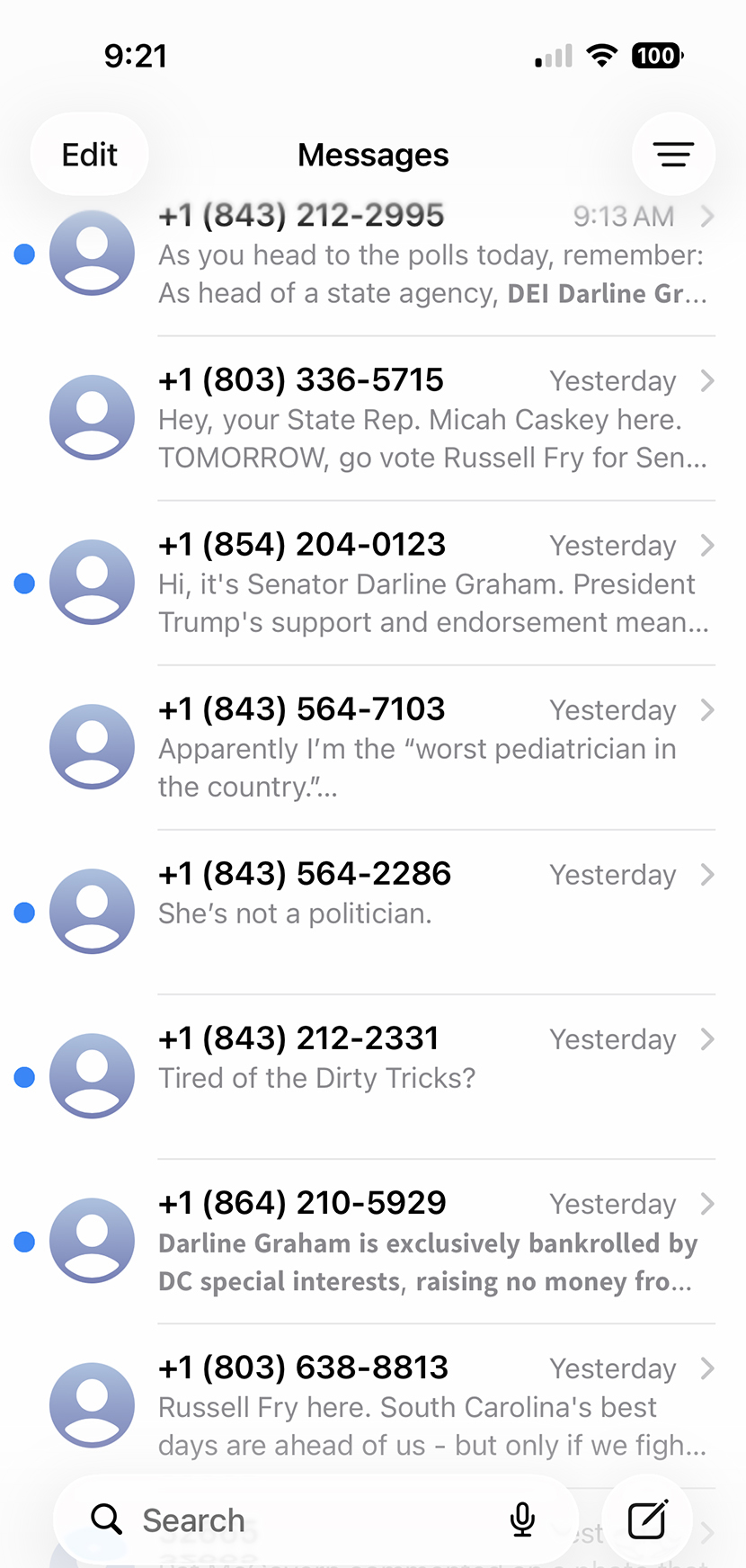
Now, I’m stuck with what you’re stuck with — the low idiocy of social media shots fired in an attempt to damage the opponent, or to enrage people on “your side” so they give you money, and more money. Button-pushing. Almost never the slightest attempt to show anyone that you, the candidate, are capable of thinking and operating effectively in a deliberative environment, and working with a wide variety of other people — not just your fan base — to pass laws that ALL of us can live with.
Which is what this country’s institutions were supposed to be, and used to be. We’ve always had lively politics, and then were able to deal with serious issues after the elections. Now we have brain-dead politics, people going about with caveman clubs trying to knock the other people on the head, and “win” to raise money and run again. Not to solve problems.
Anyway, I finally got some help the other day. Some input from someone I respect greatly. Not someone I always agree with, but I do always respect him. George Will. He’s still out there doing it. Of course, I recently cancelled my Washington Post subscription, but a friend provided me of a copy of what he wrote about this campaign. Some excerpts:
When Republican Sen. Lindsey Graham died in July, the governor appointed his sister, Darline Graham, to finish his term. When she decided to seek the Republican nomination for a full term, President Donald Trump endorsed her, so she won the primary despite a cringeworthy debate performance. Asked about Taiwan, she said: “I’m not that informed on national security.”
Andrews has graduated from medical school, so she knows what it is to know things, and how dangerous it can be to get things wrong. She is not a political rookie, having unsuccessfully run for Congress in 2022. She pleases her party’s base by being displeased with pharmaceutical companies, and what she considers insufficiently severe taxation of the wealthy. (The top 10 percent of earners pay 70 percent of federal income taxes.)
In this year of an inconclusive war, a soaring deficit and stubborn inflation, many Republican candidates seem most worried about transgender matters. Graham, emulating the rhetorical style of her presidential patron, wrote in a Fox News op-ed that Andrews is “the worst pediatrician in the country” because she “supports turning confused little boys into little girls and vice versa.” Andrews, who opposes gender surgery on minors, says such surgery has never occurred in South Carolina.
Graham also said, “I believe boys have no place in girls’ sports.” In the context of her Fox screed, this falsely suggested that Andrews disagrees…
I don’t completely agree with Will that running once and not getting elected makes for significant political experience. But I love his observation that, as a physician, Dr. Andrews “knows what it is to know things, and how dangerous it can be to get things wrong.” Meanwhile, her opponent has aggressively, embarrassingly demonstrated that she knows no such things, and if she did know them, she would set them aside in the service of her goal of being the mindslave of the stupidest, most venal and malevolent man ever to get close to the presidency.
As to that point, here’s another highlight of the column: “Graham promises she will not be senatorial, as the Framers understood that adjective.” Absolutely. If you have the slightest idea what the Senate is supposed to be, you agree with that entirely.
As I say, I respect Will greatly, and I appreciate his input. But you know who should really, really respect what he has to say?
- Republicans. I mean real Republicans, not Trump patsies. People who remember and care about the actual, respectable Grand Old Party. Will himself has been forced by Trumpism to walk away from that organization, but he continues to embody what it meant.
- Conservatives. Real ones, I mean. People who think conservative thoughts and offer them in the service of a great nation, not people who bow down to someone who shamelessly strokes their prejudices, with no constructive end in sight. I realize few people undertand the difference today, because today’s political rhetoric doesn’t provide them with the vocabulary. For more than half a century, Will has been THE conservative thinker of American journalism. He still is, with very few remaining challengers. (If you doubt that, I refer you to his comments on Dr. Andrews’ taxation ideas.)
- People who think. And those are rare, wherever they place themselves on the political spectrum. This is not just me sneering at the rest of you. I don’t think as well either, anymore. As I’ve been explaining, today’s political and journalistic environment doesn’t provide me, or you, with the kinds of generous tools and resources it used to lavish upon us.
Will Annie Andrews win this election because I put that sign out? Of course not. In fact, the odds are against her in this once independent-minded state. Her chances are better than they were against Darline’s brother, but the tendency of South Carolina’s white majority to vote only for Republicans (and lately, only for the kind of Republicans who kiss the feet of You Know Who, which is a vastly worse situation) shows signs of being set in stone.
I’m just trying to make people think, the way they used to do before they voted. It could happen. In any case, I decided to give it a try…